Central Austria
Salzkammergut
Austria's lake district decoded for UK travellers: Hallstatt and the Wolfgangsee, the Dachstein and SchafbergBahn, where to base around Bad Ischl, fares in pounds and the airport you'll actually fly into.
In short
Salzkammergut at a glance
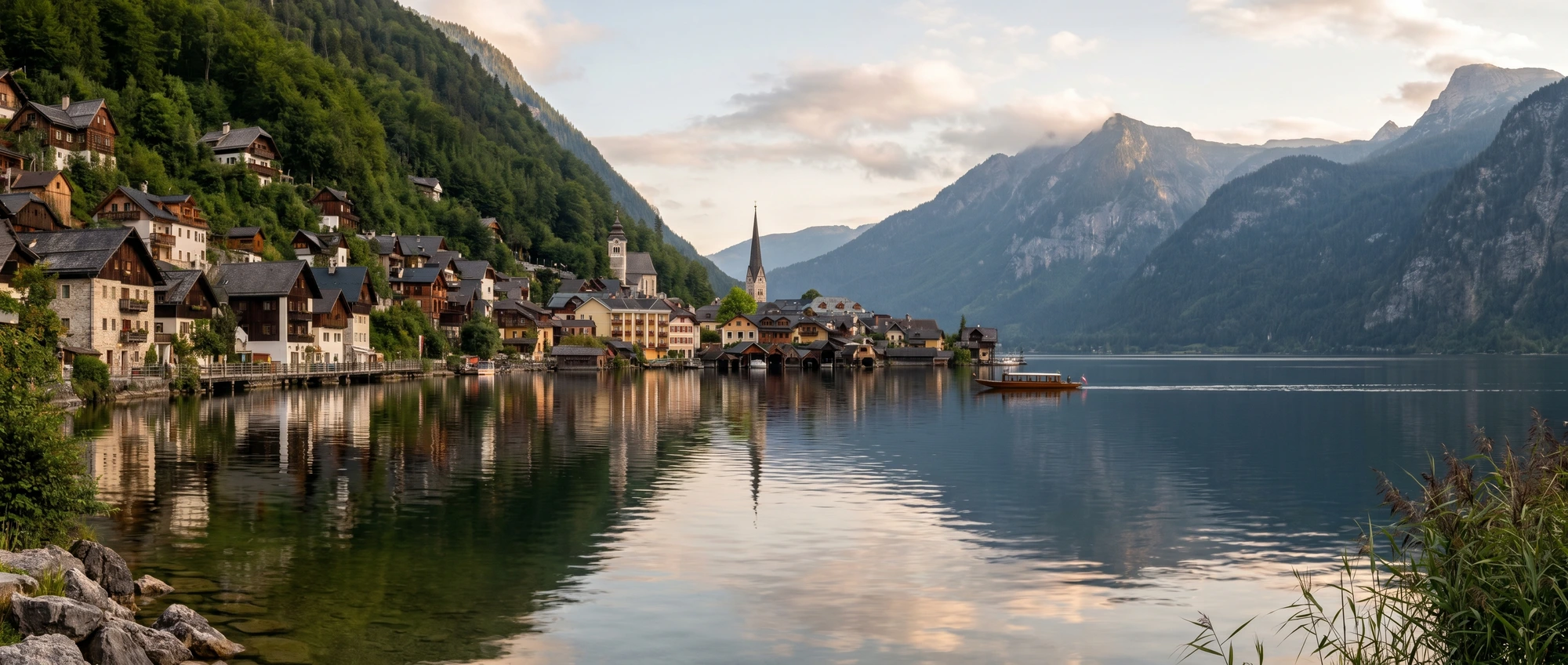
The Salzkammergut is Austria's lake district — a cluster of around 76 lakes and steep wooded hills spread across Upper Austria, Salzburg and Styria, an hour or so east of the city of Salzburg. Its postcard is Hallstatt, the tiny lakeside village whose pastel houses and church spire reflected in the Hallstätter See have made it one of the most photographed places in the country, so much so that it caps day-trippers. But the region is far bigger than that one street: the Wolfgangsee links the pilgrimage village of St. Wolfgang and laid-back St. Gilgen, the imperial spa town of Bad Ischl sits at the centre, and Gmunden guards the long Traunsee under the Traunstein cliff. Above it all the Dachstein massif and the Krippenstein ice caves rise to glacier height, and the SchafbergBahn cog railway grinds up the Schafberg for the classic five-lake view. This is a car-first region most UK visitors reach by flying to Salzburg (SZG) and driving in — Hallstatt is about 1h15 away. Allow four or five days to combine a lake base, the Dachstein and Hallstatt without rushing.
The Salzkammergut is the Austria people picture without realising it has a name — the lake district east of Salzburg where pastel villages sit under wooded hills and a church spire reflects in still water. That picture is mostly Hallstatt, a single lakeside lane so photographed that the village now caps the coaches that pour in for it. The honest thing to say about Hallstatt is that the famous view is real and the daytime crowd is also real: by late morning the lane is shoulder-to-shoulder, and the village only becomes the place on the postcards once the buses leave around 4pm. Time your visit for the early morning or the evening — ideally by staying nearby — and it rewards you. Treat it as one stop among many and the region opens up.
Because the Salzkammergut is far bigger than that one street. The Wolfgangsee strings together the pilgrimage village of St. Wolfgang and quieter St. Gilgen, with the SchafbergBahn cog railway grinding up to the five-lake view; Bad Ischl sits at the centre with its imperial spa heritage and its cafés; Gmunden guards the long Traunsee under the Traunstein; and the Dachstein rises to glacier height above Obertraun. The mistake first-timers make is trying to do it all from Salzburg as a day trip — you spend the day in the car. Fly to Salzburg, hire a car at the airport, base yourself in Bad Ischl or on the Wolfgangsee for a few nights, and you get the swimming, the cable cars and an unhurried Hallstatt rather than a rushed snapshot of it.
The route
A relaxed long weekend stretched to five days, pairing a central lake base with Hallstatt, the Dachstein and the Schafberg view without long backtracks. Drive times are estimates on the region's lakeside roads (the B158 and B145) from a Bad Ischl or Wolfgangsee base; the SchafbergBahn, Dachstein cable car and salt-mine funicular are seasonal and close in deep winter, so check live opening before you set off.
-
Days 1–2
The Wolfgangsee (St. Wolfgang or St. Gilgen)
Settle on the Wolfgangsee for swimming, the lake steamer and the pilgrimage church of St. Wolfgang with its Pacher altarpiece. Take the SchafbergBahn cog railway from St. Wolfgang up the Schafberg (around €44 return, roughly 35 minutes each way) for the view over five lakes — the scene from the opening of The Sound of Music. St. Gilgen at the western end is the quieter base and a 50-minute drive from Salzburg if you are coming straight from the airport.
-
Day 3
Bad Ischl & Gmunden
Move to Bad Ischl, the spa town where Emperor Franz Joseph summered — tour the Kaiservilla, take coffee and Zauner Esterházy cake, then drive the 30 minutes north to Gmunden on the Traunsee for the lakeside Schloss Ort castle on its causeway and the Traunstein cliff behind. Bad Ischl makes a practical central base for the rest of the trip, roughly equidistant from Hallstatt and the Wolfgangsee.
-
Day 4
Hallstatt & the salt mine
Drive the 30–40 minutes from Bad Ischl to Hallstatt early, before the coaches. Ride the funicular up to the Salzwelten salt mine (about €42 with the funicular) — the oldest working salt mine in the world, with a wooden miners' slide and the Skywalk 'World Heritage View' over the village and lake. Back down, walk the classic Marktplatz and the lakeside lane, then leave before the afternoon crush; the village quietens markedly once the day buses go around 4pm.
-
Day 5
The Dachstein at Obertraun, or home
Just across the lake from Hallstatt, take the Dachstein Krippenstein cable car from Obertraun (about €41 for the trip to the Five Fingers viewing platform) for the giant ice cave and mammoth cave, and the cliff-edge platform over the Dachstein glacier. If you are flying home from Salzburg, Obertraun is roughly 1h20 back to the airport, so this works as a final morning before the drive.
Where to base yourself
Pick one or two bases rather than moving every night.
Bad Ischl
££ mid-rangeThe imperial spa town at the geographic centre of the Salzkammergut and the most practical base — close to Hallstatt (30–40 min), the Wolfgangsee (20 min) and Gmunden (30 min), with a proper high street, the Kaiservilla, cafés and the region's main rail station on the line to Hallstatt. Less scenic on the doorstep than a lakefront village, but you trade that for being central and cheaper than Hallstatt.
Best for: A central, well-connected base and value
Wolfgangsee (St. Wolfgang & St. Gilgen)
£££ premiumThe prettiest lake base: St. Wolfgang on the north shore is the postcard pilgrimage village with the SchafbergBahn railway and lake steamers, while St. Gilgen at the western end is quieter and the closest lake to Salzburg airport (about 50 minutes). Best for swimming, the Schafberg ride and an easy day-trip mix. Lakefront rooms get pricey and book out in July and August.
Best for: Swimming, the Schafberg railway and lake steamers
Hallstatt & Obertraun
£££ premiumStaying in Hallstatt itself means you get the village in the early morning and the evening after the day-trippers leave — its quiet hours are the real reward — but rooms are few and dear and the lanes are heaving by day. Obertraun across the lake is cheaper, calmer and right at the foot of the Dachstein cable car, a short drive or boat from Hallstatt. Best if you want the Dachstein and the photogenic village without the daytime crowds.
Best for: Early-morning Hallstatt and the Dachstein
Getting around Salzkammergut
The Salzkammergut is a driving region, not a rail one. Most UK visitors fly to Salzburg (SZG) and hire a car at the airport: Hallstatt is about 1h15 away on the B158 and B145, Bad Ischl roughly 50 minutes and St. Gilgen on the Wolfgangsee about 50 minutes. The lakes, salt mines and cable-car valleys are scattered and the bus and rail links between them are slow, so a car makes the whole area far easier. That said, a car-free Hallstatt day does work in summer: the Salzkammergutbahn train runs from Bad Ischl to Hallstatt station on the far shore, where the ferry meets the train and crosses to the village. The signature uphill rides are seasonal — the SchafbergBahn cog railway from St. Wolfgang (around €44 return) and the Dachstein Krippenstein cable car at Obertraun (about €41) close in deep winter and on bad-weather days, so check live status. Austrian motorways need a vignette toll sticker — the digital 10-day vignette is about €12.40 and most hire cars from Salzburg already include one, but check. Drive on the right.
Book the essentials
Where to stay
Tours & tickets
Airport transfers
Car hire
Stay connected
Trains & rail passes
Salzkammergut FAQs
Which airport should I fly into for the Salzkammergut?
How do I avoid the crowds in Hallstatt?
Can you swim in the Salzkammergut lakes?
Ready to book?
Compare car hire