In short
What do UK travellers most need to know before booking the Maldives?
UK passport holders get a free 30-day visa on arrival (complete the IMUGA form within 96 hours of arriving), flights are ~10h25 nonstop from Heathrow, and the resort transfer — seaplane or speedboat — is a big separate cost you confirm before booking the room. Your GHIC is useless and hospitals are limited to Malé, so comprehensive insurance is essential.
The Maldives is the rare trip where the resort isn’t the decision that matters most — the way you reach it is. Once you land at Malé you’re still not on your island; a seaplane, speedboat or domestic flight stands between you and the sand, and it can cost more than a week of EuroMillions tickets and add hours to your arrival day. This guide is built around that one honest call, plus the two others that actually move your budget — the meal plan and the resort-versus-local-island fork — and the UK-specific details competitor pages skim: the plug in the wall (it’s ours), the GHIC that does nothing, and the price in pounds.
The short version
- Confirm your transfer type and price (seaplane £350–650pp, speedboat £150–350pp return) before you book the room.
- Seaplanes fly in daylight only — land before ~3pm or you may overnight at an airport hotel first.
- All-inclusive almost always beats half-board; à-la-carte resort prices are punishing when you're captive on an island.
- Your GHIC is worthless and hospitals are limited to Malé — buy insurance with high medical and evacuation cover.
- Alcohol is legal only inside resorts; a Maafushi guesthouse costs a fraction of a villa but means no alcohol on the island and modest dress off the beach.
Entry requirements for UK travellers
The Maldives is simple to enter on a UK passport: a free 30-day visa on arrival for tourism, with no application before you fly, and an unusually relaxed passport rule — it only needs to be valid for at least one month beyond your arrival date, not the six months many long-haul countries demand. The one job you can’t skip is the IMUGA online traveller declaration, which you complete within the 96 hours before you arrive; do it in the three days before your flight and have the QR code ready at immigration. Everything below is taken from the GOV.UK foreign travel advice for the Maldives; rules can change, so confirm on GOV.UK before you travel.
The pre-departure work that genuinely matters here isn’t the visa — it’s two things beach tourists underestimate. First, your health cover: there’s no GHIC reciprocity, hospitals are limited to Malé, and a resort island can be hours from emergency care. Second, the laws: this is an Islamic country with strict rules on alcohol, drugs, religion and imports that catch UK visitors out every year.
Key points before you book
- Free 30-day visa on arrival for UK tourists — no pre-application needed (GOV.UK).
- Passport valid for at least one month beyond your arrival date — no six-month rule (GOV.UK).
- Complete the IMUGA online declaration within 96 hours before you arrive (GOV.UK).
- No GHIC cover; hospitals only in Malé and resorts hours from care — comprehensive insurance is essential (GOV.UK).
- Alcohol only inside resorts; none on local islands, and never take it off-resort (GOV.UK).
- Zero-tolerance drug laws, and it's illegal to publicly practise any non-Islamic religion (GOV.UK).
- Rules can change — confirm on GOV.UK before you travel.
Passport validity
Your passport must have an expiry date at least one month after the date you arrive in the Maldives (GOV.UK). That's an unusually relaxed rule for a long-haul destination — there is no six-months-beyond-departure requirement — but a passport that close to expiry is still risky for onward connections, so allow a comfortable margin.
Visas
UK tourists get a free 30-day visa on arrival, with no application before you travel (GOV.UK). You must complete the IMUGA online traveller declaration within 96 hours before you arrive — do this in the three days before your flight, not at the airport. Anyone coming to work needs a work visa arranged in advance.
Health
Medical facilities are limited — the only fully equipped hospitals are in Malé and Hulhumalé, and a resort island can be several hours from emergency treatment by boat or seaplane (GOV.UK). There is no GHIC/EHIC cover, so you pay the full cost of any treatment and, more importantly, of evacuation. Comprehensive travel insurance with high medical and repatriation limits is non-negotiable. Check vaccine recommendations on TravelHealthPro at least 8 weeks before you travel; if you're arriving from a yellow-fever country you'll need proof of vaccination (GOV.UK).
Safety & security
Resort islands are very safe and crime against tourists is low, but two real risks stand out. First, the sea: GOV.UK records that more than eight British tourists have drowned since 2021 in strong currents and dangerous conditions, so respect resort flags and never snorkel or swim alone outside marked areas. Second, in Malé and Hulhumalé there is gang-related violence including knife crime, mainly away from tourist areas; and while terrorist attacks can't be ruled out, the realistic everyday hazard for a beach trip is the water, not crime (GOV.UK).
Local laws & customs
The Maldives is an Islamic country with strict laws that catch out beach tourists. Alcohol is available only on resort islands — do not take any out of your resort, and there is none on inhabited local islands; possession off-resort risks arrest and deportation (GOV.UK). Drug laws carry zero tolerance, with long prison sentences and severe penalties. It is illegal to publicly practise any religion other than Islam, and Bibles and pork products are prohibited imports. Same-sex relations are illegal. On local islands cover your shoulders and knees and use the designated 'bikini beach' for swimwear; nudism and topless sunbathing are banned everywhere. Don't export coral or tortoiseshell (GOV.UK).
GOV.UK is the official source for Maldives entry rules — always check it before you book.
Read GOV.UK adviceGOV.UK updated 12 May 2026 · Departly checked 9 Jun 2026
Why insurance, not your GHIC, is the one to get right
No GHIC, limited hospitals, remote islands
There is no UK–Maldives healthcare agreement, so the GHIC you’d use in Europe is worthless here, and you pay the full cost of any treatment. The bigger issue is geography: the only fully equipped hospitals are in Malé and Hulhumalé, and a resort island can be hours away by boat or seaplane, so a medical evacuation is both a real possibility and a very expensive one. Comprehensive travel insurance with high emergency-medical, evacuation and repatriation limits is essential, not optional, for the Maldives.
Buy it the same day you book, and read the water-sports clause. The genuine everyday risk in the Maldives isn’t crime — it’s the sea: GOV.UK records that more than eight British tourists have drowned since 2021 in strong currents and dangerous conditions. Make sure your policy actually covers snorkelling, water sports and any diving you plan to do, because that’s exactly the scenario you’re insuring against.
Travel insurance for Maldives
This is the one to get right, and the Maldives makes it more important than most beach destinations. There is no UK–Maldives healthcare deal, so your GHIC does nothing, and the hospitals are limited to Malé — a resort island can be hours from emergency care by boat or seaplane, and a medical evacuation costs a fortune.
- Buy comprehensive cover with high emergency-medical, evacuation and repatriation limits — from ~£25pp for a single trip.
- Check that water sports, snorkelling and any diving you'll do are actually covered; the sea is the real risk here (GOV.UK records 8+ British drownings since 2021).
- Declare pre-existing conditions, and don't skimp on the medical limit — an air evacuation from a remote atoll is exactly the scenario insurance exists for.
Flights from the UK
British Airways and Virgin Atlantic fly nonstop from Heathrow to Malé at roughly 10h25 — shorter than people expect for the Indian Ocean. From Manchester, Edinburgh, Birmingham and Glasgow you connect through a Gulf hub — Emirates via Dubai, Qatar Airways via Doha, Etihad via Abu Dhabi — which adds a few hours but is often cheaper and lets you fly from your local airport. Wherever you fly, the detail that matters is arrival time, not just price: if your resort uses a daylight-only seaplane, a flight that lands in the morning gets you to the island the same day, while a late-afternoon arrival can cost you an extra airport-hotel night.
Flights from the UK
Long-haulBritish Airways and Virgin Atlantic fly nonstop from Heathrow to Malé (around 8 BA services a week), at roughly 10h25 — shorter than people expect for the Indian Ocean. From Manchester, Edinburgh, Birmingham and Glasgow you connect through a Gulf hub (Emirates via Dubai, Qatar Airways via Doha, Etihad via Abu Dhabi), which adds a few hours but is often cheaper and lets you fly from your local airport.
Fly from
Main arrival airports
- MLE Malé Velana International — the one international gateway; every trip starts here, then transfers to your island
- GAN Gan (Addu City) — far-south domestic hub, only relevant if your resort is in the deep south
When to go
The dry north-east monsoon, roughly December to April, brings the reliable sun, calm seas and best snorkelling visibility — and the peak prices, with Christmas, New Year and February half-term the dearest weeks of all. For the best balance of weather and value, target late April or November. The wet season from May to November brings short, heavy showers and choppier water, but rates fall 40–60%, and many days still serve up long stretches of sunshine.
When to go
Sweet spot: The dry north-east monsoon, roughly December to April, is the reliable-sunshine season and the peak — calm seas, clear skies and the best snorkelling visibility, but the highest prices and the busiest resorts. For the best balance of weather and value, target late April or November, the shoulder months. The wet south-west monsoon, May to November, brings short heavy showers, more wind and rougher seas, but also resort rates 40–60% below peak — and many days still deliver long stretches of sunshine.
December to April is high season: dry, sunny, calm and expensive, with Christmas, New Year and February half-term the priciest weeks of all — book months ahead. April and November are the value sweet spots, with mostly good weather and gentler prices before and after the crowds. May to August is the wet season proper: short tropical downpours, more wind, and choppier water that can dent snorkelling visibility, but rates drop 40–50% and the sun still shines for hours most days. September to November sees the year's lowest rates (sometimes 60% below peak), a fair gamble if you'll take some rain for a half-price overwater villa.
What it costs
Resort prices are quoted and charged in US dollars; everything here is converted at roughly $1.27 to £1 (June 2026). Nonstop return flights from Heathrow run about £550–£850, and a mid-tier all-inclusive 7-night trip for two — flights, room, transfers, green tax and insurance — comes to around £4,900–£5,400, or about £2,500 each before excursions. The two figures people forget are the transfer (£300–£1,300 for a couple, depending on seaplane or speedboat) and the taxes: 17% TGST, a ~10% service charge, and green tax of $12 per person per night. A Maafushi guesthouse trip can do the whole thing nearer £2,400–£3,000.
What it costs
Nonstop return economy from Heathrow runs roughly £550–£850, dipping nearer £500 on cheap dates and topping £900+ over Christmas, New Year and February half-term. Gulf-hub connections from Manchester, Edinburgh, Birmingham or Glasgow are often a little cheaper. The cheapest month to fly is usually June, in the quieter wet season.
Daily budget per person
| Seaplane transfer, return per adult | ~£350–650 |
|---|---|
| Speedboat transfer, return per adult | ~£150–350 |
| Green tax, per person per night (resort) | ~£9.50 ($12) |
| Resort cocktail (off all-inclusive) | ~£12–18 |
| Maafushi guesthouse room, per night | ~£40–120 |
| Local-island meal vs resort à la carte | ~£5–15 vs £25+ |
Resort prices are quoted and charged in US dollars; figures here use £1 ≈ $1.27 (June 2026). On top of the room you pay 17% TGST and usually a 10% service charge (often built into all-inclusive rates), plus green tax of $12 per person per night at resorts ($6 at smaller guesthouses).
A realistic first-trip itinerary
There's no 'route' in the Maldives — you don't island-hop on a whim, because every move means a paid transfer. A first trip is one island, done slowly. The real planning is front-loaded: pick the island and meal plan, lock the transfer, and arrange your flights to land before mid-afternoon so you can transfer on the same day. This is a 7-night skeleton for a single-resort stay; stretch it by splitting two islands (budget a second transfer) or bolting on a Dubai or Sri Lanka stopover on the way.
- 1Day 1
Land at Malé, transfer to your island
Clear immigration (your IMUGA QR code ready), then your resort meets you airside. If it's a speedboat you'll be on the island within the hour; a seaplane departs from a separate lounge and only flies in daylight, so a morning UK arrival matters. Land after ~3pm and you may overnight at an airport hotel in Hulhumalé first. Don't plan anything for this day beyond arriving.
- 2Days 2–3
Settle in and snorkel the house reef
The best free thing in the Maldives is the house reef off your own beach or villa. Get fins and a mask from the dive centre, learn the resort's flag system, and snorkel the drop-off at slack tide. Don't book paid excursions yet — see what's on your doorstep first, because many mid-range resorts have a genuinely good reef you can swim to.
- 3Days 4–5
One or two paid excursions
Pick the excursions that justify the price: a snorkel trip to swim with manta rays or whale sharks (seasonal and atoll-dependent), or a sunset dolphin cruise. These run roughly £40–£90 per person. Skip the overpriced in-resort photographer packages and the captive 'private sandbank' upsell unless it's a special occasion.
- 4Days 6–7
Slow down, then transfer back
Bank a do-nothing day — the whole point of the trip. On departure day, build in a buffer: your resort will tell you the transfer time, and a seaplane back to catch an evening flight may leave hours early. Bring a few dollars for staff tips, and settle your room bill (in USD) the night before so check-out is quick.
Where to base yourself
There’s a genuine fork here that decides your whole trip. A speedboat resort in North or South Malé Atoll is the smart first-timer pick: the cheapest, most flexible transfer, and you’re on the island fast. A seaplane resort buys you seclusion and a stunning floatplane arrival, but at a real premium and on a daylight-only schedule. Overwater villas are the postcard but command a big markup, and a beach villa often sits on a better stretch of house reef. And then there’s the budget alternative most guides bury: a guesthouse on a local island like Maafushi, at a fraction of resort prices — the trade-off being no alcohol on the island and modest dress off the bikini beach.
Speedboat resorts (North & South Malé Atoll)
Resorts within ~60km of the airport reached by speedboat in 15–90 minutes, 24 hours a day. The smart first-trip choice: the transfer is cheaper (~£150–350pp return), runs at any hour so your flight time matters less, and you're on the island fast.
Good for: First-timers who want the cheapest, most flexible transfer
Seaplane resorts (outer atolls)
The dramatic option — a 20–45 minute floatplane over turquoise atolls to a more remote island. The trade-offs are real: ~£350–650pp return, daylight-only flights, and luggage limits. Worth it for the seclusion and the views, but budget for it and plan your flight to land before mid-afternoon.
Good for: Seclusion-seekers and honeymooners who'll pay for remoteness
Overwater villas
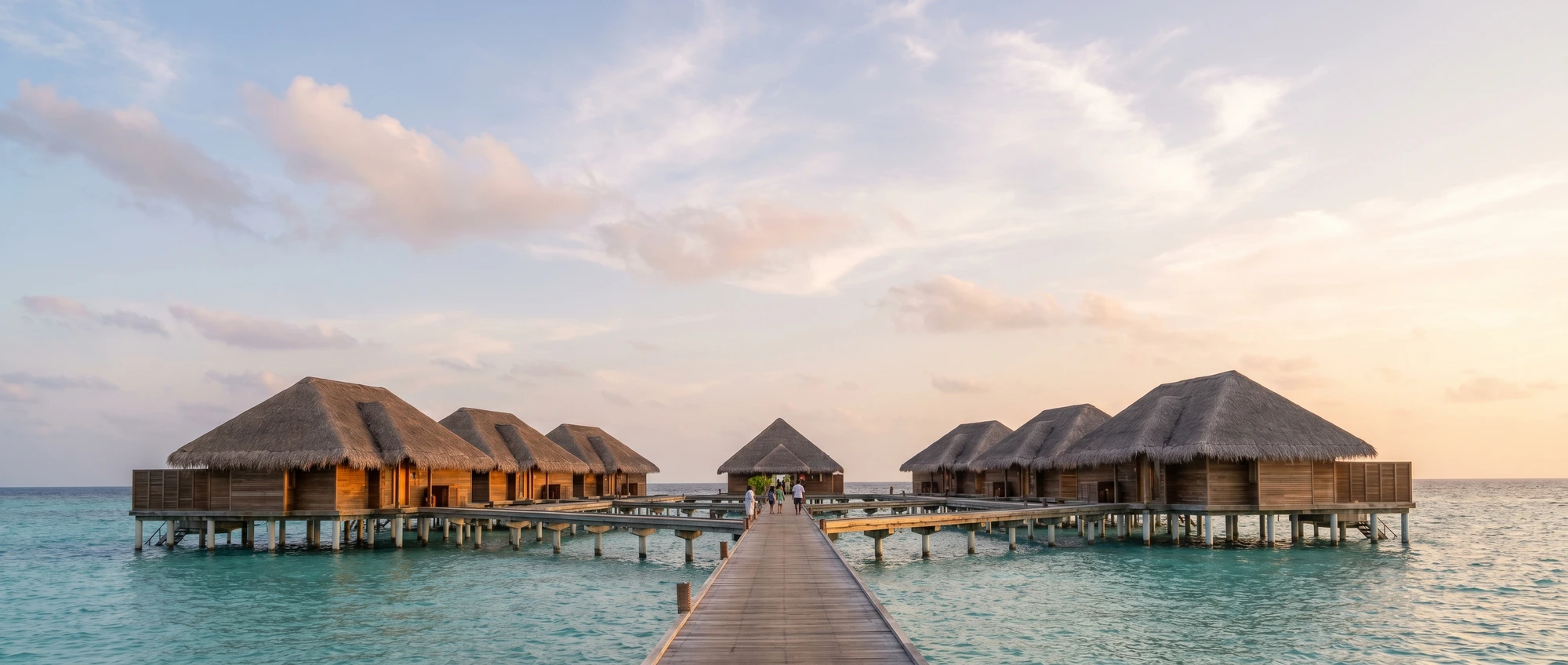
The postcard: a villa on stilts with steps into the lagoon. They command a big premium over beach villas and aren't always the better swim — beach villas often sit on a better stretch of house reef. Book overwater for the occasion and the view, not assuming the snorkelling is superior.
Good for: Honeymoons and milestone trips
Maafushi & local islands
Guesthouses on inhabited islands at a fraction of resort prices, reached by cheap public ferry or speedboat. The trade-off is the law: no alcohol on the island (do it on a licensed floating bar offshore), and modest dress off the designated bikini beach. The Maldives for a real-person budget.
Good for: Budget travellers and independent couples
Hulhumalé (near the airport)
The reclaimed island next to the airport, linked by bridge. Not a beach holiday — but the practical pick for a night before an early seaplane or after a late-landing flight, with hotels far cheaper than a resort and a 10-minute taxi to the terminal.
Good for: A transfer-buffer overnight, not a holiday base
Getting to your island — the make-or-break decision
Getting around Maldives
You don't 'get around' the Maldives so much as get to one island and stay there — and the single transfer to that island is the most underestimated cost and logistics decision of the whole trip. There are three ways out to your resort, and your resort dictates which. Speedboat (for islands within ~60km of Malé) is the cheapest and most flexible at roughly £150–£350 per adult return, takes 15–90 minutes, and runs around the clock, so your flight arrival time barely matters. Seaplane (for outer atolls) is the spectacular one at roughly £350–£650 per adult return, takes 20–45 minutes, but flies in daylight only — if your flight lands after about 3pm you'll likely overnight at an airport hotel and fly out the next morning. Far-south resorts use a domestic flight to a regional airport plus a short speedboat, at roughly £240–£480 per adult return. Crucially, the resort arranges and bills the transfer — you don't book it separately — but you must confirm the type and price when you book the room, because two resorts at the same nightly rate can differ by hundreds of pounds once the transfer is in. Between local islands, cheap public ferries and shared speedboats run on fixed schedules.
- Confirm your transfer type and price with the resort before booking the room — it's a separate, sometimes huge, cost.
- Speedboat: ~£150–350pp return, 15–90 min, runs 24 hours — the flexible, cheaper option.
- Seaplane: ~£350–650pp return, 20–45 min, daylight only — land before ~3pm or overnight near the airport.
- Far-south resorts add a domestic flight plus speedboat, ~£240–480pp return.
- Children typically pay 30–40% less on transfers; infants under 2 usually free.
- On local islands, use the public ferries and shared speedboats — far cheaper than private transfers.
The mistake is treating the transfer as an afterthought once the room is booked. Two resorts at the same nightly rate can differ by hundreds of pounds once the transfer is in, and a daylight-only seaplane can force an extra airport-hotel night you didn’t budget for. The resort arranges and bills the transfer — you don’t book it separately — but you must confirm the type and price when you reserve the room, and pick your flight times around it. Get that right and the rest of the Maldives runs itself.
Staying connected
UK roaming to the Maldives is expensive — it sits well outside the inclusive EU-style zones, so the networks charge around £6–£8 a day, and remote-island resort wifi can be slow. A travel eSIM from Dhiraagu or Ooredoo runs roughly £15–£45 for 20–30GB over the trip; install it before you fly and activate on landing. Download offline maps, your IMUGA confirmation and boarding passes before you transfer out to a seaplane resort, where signal can be thin.
Stay connected in Maldives
UK roaming to the Maldives is expensive — it sits well outside the EU-style inclusive zones, so EE, Vodafone and Three charge roughly £6–£8 a day. Over a week that's £40–£60, and resort wifi, while usually free, can be slow or patchy on remote islands.
- A travel eSIM runs roughly £15–£45 for 20–30GB over 30 days from the two networks, Dhiraagu and Ooredoo — far less than daily UK roaming.
- Install it before you fly and activate on landing at Malé; you'll need wifi to scan the QR code, so set it up at home.
- On a seaplane resort, signal can be thin — download offline maps, your IMUGA confirmation and boarding passes before you transfer out.
Money: dollars, cards and the tax stack
You'll barely see the local rufiyaa as a tourist: resorts, guesthouses, transfers and excursions are all priced and charged in US dollars, and your final bill is settled in USD on a card at check-out. The practical kit is one fee-free Visa or Mastercard for the room bill and excursions, plus around $50–$100 in small US-dollar notes for tipping staff (a few dollars per day for your villa host and waiters is normal and appreciated). When a card terminal asks whether to charge in GBP or the local currency, always decline the GBP conversion — dynamic currency conversion hands the merchant a poor rate and costs you 3–5%. Build the taxes into your budget before you go, not as a check-out surprise: 17% TGST and usually a 10% service charge sit on top of à-la-carte spend (all-inclusive rates often fold these in), plus green tax of $12 per person per night at resorts. There's little reason to carry rufiyaa unless you're on a local island using ferries and small shops.
Fee-free travel money
Skip the airport exchange desk — a fee-free travel card gives you the real exchange rate abroad.
Before you fly
Two small UK-specific jobs round out the trip: pre-book your airport parking, which is almost always cheaper booked ahead than on the day, and double-check the essentials before you fly — the IMUGA form, insurance, your transfer confirmation — so nothing slips through in the last 48 hours.
Airport parking & lounges
Pre-book your UK airport parking or a lounge — it's almost always cheaper booked ahead than on the day.
How we know this
How we know this
- GOV.UK foreign travel advice — Maldives — entry, passport validity, visa, IMUGA, health, safety and local laws
- NHS Fit for Travel / TravelHealthPro — vaccine recommendations and travel-health advice
- Maldives Inland Revenue Authority (MIRA) & Ministry of Finance — TGST, green tax and departure-fee rates
- Resort and transfer operators (seaplane, speedboat and domestic-flight pricing) — transfer types, times and 2026 fares
GOV.UK last updated 12 May 2026.