







In short
Is Turkey a good holiday for UK travellers?
Yes — it's short-haul (~3h50 to Istanbul, ~4h to the coast), there's no visa for a holiday, and it's markedly cheaper than Spain or Greece, with one country giving you a world-class city break, a summer beach coast and the balloon valleys of Cappadocia. The one thing to know: your UK GHIC does not work here, so travel insurance with medical cover is essential.
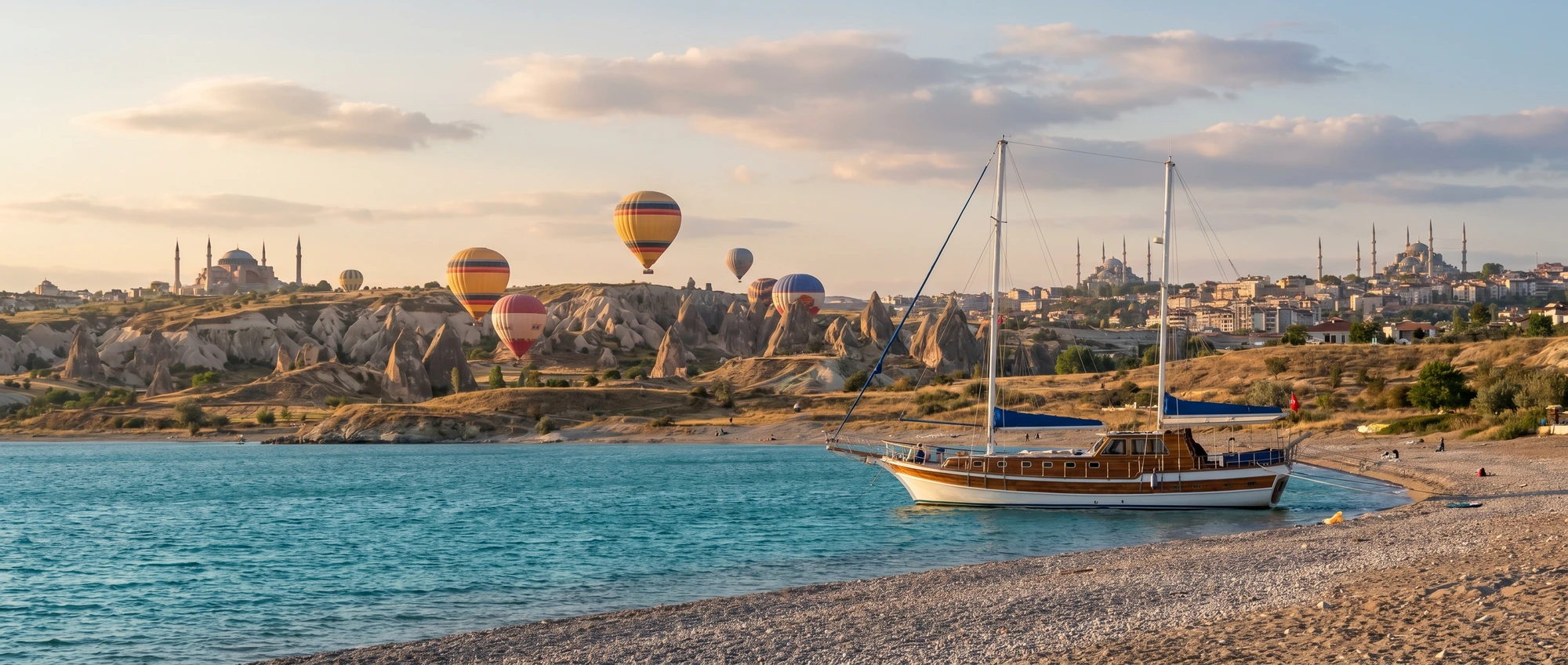
Turkey is really three holidays wearing one flag. Istanbul is a vast, layered city break straddling Europe and Asia; the Mediterranean and Aegean coasts — Antalya, Fethiye, Bodrum — are the summer-beach engine that fills UK charter flights; and Cappadocia is the surreal rock-valley landscape famous for its dawn balloon flights. The trick is not trying to do all of it at once, and not driving the enormous distances between them. Below we set out, for a UK traveller spending their own money in 2026, exactly what each part suits, what it costs in pounds, and the entry rules straight from GOV.UK — including the one health card that doesn’t work here.
The short version
- Your UK GHIC is NOT valid in Turkey — buy travel insurance with medical cover and repatriation before you fly.
- No visa and no e-visa for a holiday: British citizens get 90 days in any 180-day period (GOV.UK).
- Fly between the hubs — Istanbul to Cappadocia is a cheap ~1h15 flight, not a 10-hour bus or a hire-car slog.
- GOV.UK advises against all travel within 10km of the Turkey–Syria border — well away from the tourist trail.
- Pay in lira, never pounds or euros, at card machines to dodge the ~5% DCC markup.
Entry requirements for UK travellers
In short
Do UK citizens need a visa for Turkey?
No. British citizens can visit Turkey visa-free for up to 90 days in any 180-day period for tourism or business (GOV.UK) — and the old online e-visa was scrapped for UK tourists in 2024, so there's nothing to buy in advance. Your passport must be valid for at least 150 days from the day you arrive and have a blank page. Rules can change — confirm on GOV.UK before you travel.
The paperwork for a Turkish holiday is light: no visa, no e-visa, just a passport that clears Turkey’s unusual validity rule. Most countries want three or six months; Turkey wants a specific 150 days’ validity from the day you arrive, plus one blank page for the entry stamp, so check it against your return date rather than assuming an “in date” passport is fine. Other British passport types — British National (Overseas), for example — do still need a visa.
Key points before you book
- No visa and no e-visa for stays up to 90 days in any 180-day period (GOV.UK).
- Passport: valid 150+ days from arrival with one blank page (GOV.UK).
- Your UK GHIC/EHIC is NOT valid — carry travel insurance with medical cover and repatriation (GOV.UK).
- GOV.UK advises against all travel within 10km of the Turkey–Syria border (GOV.UK).
- High threat of terrorism; stay alert in crowded and tourist areas (GOV.UK).
- Severe penalties for drugs, buying antiquities, and insulting Turkey, its flag or the President (GOV.UK).
- Emergency number across Turkey is 112 (GOV.UK).
Passport validity
Your passport must be valid for at least 150 days from the day you arrive in Turkey, and have at least one blank page for the entry stamp. This is unusual — most countries want 3 or 6 months, but Turkey's rule is a specific 150 days, so check it against your return date. Turkish residents need 6 months' validity (GOV.UK).
Visas
No visa for a holiday. British citizen passport holders can visit Turkey without a visa for up to 90 days in any 180-day period, for tourism or business. The old online e-visa was abolished for UK tourists in 2024, so there is nothing to buy or apply for in advance. Other types of British passport (e.g. British National Overseas) still need a visa (GOV.UK).
Health
Crucial difference from the EU: the UK GHIC and EHIC are NOT valid in Turkey, so there is no reciprocal state healthcare — you pay for treatment, and private hospitals (common in resorts) can be expensive. Comprehensive travel insurance with medical cover and repatriation is essential. No vaccinations are required for a standard tourist trip, but check TravelHealthPro at least 8 weeks ahead for current recommendations (GOV.UK).
Safety & security
Most tourist trips to Turkey are trouble-free, but GOV.UK flags a high threat of terrorism — terrorists are likely to try to carry out attacks, which could be indiscriminate, and there have been attacks on police, official buildings and public places. GOV.UK advises against all travel within 10km of the Turkey–Syria border and against all but essential travel to several south-eastern provinces; special permits are needed for Hakkari and to climb Mount Ararat. Day-to-day, the main risk in tourist areas is pickpocketing and street theft. GOV.UK notes reports of sexual assault and of drink-spiking, so watch your drink and avoid accepting drinks from strangers. Rules can change — confirm on GOV.UK before you travel.
Local laws & customs
Penalties are severe and catch tourists out. Drug offences (including cannabis) carry 4–24 years in prison. Buying or exporting antiquities — including old coins and fossils sold by street traders — carries 5–12 years. It is a criminal offence to insult the Turkish nation, the flag or the President, punishable by 6 months to 3 years; this has been applied to social-media posts. Don't photograph military or official sites. Dual British-Turkish nationals leaving with a child under 18 may need written permission from the Turkish parent (GOV.UK).
GOV.UK is the official source for Turkey entry rules — always check it before you book.
Read GOV.UK adviceGOV.UK updated 20 May 2026 · Departly checked 7 Jun 2026
The bigger thing to sort is health cover, and this is where Turkey differs sharply from the EU. Your UK GHIC and EHIC are not valid here — Turkey isn’t in the EU and there’s no reciprocal healthcare deal, so you pay for any treatment yourself, and private hospitals in resort areas can be expensive. Comprehensive travel insurance with medical cover and repatriation is essential, not a nice-to-have; an air ambulance home runs to tens of thousands of pounds. Rules can change — confirm on GOV.UK before you travel.
Flights from the UK
In short
How long is the flight to Turkey from the UK?
About 3 hours 50 minutes to Istanbul direct from London, and around 4 hours to the coastal resort airports (Antalya, Dalaman, Bodrum). Turkish Airlines and Pegasus fly Istanbul year-round; Jet2, easyJet and TUI run seasonal coastal routes from spring to autumn. There are no UK direct flights to Cappadocia — you connect through Istanbul.
Turkey is medium-haul but only just — under four hours, on a par with the eastern Med. Istanbul flies year-round on Turkish Airlines and the low-cost Pegasus from several UK airports, with off-peak returns from around £40–£90. The coastal resort airports (Antalya, Dalaman for Fethiye and Marmaris, Bodrum) are seasonal charter territory on Jet2, easyJet and TUI, cheapest in May and late September. Cappadocia has no UK direct service: you connect through Istanbul to Kayseri or Nevşehir, which is why it slots naturally into a multi-stop trip rather than a standalone break.
Flights from the UK
Medium-haul (just under 4 hours)Turkish Airlines and Pegasus fly Istanbul from several UK airports; Jet2, easyJet, TUI and Ryanair run seasonal charter and scheduled routes to the coast (Antalya, Dalaman, Bodrum) from spring to autumn. Cappadocia has no UK direct flights — you connect through Istanbul to Kayseri (ASR) or Nevşehir (NAV), or take an overnight bus or domestic flight.
Fly from
Main arrival airports
- IST Istanbul (new airport, European side)
- SAW Istanbul (Sabiha Gökçen, Asian side)
- AYT Antalya (Mediterranean coast)
- DLM Dalaman (Turquoise Coast — Fethiye, Marmaris)
- BJV Bodrum (Milas–Bodrum, Aegean)
- ADB Izmir (for Ephesus & the Aegean)
- ASR Kayseri (for Cappadocia)
- NAV Nevşehir (for Cappadocia)
When to go
In short
When is the best time to visit Turkey?
April–May and September–October for the best all-round weather (18–28°C), reliable Cappadocia balloon flights and prices 20–35% below the summer peak — May is the standout month. For a beach-only trip, June–August is prime on the coast, but inland Cappadocia hits 35–40°C then. Winter is cheapest and good for a quiet Istanbul.
When to go
Sweet spot: April–May and September–October. You get 18–28°C across most regions, reliable Cappadocia balloon flights, manageable crowds, and accommodation roughly 20–35% below the July–August peak. May is the single best all-round month — warm everywhere, tulips in Istanbul, and the highest balloon-flight success rates.
Match the season to the region. For the beach, June–August is prime on the Mediterranean and Aegean coasts (sea at 27–32°C) — but inland Cappadocia and the south-east push 35–40°C and the big-city sightseeing is sweaty and pricey. For Istanbul and Cappadocia together, the shoulder seasons win outright. Winter (November–March) is cheapest, with snow-dusted Cappadocia and quiet Istanbul, plus skiing at Uludağ — but the coast is closed-up and cool, and some charter routes don't run.
The shoulder seasons suit almost every kind of Turkey trip, and the reason is the geography: a single trip often combines coast, city and the high inland plateau of Cappadocia, which behave very differently in July. High summer is glorious on the Mediterranean and Aegean coasts (sea at 27–32°C) but punishing inland — Cappadocia and the south-east push 35–40°C, forcing morning-only sightseeing. If you’re going purely for the beach, June–August is your window; for Istanbul-and-Cappadocia, go in spring or early autumn. Winter flips the logic: it’s the cheapest time, with snow-dusted Cappadocia and a quiet Istanbul, but the coast shuts up shop.
What it costs
In short
How much does a trip to Turkey cost from the UK?
Turkey is markedly cheaper than Spain or Greece on the ground. Reckon on £30–£45 a day budget, £60–£95 mid-range. A 4-night Istanbul city break works out around £550–£650 per person budget and £900–£1,000 for a mid-range couple all-in; adding Cappadocia roughly doubles it. Off-peak return flights run ~£40–£90.
What it costs
UK return flights to Istanbul run from about £40–£90 off-peak on Pegasus or a low-cost carrier booked ahead, £150–£260 in spring and autumn on Turkish Airlines or BA, and £305–£435+ in July and August. Coastal charter flights (Antalya, Dalaman, Bodrum) are summer-only and follow package-holiday pricing — cheapest in May and late September. November to March is the cheapest window for Istanbul city breaks.
Daily budget per person
| Lokanta meal (neighbourhood canteen) | 200–360₺ / £3–£6 |
|---|---|
| Simit / street döner | 55–160₺ / £0.90–£2.60 |
| Istanbulkart single ride (metro/tram/ferry) | 42₺ / £0.70 |
| Hagia Sophia entry (gallery) | €25 / ~£21 |
| Topkapı Palace + Harem | ~€45 / ~£38 |
| Cappadocia hot-air balloon (shoulder season) | €150–€250 / £125–£210 |
| Pamukkale + Hierapolis combined ticket | €30 / ~£25 |
| Ephesus ancient city entry | ~€40 / ~£34 |
Two money rules matter in Turkey. First, eat where locals eat: a meal at a neighbourhood lokanta (canteen) is £3–£6, against £13–£26 for the same dishes on a tourist drag in Sultanahmet. Second, because of inflation, lira prices climb through the year and many businesses quote in euros — pay in lira where you can and always use a fee-free travel card rather than airport bureaux.
The figures above are mid-2026 prices converted at roughly £1 = 61 lira, with the caveat that Turkish inflation pushes lira prices up through the year — which is exactly why so many tourist businesses now quote in euros. The single biggest day-to-day saving is where you eat: a meal at a neighbourhood lokanta (canteen) is £3–£6, against £13–£26 for the same dishes on a tourist drag in Sultanahmet. Eat where locals eat and a city week stretches a long way.
A realistic first itinerary
Turkey is much bigger than UK travellers expect — Istanbul to Cappadocia is a 730km hop, and Cappadocia to the Mediterranean coast is another long haul — so the classic first-trip mistake is trying to drive it all in a week. Don't. Use domestic flights (Turkish Airlines and Pegasus fly the internal routes cheaply) to skip the long road days, and treat this as a fly-between-hubs trip, not a road trip. Ten to fourteen days is the honest minimum for the Istanbul–Cappadocia–coast trio.- 1Days 1–3
Istanbul
Pre-book Hagia Sophia and the Topkapı Harem, walk the Sultanahmet sights, cross to the Asian side by ferry for dinner in Kadıköy, and do a Bosphorus cruise. Stay in Sultanahmet for the sights or Beyoğlu/Karaköy for the food and nightlife.
- 2Day 4
Fly to Cappadocia (~1h15)
A short domestic flight to Kayseri (ASR) or Nevşehir (NAV) saves a 10-hour overnight bus. Don't drive it.
- 3Days 4–6
Cappadocia (Göreme)
Take the dawn balloon flight (book ahead — weather cancels flights, so leave a spare morning), explore the Göreme open-air museum and the underground cities, and hike the Rose and Love valleys at sunset.
- 4Day 7
Fly to the coast or Izmir
Connect via Istanbul to Antalya, Dalaman or Izmir for the beach-and-ruins half of the trip — again by plane, not the long road.
- 5Days 7–10
Turquoise Coast or Ephesus
Either base on the coast around Fethiye/Ölüdeniz for boat trips and beaches, or use Izmir/Selçuk to see Ephesus, one of the best-preserved ancient cities in the Mediterranean, plus Pamukkale's white travertine terraces.
The honest cut for a 7-day version is to drop one leg — Istanbul plus Cappadocia, or Istanbul plus the coast — rather than rushing all three. The mistake to resist is treating this as a road trip: the distances are huge, and the smart move is cheap domestic flights between hubs, leaving the hire car for the coast alone.
Where to base yourself
In short
Where should I stay in Turkey for a first trip?
In Istanbul, Sultanahmet puts the big sights on your doorstep, while Beyoğlu/Karaköy is the better all-round base for food and nightlife and Kadıköy on the Asian side is cheaper and more local. Beyond the city, base in Cappadocia (Göreme) for the balloons and valleys, and the Turquoise Coast (Fethiye, Kaş) for a beach week.
Sultanahmet (Istanbul old city)
The most efficient base for first-timers: Hagia Sophia, the Blue Mosque, Topkapı Palace and the Grand Bazaar are all within a 15-minute walk. The honest trade-off is that it can feel like an open-air museum — packed with tour groups by day and thin on real neighbourhood life, with restaurants pitched at short-stay visitors. Great for a 2–3 night sightseeing blitz, less so for a longer stay.
Good for: First-timers who want the big sights on the doorstep
Beyoğlu, Galata & Karaköy (Istanbul, European side)
Where modern Istanbul lives — Galata Tower, İstiklal Caddesi, rooftop bars, and the design-shop-and-café reinvention of the old Karaköy port. A short tram or walk over the Galata Bridge to the old-city sights, but with proper restaurants and nightlife. The best all-round base if you want a city, not just a museum quarter.
Good for: Food, bars and a base that feels like a real city
Kadıköy (Istanbul, Asian side)
Where Istanbul actually eats and drinks — markets, third-wave coffee, live music and prices below the European side. The catch is a 20–25 minute ferry each way, which adds up if you're doing museums daily. Best for travellers who want to slow down and live like a local rather than tick off a list.
Good for: Slower trips, food lovers and better value
Cappadocia (Göreme & Uçhisar)
The fairy-chimney heartland and the place for the dawn balloon flight. Göreme puts you in the middle of the valleys and the cave-hotel scene; Uçhisar is quieter and higher, with the best balloon-watching views. Book a cave hotel for the experience, and leave a buffer morning because balloons are weather-dependent and routinely cancelled.
Good for: The balloon flight, rock valleys and cave hotels
The Turquoise Coast (Fethiye, Ölüdeniz, Kaş)
Turkey's Mediterranean-and-Aegean string of resorts and the engine of UK summer charters from Dalaman. Fethiye and Ölüdeniz for the beaches and paragliding, Kaş for a low-rise, characterful base, Bodrum further north for a livelier scene. Honest steer: avoid the all-inclusive mega-resort strips if you want Turkey rather than an international package bubble.
Good for: A summer beach week with boat trips and ruins in reach
These are country-level bases — the street-by-street detail (which lane in Sultanahmet, which corner of Kadıköy) belongs on the individual city guides. The pattern to follow on the coast: stay in a real town like Kaş or Fethiye and travel out to the beaches and boat trips, rather than basing yourself in an all-inclusive mega-resort and never leaving it. It costs about the same and you get Turkey instead of an international package bubble.
Getting around
In short
What's the best way to get around Turkey?
Fly between the hubs — Turkish Airlines and Pegasus run cheap domestic flights (Istanbul–Cappadocia ~1h15, ~£30–£60), which beat the 10-hour overnight buses. Intercity coaches are comfortable for short hops, and a fast train links Istanbul and Ankara. In Istanbul, one Istanbulkart covers the metro, tram, funicular and the Bosphorus ferries (~70p a ride). Hire a car only for the coast, never for Istanbul.
Getting around Turkey
Turkey is too big to drive end to end on a normal holiday, so the move is to fly between the hubs: Turkish Airlines and Pegasus run frequent, cheap domestic flights (Istanbul–Cappadocia is ~1h15, Istanbul–Antalya ~1h10), often for £30–£60 one way booked ahead — far better than a 10-hour overnight bus. Intercity coaches (otobüs) are comfortable and good value for shorter hops, and a fast train links Istanbul and Ankara. Inside Istanbul, the metro, tram, funicular and ferries all run on one Istanbulkart — a single ride is about 42₺ (70p), and the cross-Bosphorus ferries are both transport and the best cheap sightseeing in the city. Rent a car only for the coast (the Lycian coast road and the villages behind it) — never for Istanbul, where traffic and parking are brutal.
- Fly between hubs: Istanbul–Cappadocia is ~1h15 and ~£30–£60 booked ahead, versus a 10-hour overnight bus.
- Buy one Istanbulkart on arrival and load it — it covers metro, tram, funicular, bus and the Bosphorus ferries (a ride is ~42₺ / 70p).
- Istanbul Airport (IST) to Sultanahmet: the Havaist bus is ~250₺ (£4) and 75–90 min; metro (M11+tram) is ~120₺ (£2) and 75–85 min; a taxi is 2,300–2,500₺ (£38–£41).
- The cross-Bosphorus ferry is cheap transport and the best sightseeing in Istanbul — use it to reach Kadıköy on the Asian side.
- Intercity coaches are comfortable and cheap for short hops; the high-speed train links Istanbul and Ankara.
Inside Istanbul, the one thing to do on arrival is buy an Istanbulkart and load it — it covers the metro, tram, funicular, buses and the Bosphorus ferries, and a single ride is about 42₺ (70p). The cross-Bosphorus ferries deserve a special mention: they’re cheap public transport and the best sightseeing in the city at the same time, so use one to reach Kadıköy on the Asian side rather than paying for a tourist cruise.
Staying connected & covered
Turkey is outside the EU, so the free-roaming rules never applied — UK networks typically charge a pricier “rest of world” rate here, often £6–£8 a day or more, which adds up fast over a week. Check your tariff, and if it’s steep, a Turkey eSIM switches on the moment you land and sidesteps the country’s IMEI-registration quirk (a physical Turkish SIM can get a UK handset blocked after about 120 days; an eSIM doesn’t). The other thing to sort — and it matters more here than anywhere in the EU — is insurance, because your GHIC does nothing in Turkey.
Stay connected in Turkey
Turkey is outside the EU, so EU roaming rules never applied — UK networks charge premium roaming here (often £6–£8/day or more), which adds up fast. A travel eSIM is far cheaper and works the moment you land. Note that Turkey registers phone IMEIs: a foreign SIM/eSIM works fine for a tourist trip, but a physical Turkish SIM left in a UK handset can get the phone blocked after about 120 days.
- Check your UK tariff — Turkey is usually charged at a higher 'rest of world' roaming rate, not the EU rate.
- A typical 5–10GB Turkey eSIM costs about £8–£15, well below a week of premium daily roaming.
- eSIMs install before you fly via a QR code and avoid the Turkish IMEI-registration issue that affects physical SIMs.
Travel insurance for Turkey
This is the big one for Turkey: your UK GHIC and EHIC are NOT valid here, so there is no reciprocal state healthcare and you pay for treatment up front. Private hospitals in resort areas can be costly, and an air ambulance home runs to tens of thousands of pounds. Comprehensive travel insurance with medical cover and repatriation is essential, not a nice-to-have.
- Make sure the policy covers medical treatment AND repatriation to the UK — the GHIC does neither here.
- Single-trip cover for a healthy younger traveller on a short trip starts at roughly £8–£20.
- Declare any pre-existing conditions and check the policy covers your activities (paragliding, ballooning, boat trips, scooters).
Money
Turkey runs on the lira, and high inflation means prices drift upward through the year — so quote figures are often stale and many tourist businesses now price in euros to hedge. Cards, Apple Pay and Google Pay are widely accepted in cities and resorts, but carry some lira cash for markets, lokantas, ferries and small bills; the Grand Bazaar and rural areas still run on cash. The rules that save UK travellers money: pay in lira, not pounds or euros, when a card machine asks (choosing your home currency triggers Dynamic Currency Conversion, a markup of up to ~5%); use a fee-free travel card over airport exchange desks, which give poor rates; and withdraw from bank ATMs rather than standalone machines. Tipping is expected — round up or leave 5–10% in restaurants, and a few lira for hotel and bathroom staff.Fee-free travel money
Skip the airport exchange desk — a fee-free travel card gives you the real exchange rate abroad.
Before you fly
The two Turkey-specific moves that save real money and hassle are buying travel insurance with proper medical cover (your GHIC won’t help here) and booking domestic flights between Istanbul, Cappadocia and the coast well ahead rather than facing the long overnight buses. Sort a Turkey eSIM before you fly and pre-book your UK airport parking too — it’s almost always cheaper booked ahead than on the day.
Airport parking & lounges
Pre-book your UK airport parking or a lounge — it's almost always cheaper booked ahead than on the day.
How we know this
How we know this
- GOV.UK foreign travel advice — Turkey — entry, passport, visa, health, safety and local laws (print page, updated 20 May 2026)
- NHS — Healthcare when travelling outside the EU — the UK GHIC/EHIC is not valid in Turkey — carry travel insurance
- Müze (Museums of Türkiye) & official site ticketing — Hagia Sophia, Topkapı, Ephesus and Pamukkale entry prices
- İETT & Istanbulkart — Istanbul public transport fares and airport-transfer options
GOV.UK last updated 20 May 2026.