







In short
What do UK travellers most need to know before booking Thailand?
UK passport holders get 60 days visa-free for tourism (no advance application), but you must fill in the free digital arrival card before you fly. Flights are ~12 hours nonstop from Heathrow, there's no GHIC cover so comprehensive insurance is essential, and the Andaman and Gulf coasts run opposite monsoons — so book your beach by the calendar, not the photo.
Thailand is the long-haul trip UK travellers most often over-pack, and the one where the calendar matters more than the map. The instinct is to cram Bangkok, Chiang Mai and three islands into a fortnight; the reality is that three chapters — a city, the north and one island region — done properly beats five done from a departure lounge. This guide is built around two honest calls: which coast to book given the opposite monsoons, and the two decisions that actually move the needle before you fly — your health cover and the free arrival card almost nobody mentions — plus the UK-specific details competitor pages skate over: the airport you fly from, the plug in the wall, the card in your pocket and the price in pounds.
The short version
- Fill in the free Thailand Digital Arrival Card before you fly — it's not a visa, but airlines can refuse boarding without it.
- Book your beach by the calendar: the Andaman (Phuket/Krabi) is best Nov–Apr, the Gulf (Samui/Phangan) best Feb–Aug.
- Your GHIC is worthless here — buy comprehensive insurance; a private hospital day can run £680+.
- Leave the vape at home — possessing one in Thailand can mean a fine of £115–680, confiscation or detention.
- Fly the long internal legs and use Grab in the cities — and think hard before renting a scooter.
Entry requirements for UK travellers
Thailand is simple to enter on a UK passport — 60 days visa-free for tourism, extendable in-country by another 30, with no application before you fly — but it has one step Japan doesn’t: a free online arrival card you must complete in the three days before you land. Skip it and your airline may not let you board. Your passport also needs to be valid for at least 6 months beyond your arrival date, a stricter rule than many long-haul destinations, so check it before you book. Everything below is taken from the GOV.UK foreign travel advice for Thailand; rules can change, so confirm on GOV.UK before you travel.
The pre-departure work that genuinely matters here isn’t the visa — it’s two things travellers underestimate. First, vapes and e-cigarettes are illegal to even possess in Thailand, and people are fined or detained for bringing them in; leave them at home. Second, drug penalties are severe — trafficking can carry the death penalty, and although cannabis was decriminalised it’s now medical-use only — so don’t treat Thailand’s relaxed reputation as a free pass.
Key points before you book
- 60 days visa-free for UK tourists, extendable by 30 — no pre-application needed (GOV.UK).
- Complete the free Thailand Digital Arrival Card online before you fly — airlines may deny boarding without it (GOV.UK).
- Passport valid for at least 6 months beyond arrival, with a blank page (GOV.UK).
- No GHIC cover — a private hospital day can run £680+, so comprehensive insurance is essential (GOV.UK).
- Vapes and e-cigarettes are illegal to possess — fines, confiscation or detention (GOV.UK).
- Avoid counterfeit spirits — methanol poisoning can be fatal and is undetectable by taste (GOV.UK).
- Rules can change — confirm on GOV.UK before you travel.
Passport validity
Your passport must have an expiry date at least 6 months after the day you arrive, and at least one blank page for the entry stamp (GOV.UK). This is a stricter rule than Japan's — a passport that's merely valid for the trip isn't enough, so check the date before you book.
Visas
UK tourists can visit Thailand visa-free for up to 60 days for tourism or business, with no application before you travel; this is extendable in-country by a further 30 days (GOV.UK). Separately, you must complete the free Thailand Digital Arrival Card (TDAC) online within three days before you arrive — it applies to everyone entering by air, land or sea, and airlines may not let you board without it.
Health
There is no GHIC/EHIC cover in Thailand — you pay the full cost of any treatment, and a day in a private hospital can run ฿30,000+ (~£680), so comprehensive insurance is essential (GOV.UK). Dengue, spread by daytime mosquitoes, is a genuine year-round risk that peaks in the June–November rains; there's no specific cure, so use repellent and avoid ibuprofen and aspirin if you get a high fever. Malaria risk is low and mostly confined to forested border zones, not the beaches or cities. Check vaccine recommendations on TravelHealthPro at least 8 weeks before you travel, and carry a copy of any prescription for medicines you bring.
Safety & security
Thailand is broadly safe for tourists and most trips are trouble-free, but GOV.UK flags real risks: drink-spiking and drug-assisted assault in nightlife areas, and methanol poisoning from counterfeit or home-made spirits — small amounts can kill, and you can't detect it by taste or smell, so stick to sealed, branded bottles and be wary of cheap cocktail buckets. Petty theft and scams target tourists in Bangkok, Phuket and Pattaya. GOV.UK advises against all travel within 20km of the Cambodia border in places after 2025 border clashes, and against travel to the far-southern provinces near Malaysia. Roads are a leading cause of tourist deaths — Thailand has one of the world's highest motorbike fatality rates, so think hard before renting a scooter.
Local laws & customs
Drug laws are severe: trafficking can carry the death penalty, and while cannabis was decriminalised it is now restricted to medical use — recreational use is illegal and you cannot take it out of the country (GOV.UK). Vapes, e-cigarettes and heat-not-burn devices are banned outright: possession alone can bring a fine of ฿5,000–30,000 (~£115–680), confiscation or detention, so leave them at home. Criticising the Thai monarchy (lèse-majesté) is a serious crime with long prison sentences. Smoking in public can be fined up to ฿5,000, alcohol sales are restricted (typically banned roughly 2pm–5pm and midnight–11am), and temples enforce a dress code — cover shoulders and knees, and remove shoes and hats.
GOV.UK is the official source for Thailand entry rules — always check it before you book.
Read GOV.UK adviceGOV.UK updated 2 Jun 2026 · Departly checked 8 Jun 2026
Why insurance, not your GHIC, is the one to get right
Your GHIC does nothing in Thailand
There is no UK–Thailand reciprocal healthcare agreement, so the GHIC you’d use in Europe is worthless here. GOV.UK is clear that you pay the full cost of any treatment — and a serious problem usually means a private international hospital, where a day’s stay can run ฿30,000+ (~£680) and an emergency evacuation from an island far more. Comprehensive travel insurance with emergency medical, hospital and repatriation cover is essential, not optional, for Thailand.
Buy it the same day you book the flights, before the dates blur into the holiday. One Thailand-specific trap to check: if there’s any chance you’ll ride a scooter or moped, confirm the policy actually covers it — many exclude motorbike riding unless you hold a valid UK motorcycle licence, and given Thailand’s road record, an uninsured scooter accident is the nightmare scenario. The better news is that big private hospitals like Bumrungrad and Bangkok Hospital can bill your insurer directly, so carry your policy number and the 24-hour assistance line.
Travel insurance for Thailand
This is the one to get right. There is no UK–Thailand reciprocal healthcare deal, so your GHIC does nothing and you pay the full cost of any treatment — and a serious problem here usually means a private international hospital, where a day's stay can run ฿30,000+ (~£680) and an emergency evacuation from an island far more.
- Buy comprehensive cover with emergency medical, hospital and repatriation — from ~£25pp for a single trip.
- Check the policy covers scooter and moped riding if there's any chance you'll ride one — many exclude it unless you hold a valid UK motorbike licence.
- Many big private hospitals (Bumrungrad, Bangkok Hospital) can bill your insurer directly — carry your policy number and the 24-hour assistance line.
Flights from the UK
Heathrow flies nonstop to Bangkok on Thai Airways and EVA Air, at roughly 11h30–12h eastbound. From Manchester, Edinburgh, Birmingham and other regional airports — and often more cheaply from Heathrow too — you connect through a Gulf hub such as Doha, Dubai or Abu Dhabi on Qatar, Emirates or Etihad, which adds a few hours but frequently undercuts the direct fare. Wherever possible, fly open-jaw: into Bangkok and out of Phuket, so you don’t waste your last day backtracking north to your arrival airport.
Flights from the UK
Long-haulHeathrow has nonstop flights to Bangkok on Thai Airways and EVA Air, at roughly 11h30–12h eastbound. From Manchester, Edinburgh, Birmingham and other UK airports — and often more cheaply from Heathrow too — you connect through a Gulf hub such as Doha, Dubai or Abu Dhabi (Qatar, Emirates, Etihad), which adds a few hours but frequently undercuts the direct fare.
Fly from
Main arrival airports
- BKK Bangkok Suvarnabhumi — the main long-haul gateway; ~30 min and ~£1 on the Airport Rail Link to the city
- DMK Bangkok Don Mueang — the budget and domestic hub, north of the city, used by AirAsia and Nok Air
- HKT Phuket — the southern beach gateway, handy for an Andaman-first or open-jaw trip
When to go — and which coast
This is the decision that makes or breaks a Thailand trip, because the two coasts run opposite monsoons. Broadly, November to April is the cool, dry, all-round season for Bangkok, the north and the Andaman beaches (Phuket, Krabi), while the Gulf islands (Koh Samui, Phangan, Tao) are at their best February to August. So the “rainy season” is never the whole country at once — when Phuket is wet from May to October, the Gulf is dry, and vice versa. December–January is the weather-and-price peak; the May–June and September shoulders are underrated value if you match the coast to the month.
When to go
Sweet spot: There is no single best month for the whole country, because the two coasts run opposite monsoons. Broadly, November to April is the cool, dry, all-round high season for the mainland and the Andaman beaches (Phuket, Krabi); the Gulf islands (Koh Samui, Phangan, Tao) are best February to August. December–January is peak for weather and prices alike; the hot season peaks in April around Songkran. For the best value with decent weather somewhere, the May–June and September shoulders are underrated — just match the coast to the calendar.
November to February is the cool, dry sweet spot for Bangkok, the north and the Andaman coast — the most comfortable temperatures, the biggest crowds and the highest prices. March to May is the hot season, building to fierce heat and the Songkran water festival in mid-April. The southwest monsoon brings rain to the mainland and the Andaman side roughly May to October, peaking September–October, while that's exactly when the Gulf islands are at their driest. The Gulf then takes its turn with the heaviest rain from October to December. The upshot: in almost any month there's a sunny coast somewhere, but you have to pick the right one.
What it costs
Everything here is priced in pounds at roughly ฿44 to £1 (June 2026). Day-to-day Thailand is cheap — street pad thai is under £2, a restaurant meal with a beer £6–9 — so the budget is dominated by flights and the internal hops, not by being there. Direct return flights from Heathrow run about £650–£950, and a mid-range 14-night trip for two across Bangkok, Chiang Mai and an island — flights, hotels, food and two internal flights included — comes to around £3,000–£3,400, or roughly £1,500 each before shopping. One UK-specific catch: every Thai ATM charges a flat ฿220 (~£5) foreign-card fee, so withdraw larger amounts less often.
What it costs
Direct return economy from Heathrow on Thai Airways or EVA Air runs roughly £650–£950, while a one-stop Gulf-hub fare (Qatar, Emirates, Etihad) often comes in nearer £580–£700 outside peak. The cheapest months are May, June and September; the priciest are the December–January peak and Easter. Fly open-jaw — into Bangkok, out of Phuket — to save backtracking north at the end.
Daily budget per person
| Bangkok BTS Skytrain single ride | ~£0.40–1.50 |
|---|---|
| Pad thai from a street stall | ~£1.10–1.80 |
| Restaurant meal with a beer | ~£6–9 |
| Hostel dorm bed, per night | ~£6–11 |
| Domestic flight Bangkok → Chiang Mai | ~£35–80 |
| Bangkok → Chiang Mai 2nd-class sleeper | ~£22–24 |
All baht figures use £1 ≈ ฿44 (June 2026). Thailand is cheap day-to-day but flights and the time of year dominate the budget. Thai ATMs charge a flat ฿220 (~£5) foreign-card fee per withdrawal on top of your bank's, so take out larger amounts less often, and a long-delayed ฿300 (~£7) arrival fee may eventually be added to airfares.
A realistic first-trip itinerary
The first-timer's mistake is treating Thailand as one country to tick off in a fortnight; the better way is three chapters — Bangkok, the north, one island region — and resisting the urge to add a fourth. The Andaman and Gulf coasts run opposite weather, so let the calendar pick your beach rather than the prettiest photo. This is a 10-day skeleton; stretch it to 14 by adding island days or a Chiang Rai trip, and fly the long internal legs rather than burning a day on a bus.
- 1Days 1–3
Land in Bangkok
You'll arrive tired after ~12 hours and a 6–7 hour time jump, so go easy on day one. Take the Airport Rail Link (~30 min, ~£1) rather than a queue-and-haggle taxi. Do the Grand Palace and Wat Pho early before the heat and crowds, eat your way through a night market, and use the BTS and river boats to dodge Bangkok's notorious traffic.
- 2Days 4–6
Fly north to Chiang Mai
Take a one-hour internal flight (~£35–80) rather than the 12-hour sleeper unless the train is the point. Chiang Mai is the calmer, greener counterweight to Bangkok: old-city temples, the Sunday walking street, a cookery class, and an ethical, no-riding elephant sanctuary. Skip any 'elephant trekking' that puts tourists on the animals' backs.
- 3Day 7
Travel south to the islands
Fly from Chiang Mai to your chosen coast — there's no quick overland route, so don't try to bus it. Pick by season: Krabi or Phuket on the Andaman side from November to April, Koh Samui on the Gulf side from February to August. Treat this as a travel day, not a sightseeing one.
- 4Days 8–10
Beach and boats
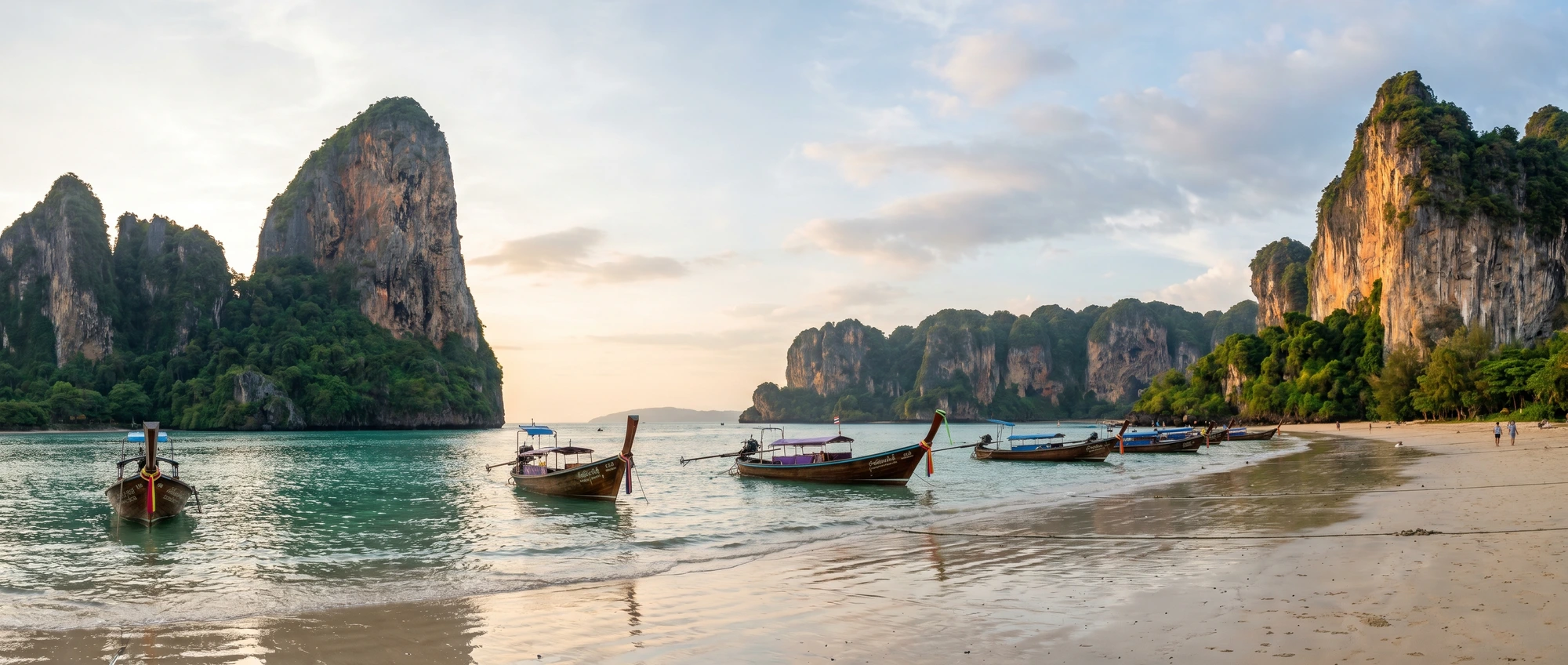
Base on one island or beach rather than hopping every night. Do a longtail or speedboat day trip to quieter bays, snorkel, and have at least one slow day. From Krabi, Railay's climbing beaches are a short boat away; from Phuket, the Phi Phi day trip is gorgeous but busy — go early. Fly home from the nearest southern airport to avoid backtracking to Bangkok.
Where to base yourself
In Bangkok, stay along the Sukhumvit line for hotels at every price with the BTS and MRT on the doorstep — the only reliable way to beat the city’s traffic — or near the riverside if temples and atmosphere matter more than nightlife. In Chiang Mai, the moated Old City puts you walking-distance from dozens of temples and the Sunday market, with trendier Nimman as the café alternative. For the beach, let the season pick the coast: Ao Nang or Railay in Krabi on the Andaman side from November to April, Bophut on Koh Samui on the Gulf side from February to August.
Sukhumvit (Bangkok)
The most practical first-timer base: hotels at every price, rooftop bars, and the BTS and MRT on the doorstep so you skip the traffic. Sois closer to Asok and Phrom Phong are calmer; the lower Nana/Soi Cowboy end skews nightlife.
Good for: First-timers who want transit and variety
Riverside / Old City (Bangkok)
Near the Grand Palace, Wat Pho and the river boats, with atmospheric heritage stays. It's further from the BTS and evening life, so it's the trade-off for being walking-distance to the big sights rather than the nightlife.
Good for: Temples and river atmosphere
Old City (Chiang Mai)
Inside the moated square, walkable between dozens of temples and the Sunday walking street, with cheap guesthouses and cafés. The best all-round Chiang Mai base; Nimman to the west is the trendier, café-and-co-working alternative.
Good for: Temples, walkability and slow mornings
Ao Nang / Railay (Krabi)
The Andaman-coast base for the November–April season: Ao Nang for restaurants and boat piers, boat-only Railay for climbing and quieter beaches. Better value and less party-heavy than Phuket's busiest strips.
Good for: Andaman beaches, Nov–Apr
Bophut / Choeng Mon (Koh Samui)
The Gulf-coast base for the February–August window, when the Andaman side is wet. Bophut's Fisherman's Village is walkable and dinner-friendly; Choeng Mon is quieter and family-leaning. Skip Chaweng's strip unless you want late nights.
Good for: Gulf beaches, Feb–Aug
Getting around — fly the long legs, Grab the short ones
Getting around Thailand
Thailand is big, and the smart move is to fly the long legs and go local in the cities. Internal flights on AirAsia, Nok Air, Bangkok Airways and Thai are cheap and frequent — Bangkok to Chiang Mai or Phuket is about an hour for ฿1,500–3,500 (~£35–80), versus 12 hours on the sleeper train. In Bangkok, the BTS Skytrain and MRT subway are the only reliable way to beat the traffic at ฿17–65 (~£0.40–1.50) a ride; you can now tap a contactless Visa or Mastercard straight onto the MRT gates. For doors-to-door, use the Grab app — the price is fixed in advance, so there's no haggling and far less chance of being overcharged than in a street taxi or tuk-tuk. The Bangkok–Chiang Mai sleeper train is a genuinely good experience if you want it (book the 90-day window the moment it opens — lower berths sell out in hours), but it's a choice, not the efficient option. You won't want a hire car for a typical first trip, and renting a scooter is the single biggest avoidable risk given Thailand's road record.
- Fly the long legs: Bangkok–Chiang Mai or Phuket is ~1 hour for ~£35–80, vs 12 hours by train.
- In Bangkok, use the BTS and MRT to beat the traffic — ฿17–65 (~£0.40–1.50) a ride; tap a contactless card on the MRT.
- Use Grab for taxis — the fare is fixed in the app, so no haggling and far less overcharging.
- Take the Airport Rail Link from Suvarnabhumi: ~30 min, ~£1, vs a slow taxi in traffic.
- Sleeper train Bangkok–Chiang Mai: book at the 90-day window — lower berths sell out in hours.
- Think twice about renting a scooter — Thailand has one of the world's highest motorbike death rates.
The instinct to “see it overland” costs you days you don’t have. Bangkok to Chiang Mai or Phuket is about an hour by plane for £35–80, against twelve hours on the sleeper train — take the train only if the journey is the point. In the cities, the BTS and MRT beat the traffic for pennies, and the Grab app fixes your taxi fare in advance so there’s no haggling or meter games. The one thing to weigh carefully is a scooter: it’s how most people get around the islands, but Thailand has one of the world’s highest motorbike fatality rates, and many UK insurance policies won’t cover you on one without a motorcycle licence.
Staying connected
UK roaming to Thailand is expensive — it sits outside the inclusive EU-style zones, so the networks charge around £5–£8 a day, far more than the ~£2.25 you’re used to in Europe. Over a fortnight that’s £70–£200+. A travel eSIM at £15–£35 for the whole trip is the obvious value move; install it before you fly and activate on landing onto Thailand’s strong city 4G and 5G — it’s also what makes booking Grab rides and reading Thai-only menus painless.
Stay connected in Thailand
UK roaming to Thailand is expensive — Thailand sits well outside the EU-style inclusive zones, so EE and Three charge around £5–£7 a day and Vodafone closer to £8, far more than the ~£2.25/day you're used to in Europe. Over a two-week trip that's easily £70–£200+.
- A travel eSIM is typically £15–£35 for 10GB-plus over a fortnight — often a 70%+ saving on daily roaming.
- Activate it on landing — Thailand's 4G/5G is excellent in the cities and good on the bigger islands.
- Handy for booking Grab rides, using offline maps and translating Thai-only menus and signs.
Money: cash, cards and the baht rule
Thailand is still a largely cash economy once you leave the malls and chain hotels — street food, markets, tuk-tuks, longtail boats and small guesthouses are cash-only, while Bangkok malls, mid-range hotels and the MRT take cards. The practical kit: a fee-free travel card (Wise, Revolut, Chase or a Starling-style account) plus a daily float of baht. Withdraw from a bank ATM rather than the airport, and note every Thai ATM charges a flat ฿220 (~£5) foreign-card fee on top of your bank's, so take out ฿10,000–20,000 (~£230–455) at a time rather than little and often. Two rules that save money: always choose to be charged in baht, never GBP, when an ATM or card machine offers — picking pounds (dynamic currency conversion) hands the bank a poor rate and costs you 3–5%; and tipping isn't expected, though rounding up a restaurant bill or leaving ฿20–50 is a normal courtesy.
Fee-free travel money
Skip the airport exchange desk — a fee-free travel card gives you the real exchange rate abroad.
Before you fly
Two small jobs round out the trip: pre-book your airport transfer (or plan the ~£1 Airport Rail Link from Suvarnabhumi, which beats a taxi crawling through traffic) and double-check the essentials before you fly — the arrival card, insurance, the no-vape rule — so nothing slips through in the last 48 hours.
How we know this
How we know this
- GOV.UK foreign travel advice — Thailand — entry, passport validity, visa, digital arrival card, health, safety and local laws
- NHS Fit for Travel / TravelHealthPro — dengue, malaria and vaccine recommendations
- State Railway of Thailand & seat61.com — sleeper-train times, fares and the 90-day booking window
- BTS/MRT and Airport Rail Link operators — Bangkok transit fares and airport transfer times
GOV.UK last updated 2 Jun 2026.