Western Thailand
Bridge over the River Kwai
How to visit the Bridge over the River Kwai in Kanchanaburi: walk it for free, ride the Death Railway across it for 100 baht, and pair it with the War Cemetery so the WWII history lands.
Where
Kanchanaburi, Thailand
Opening hours
The bridge is free and walkable at any time; it gets least crowded before about 09:00. The Thailand-Burma Railway Centre opens roughly 09:00-16:00 daily; Kanchanaburi War Cemetery is open in daylight hours and free.
Tickets
Walking the bridge: free. Death Railway local train, River Kwai Bridge station to Nam Tok: 100 baht (about £2) one way, foreigner flat fare, bought at the station. Thailand-Burma Railway Centre: 160 baht (about £3.60) adults.
Time needed
About 30 minutes to walk the bridge; a half-day to combine it with the train ride, War Cemetery and railway museum; a full day if you continue to Nam Tok and Hellfire Pass.
In short
Visiting Bridge over the River Kwai
Walking the bridge is free and open all day — the cost is the crowds, not a ticket. The thing worth doing is riding the Death Railway local train across it: a slow rumble over the steel-and-wood spans for 100 baht (about £2) one way, bought at the station on the day. Allow about 30 minutes at the bridge itself, but treat it as one stop in a half-day that includes the Kanchanaburi War Cemetery and the Thailand-Burma Railway Centre — without those, the bridge is just a bridge.
How to visit without being underwhelmed
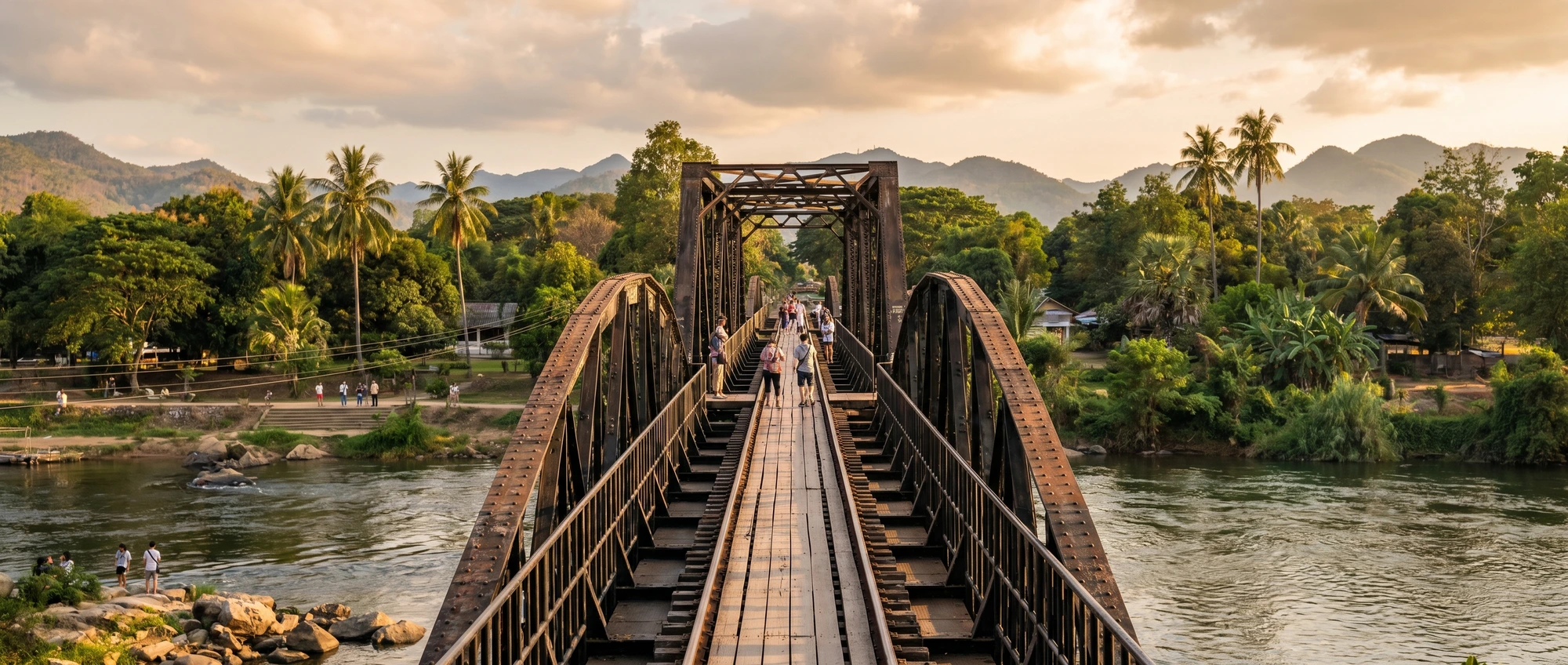
Be clear about what the bridge is before you make the trip. It’s a working steel-and-wood railway bridge over a wide brown river, and the two straight-sided centre spans are post-war replacements installed after Allied bombing destroyed the originals in 1945 — only the curved spans the Japanese brought from Java are original. People who arrive expecting the cinematic structure from the 1957 film, or a dramatic gorge, leave flat. People who arrive understanding it as the surviving piece of the Thailand-Burma “Death Railway”, built by Allied prisoners of war and Asian labourers at a terrible cost, leave moved. That difference is entirely about preparation, not the bridge.
Walking across it is free — there’s no ticket, no gate, and you can do it any time of day. Stick to the planked walkways and the passing-bays cut into the sides, because the line is live: trains cross slowly at a 10 km/h crawl and announce themselves loudly, but you do have to step aside. Come before about 09:00 if you want it without coach-tour crowds and the small market of stalls at the eastern end.
Ride the train across it — that’s the bit worth doing
The single best thing here isn’t standing on the bridge, it’s riding the Death Railway local train over it. The ordinary service rumbles across the bridge and on along the cliff-hugging wooden viaduct toward Nam Tok for a flat 100 baht (about £2) one way for foreign passengers. You buy it at River Kwai Bridge station on the day — the standard local train can’t be reserved online and usually doesn’t need to be. There are a few departures daily, so check the board at the station when you arrive rather than trusting any printed timetable, as times shift.
You don’t have to ride the whole two-and-a-bit hours to Nam Tok. Plenty of people board at the bridge and hop off at Kanchanaburi or Tha Kilen (for the Hellfire Pass area further on) to keep it short. If a weekend or public-holiday special tourist train is running, that one is busier and is worth booking ahead.
What to pair it with — and should you bother?
A bridge on its own is a 30-minute stop. Build a half-day around it instead. The Kanchanaburi War Cemetery, the resting place of 5,085 Commonwealth war dead, is free and a short ride south in the town — it’s quiet, immaculately kept, and it’s where the railway’s human cost actually registers. Across from it, the Thailand-Burma Railway Centre (about 160 baht, roughly £3.60, open daily to late afternoon) is the museum that explains how and why the line was built; go here before the bridge if you can, so the bridge means something when you reach it.
It’s worth it, but conditionally. Treated as a tick-box photo stop, the Bridge over the River Kwai disappoints — it’s been disappointing day-trippers for decades. Treated as one stop in a sequence that includes the cemetery and the museum, and ideally the slow train ride across the spans, it’s one of the more affecting things you can do near Bangkok. Spend the £2 on the train and the £3.60 on the museum; skip the riverside floating restaurants pushed at tour groups unless you genuinely want lunch on the water.
Planning the rest of your trip? See the Kanchanaburi city guide.
More to see in Kanchanaburi

Book the essentials
Tours & tickets
Bridge over the River Kwai FAQs
Do you have to pay to see the Bridge over the River Kwai?
Can you ride a train across the Bridge over the River Kwai?
Is the Bridge over the River Kwai worth visiting?
How do you get to the Bridge over the River Kwai from Bangkok?
Ready to book?
Check tickets & tours