Southern Thailand
Railay Beach
How to do Railay Beach near Krabi: which of the four beaches to actually swim at, when to land before the day-trip boats, the longtail logistics, and whether it's worth an overnight.
Where
Krabi, Thailand
Opening hours
The beaches are open and free at any time, but access is tidal and boat-bound: shared longtails from Ao Nang run roughly 08:00–18:00, with a surcharge after dark. There are no gates and no ticket.
Tickets
Free to enter. The cost is the boat: about ฿100 (£2.30) each way on a shared longtail from Ao Nang, ฿150 (£3.40) after 18:00. A half-day beginner climbing course is roughly ฿1,000–1,200 (£23–27) in a group or about ฿3,500 (£80) one-to-one.
Time needed
Half a day to see West and Phra Nang properly; a full day if you swim, climb or kayak; one to two nights if you want the cliffs to yourself before and after the day boats.
In short
Visiting Railay Beach
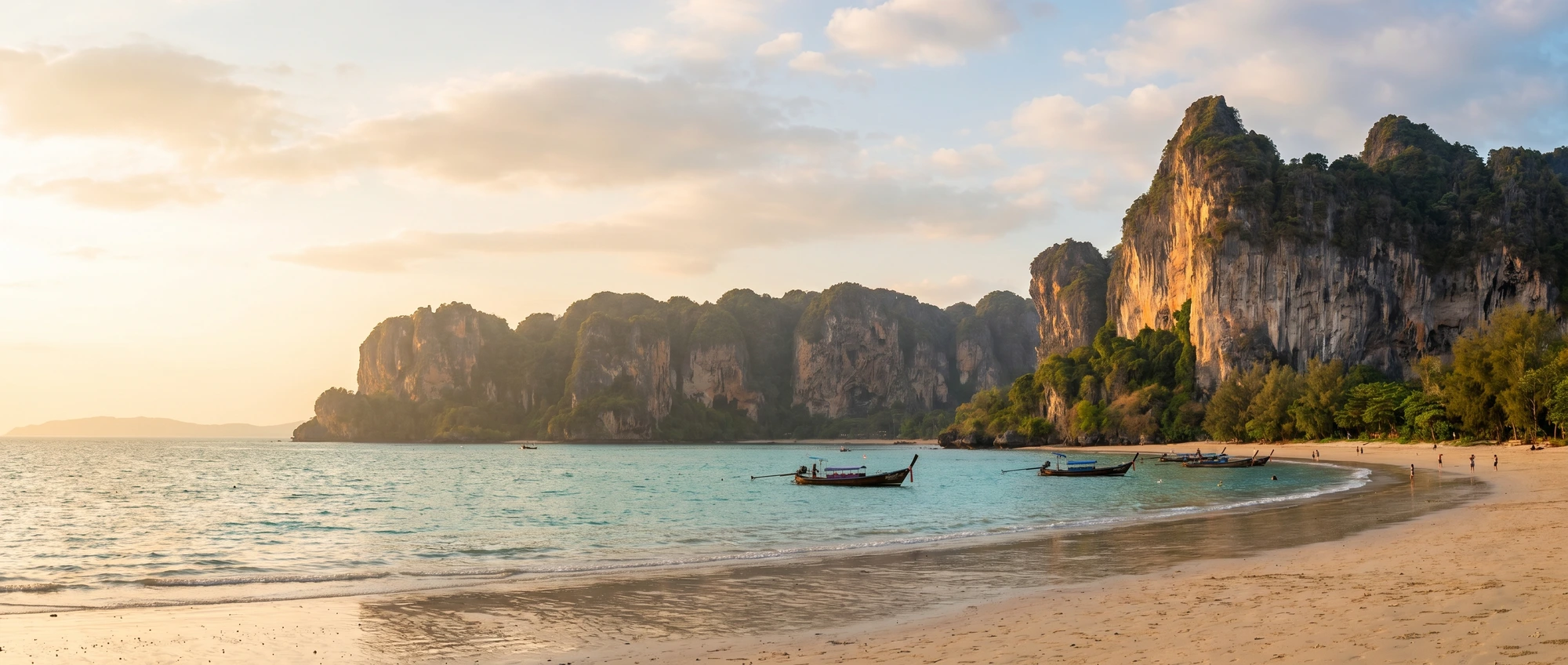
Railay isn't one beach but a road-free peninsula of four, reached only by longtail boat from Ao Nang. Don't judge it by Railay East, where the boats from Krabi land into mangrove and there's almost no beach at low tide — walk the few hundred metres across to Railay West to swim, and round the headland to Phra Nang, the best stretch of sand here. Go early: a 10-minute longtail from Ao Nang costs about ฿100 (£2.30) each way, but the day-trip armada lands on Phra Nang from mid-morning, so aim to be on the sand before 09:00. It works as a half-day from Ao Nang or a one-to-two-night splurge; it does not work as a single base for a whole trip.
It’s four beaches, not one — and most people land at the wrong one
Railay is a road-free peninsula off the Krabi mainland, cut off by limestone cliffs and reachable only by boat. The mistake is judging it by Railay East, where boats from Krabi’s piers land into a mangrove fringe that has almost no beach at low tide. East is a walkway, not a swim. Cross the flat few hundred metres of paved path to Railay West — soft sand, calm water, the resorts and restaurants, and where the shared longtails from Ao Nang drop you — and then walk round the southern headland to Phra Nang, the best stretch of sand on the peninsula, with the sacred Princess Cave at one end and climbers working the wall behind it. Tonsai, over a scramble of rocks to the north of West, is the budget, backpacker and serious-climbing beach.
Getting there is the whole logistics puzzle. From Ao Nang you take a shared longtail from the Longtail Boat Service Club for about ฿100 (£2.30) each way; it leaves once roughly eight people are aboard, takes 10–15 minutes, and lands at Railay West. Boats run 08:00–18:00, with a ฿50 surcharge after dark. At low tide you’ll wade shin-deep to board and to land, so wear shoes or sandals you can soak — and don’t bother trying to reach Railay by road, because you can’t.
Day trip or overnight — what Railay is really worth
Time it around the day-trip fleet. The big tour boats start unloading onto Phra Nang from mid-morning, so aim to be on the sand before 09:00 for the cove to yourself, or accept the crowds and the long-tail line of moored boats from about 10:00. An overnight is the other way to win: stay one or two nights on the peninsula and you get Phra Nang at dawn and dusk, after the day-trippers have gone, which is the version that lives up to the photos.
If you fancy the climbing, this is one of the best places in the world to start: bolted limestone, walls right behind the beach, and a string of schools on West and Tonsai. A half-day beginner taster with kit, instructor and insurance is about ฿1,000–1,200 (£23–27) in a group, or roughly ฿3,500 (£80) one-to-one — book on the day in low season, a day or two ahead in the November–March peak.
Railay earns its place as a half-day from Ao Nang or a one-to-two-night splurge, and not much more. The cliffs dropping straight into the sea are the real thing, but the peninsula has no roads, limited and pricey shops, premium resort rates and a boat ride for every errand — fine for a short, deliberate stay, a slog as a base for a whole holiday. Do it as part of a Krabi trip based in Ao Nang, not instead of one.
Planning the rest of your trip? See the Krabi city guide.