Andaman Coast
Andaman Coast
Thailand's west-coast winter-sun belt — Phuket, Krabi, Khao Lak and the Phi Phi and Similan islands. Which base town suits you, how the ferries actually link up, and why you book this coast for December–April, not the school summer holidays.
In short
Andaman Coast at a glance
The Andaman Coast is Thailand's west-facing beach belt and the heart of UK winter-sun holidays: limestone cliffs dropping into clear water, Phuket as the big all-rounder, Krabi as the quieter, prettier counterpart, Khao Lak for families and divers, and the Phi Phi and Similan islands for the day trips. The single decision that shapes everything is timing — this coast is best December to April and turns wet and rough from May, exactly when the Gulf islands (Koh Samui side) come good. Get the season right, pick one base rather than hopping every night, and the ferries do the rest. Allow 7–10 beach days; fly into Phuket (HKT) or Krabi (KBV) and ideally fly home from the other to skip backtracking.
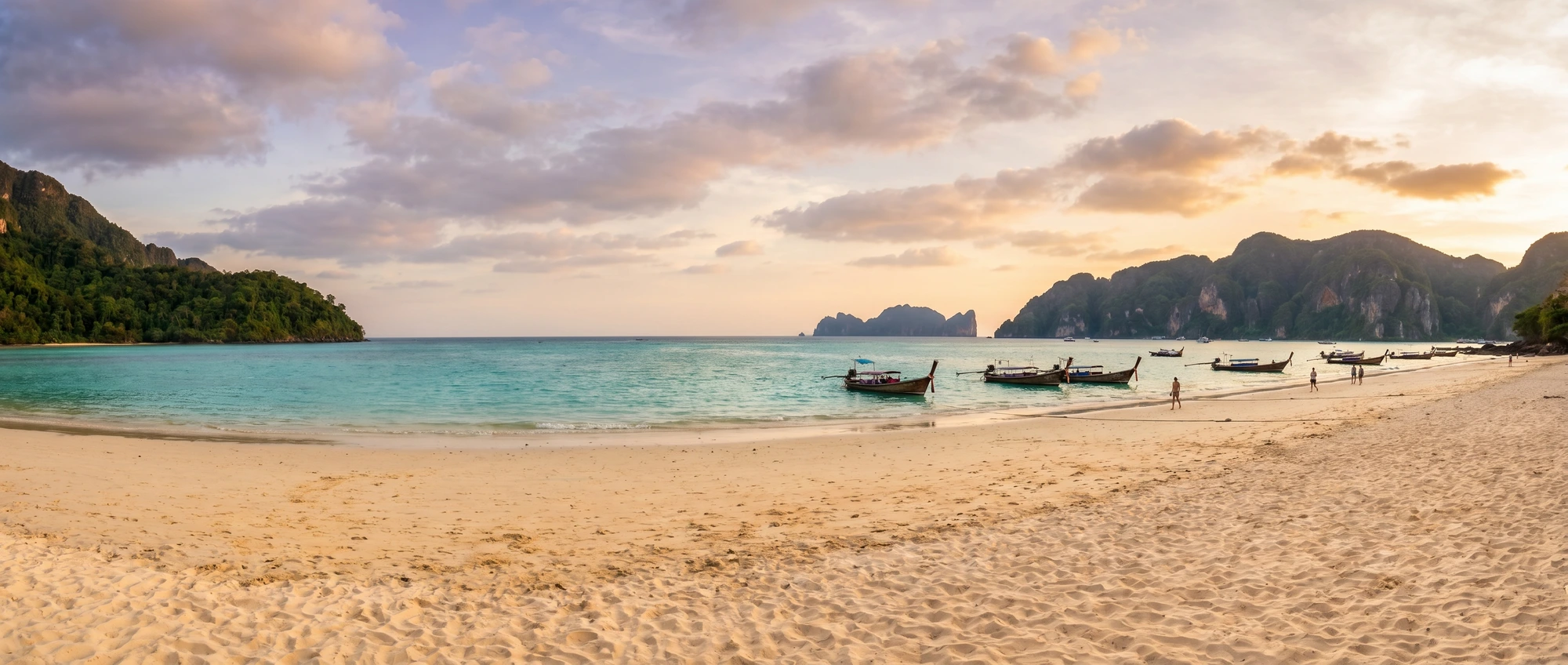
The Andaman Coast is Thailand’s west-facing beach belt and the reason most UK winter-sun holidays end up here: limestone karsts standing out of clear water, long sandy bays and a string of islands a boat-ride offshore. The mainland gives you three flavours of base. Phuket is the all-rounder — the most flights from the UK, the widest choice of hotels and food, and the only real nightlife, concentrated on Patong’s Bangla Road. Krabi, which in practice means Ao Nang and the cliff-cut Railay peninsula, is quieter, prettier and 20–40% cheaper for hotels and tours. Khao Lak, an hour north of Phuket airport, is the low-rise, family-and-diver option that’s asleep by 10pm and the launch point for the Similan Islands.
The decision that actually shapes the trip is the calendar, not the map. The Andaman side is at its best December to April — dry, calm seas, ferries running on time — and turns wet and rough from May to October, which is exactly when the Gulf islands on the other side of the country (Koh Samui, Phangan) come good. The Similan Islands underline the point: the national park closes outright from 15 May to mid-October, so the headline diving and snorkelling is a winter-only trip. If your only window is the school summer holidays, switch coasts rather than gambling on the weather.
Once you’re here, boats do the work and a car rarely earns its keep. From Phuket’s Rassada Pier it’s about two hours to Phi Phi (roughly ฿350–500, £8–11) or to Ao Nang and Railay (฿900, £20); from Krabi side, Phi Phi is closer at around 90 minutes. Railay has no road at all — you reach it only by a 15–20 minute longtail from Ao Nang (฿150–250, £3–6), which is precisely why it stays calm. Airport transfers are simple: HKT to the west-coast beaches is 45–60 minutes and ฿700–900 (£16–20), Krabi airport to Ao Nang about 45 minutes and ฿600 (£14). The smart move is to fly open-jaw — into one airport, out of the other — pick a single base or two rather than hopping every night, and book ferries a day ahead in high season.
The route
A relaxed week to ten days that pairs one mainland base with the islands by boat, rather than packing and re-packing every night. It assumes the December–April high season, when the ferries run frequently and the seas are calm; outside that window, build in slack for cancelled crossings. Fly open-jaw — in to Phuket, out of Krabi — to skip the long drive back at the end.
-
Days 1–3
Phuket as the soft landing
Land at HKT and base on the west coast — Karon or Kata for an easy beach, Patong only if you actively want the Bangla Road nightlife. A taxi to Patong is ฿700–900 (~£16–20) and 45–60 min, longer in the 4–7pm crush. Use these first days to acclimatise to the heat and the 6–7h time jump, then take a day boat to Phi Phi (go on the early departure to beat the Phuket crowds).
-
Day 4
Ferry across to Krabi
The daily ferry from Phuket's Rassada Pier reaches Ao Nang around 10:30 and Railay by 10:45, about ฿900 (~£20). Treat it as a travel day with a swim at the end rather than cramming sights in. Krabi feels softer and cheaper than Phuket the moment you arrive.
-
Days 5–7
Ao Nang & Railay
Base in Ao Nang for restaurants and the boat piers, and hop to Railay — the cliff-backed climbing peninsula reachable only by a 15–20 min longtail (~฿150–250/£3–6) because no road runs in. Do a four-islands longtail trip and one slow beach day. Krabi/Ao Nang to Phi Phi is just 1.5h if you want a second island hit.
-
Days 8–10 (optional)
Khao Lak for the quiet finish
If you have the days and want to wind down, transfer 1.5h north to Khao Lak — laid-back, family-friendly, asleep by 10pm and the launch point for the Similan Islands liveaboards and day boats (open only mid-October to mid-May). Otherwise fly home from Krabi (KBV) to close an open-jaw loop.
Where to base yourself
Pick one or two bases rather than moving every night.
Karon / Kata (Phuket)
££ mid-rangeThe best first base on Phuket if you want a proper swimmable beach without Patong's chaos: long sandy bays, a walkable strip of restaurants and easy taxis. Quieter and more family-friendly than Patong but still well connected — 45–60 min from HKT.
Best for: First-timers, swimmable beach, families
Patong (Phuket)
££ mid-rangePhuket's only real nightlife base, centred on Bangla Road, which runs loud and neon until the 4am close. The beach is fine by day but the appeal is the nights — pick it only if that's what you came for, and a side soi away from Bangla if you want to sleep.
Best for: Nightlife, bars, late nights
Ao Nang (Krabi)
££ mid-rangeThe Krabi-side base and the better-value Andaman choice: a walkable beach town with restaurants, dive shops and the boat piers for Railay, Phi Phi and the four-islands trips. Softer and cheaper than Phuket — mid-range rooms run noticeably less for similar quality.
Best for: Boat trips, value, quieter beaches
Railay (Krabi)
££ mid-rangeA cliff-ringed peninsula cut off from the road, reached only by longtail from Ao Nang — which is exactly why it's calm. Famous for rock climbing and a couple of stunning beaches; it suits a few nights of doing very little, but stock up as everything is shipped in and pricier.
Best for: Climbing, seclusion, scenery
Khao Lak
££ mid-rangeAn hour or so north of Phuket airport: a low-rise, low-key strip of resorts that's asleep by 10pm, popular with families and northern Europeans, and the launch point for Similan Islands diving. The trade-off for the calm is that there's little to do after dark.
Best for: Families, diving, a quiet finish
Getting around Andaman Coast
The Andaman coast is stitched together by boats, so you rarely need a car. From Phuket's Rassada Pier, speedboats and big ferries run to Phi Phi (~2h, ~฿350–500/£8–11) and a daily ferry to Ao Nang and Railay (~2h, ~฿900/£20); from Krabi/Ao Nang it's just ~1.5h to Phi Phi. Crucially, Railay has no road — you reach it only by a 15–20 min longtail from Ao Nang (~฿150–250/£3–6). Airport transfers are straightforward: Phuket (HKT) to the west-coast beaches is 45–60 min and ฿700–900 (~£16–20) by taxi, Krabi (KBV) to Ao Nang is ~45 min and about ฿600 (~£14). Use the Grab app where it works for fixed fares, book ferries through your hotel or a pier desk the day before in high season, and remember the whole network thins out and gets cancelled in rough weather from May to October. A hire car or scooter is rarely worth it for a beach trip, and Thailand's road record makes a scooter the biggest avoidable risk.
Book the essentials
Where to stay
Tours & tickets
Airport transfers
Stay connected
Andaman Coast FAQs
Phuket or Krabi — which should I base in?
When is the best time to visit the Andaman coast?
How do you get from Phuket to Phi Phi or Krabi?
Can you visit the Similan Islands all year?
How much does an Andaman beach week cost a UK couple?
Ready to book?
Book experiences