Inland Aegean (Denizli)
Travertine terraces
Pamukkale's white calcium pools: the barefoot path up from the lower gate, what the combined ticket covers, and an honest word on how much of the famous turquoise water there actually is.
Where
Pamukkale, Turkey
Opening hours
Official site page checked 25 October 2026: daily 08:00–18:00, desk closes 17:00; north and south gates close at 18:00, pedestrian entrance at 17:00. This does not establish 06:30 early access or an all-summer late opening. Pool status needs confirmation because official sources conflict. https://muze.gov.tr/muze-detay?DistId=PMK&SectionId=PMK01.
Tickets
Foreign-visitor combined Pamukkale/Hierapolis entry €30; the tariff also lists the archaeology museum as free. Published foreign-visitor tariff checked 25 October 2026: https://muze.gov.tr/document/bakanlik_yonergesi_tr.pdf. Euro tariffs are collected in Turkish lira under the ministry’s conversion rules; do not use a fixed lira or GBP conversion. Cleopatra’s/Antique Pool status conflicts across official sources: the tariff PDF says closed, while the site page says open. Confirm pool operation and any separate swim product directly before planning it.
Time needed
Around 1.5–2 hours for the barefoot walk up and the main terrace sections; longer if you also explore the Hierapolis ruins, which the same ticket covers.
In short
Visiting Travertine terraces
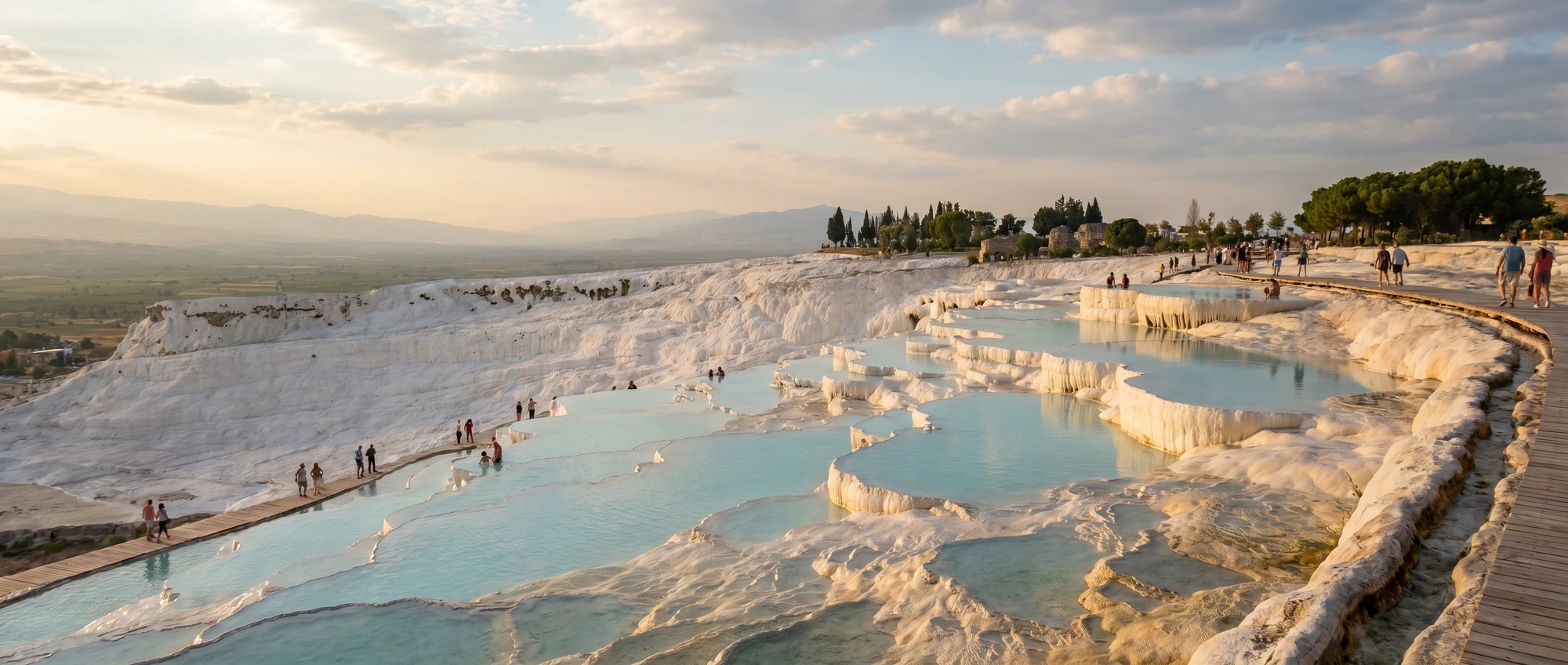
Pamukkale's travertine terraces are the white calcium-carbonate pools that draw everyone here. You walk up a marked barefoot path from the lower gate, shoes in hand. Be realistic: only short sections actually hold the turquoise water of the photos, so the postcard pools are smaller and fewer in reality. The terraces share a combined ticket with the ruins of Hierapolis above them.
The barefoot walk up
The travertine terraces are why everyone comes to Pamukkale: a cascade of brilliant-white calcium-carbonate shelves spilling down the hillside, formed over millennia by mineral-rich spring water. To protect that fragile surface you must take your shoes off at the lower gate and carry them, walking up the marked path barefoot. The wet rock is grippy and warm underfoot; the dry sections can be hard, ridged and a little sharp, so take it slowly. It is part of the fun rather than an ordeal, and the white-against-blue-sky landscape is genuinely striking.
The published foreign-visitor Pamukkale/Hierapolis tariff, checked 25 October 2026, is €30; the archaeology museum is separately listed as free. Euro tariffs are collected in lira under the ministry’s conversion rule, so no fixed lira or GBP equivalent is a current quote. The site page lists 08:00–18:00, desk closes 17:00, with the pedestrian entrance closing at 17:00 and north/south gates at 18:00.
An honest word on the pools
Here is the thing the photos don’t tell you. Only short sections of the terraces actually hold the bright turquoise water you’ve seen online. Water flow is deliberately managed and rotated to preserve the formation, so on any given day large stretches sit dry and chalky-white. The famous brimming pools are smaller and fewer in reality than the marketing implies, and they get crowded with people queuing for the same photo.
That said, don’t write it off. The sheer scale of the white travertine is a remarkable sight, and pairing it with Hierapolis above — temples, a theatre and a vast necropolis, all on the same ticket — turns a short photo stop into a proper half-day. Allow 1.5 to 2 hours for the terraces alone. Come early within the dated opening hours, when the white rock glows and the day-tripper coaches have thinned out, and the place rewards you far more than a rushed midday scramble does.
Planning the rest of your trip? See the Pamukkale city guide.
More to see in Pamukkale
Book the essentials
Tours & tickets
Travertine terraces FAQs
Do you really have to walk barefoot?
Are the pools as turquoise as the photos?
Is the ticket just for the terraces?
Ready to book?
Check tickets & tours