Istanbul Province
Grand Bazaar
How to visit Istanbul's Grand Bazaar: the opening hours that catch people out, how to haggle without overpaying, and whether the 15th-century covered market is worth your morning.
Where
Istanbul, Turkey
Opening hours
Monday to Saturday, roughly 09:00–19:00. Closed all day Sunday and on the religious holidays of Eid al-Fitr (Ramazan Bayramı) and Eid al-Adha (Kurban Bayramı). Individual shops keep their own hours and many start shutting before 19:00.
Tickets
Free — there is no entry fee or ticket. Bring Turkish lira (₺) for purchases; many traders quote in euros or dollars but you'll usually do better paying in cash lira and you'll need it for the smaller stalls.
Time needed
About an hour to walk the main lanes and soak up the atmosphere; half a day if you're seriously shopping for a carpet or gold.
In short
Visiting Grand Bazaar
Entry is free and there is no ticket to book — but the Grand Bazaar is closed all day Sunday and on the two Eid holidays, which is the single thing that catches travellers out. Go on a weekday morning soon after the 09:00 opening, before the coach groups arrive, and treat the marked prices as an opening bid: haggling is expected on carpets, jewellery, leather and lamps. Allow an hour to wander, half a day if you intend to buy.
How to visit without the common mistake
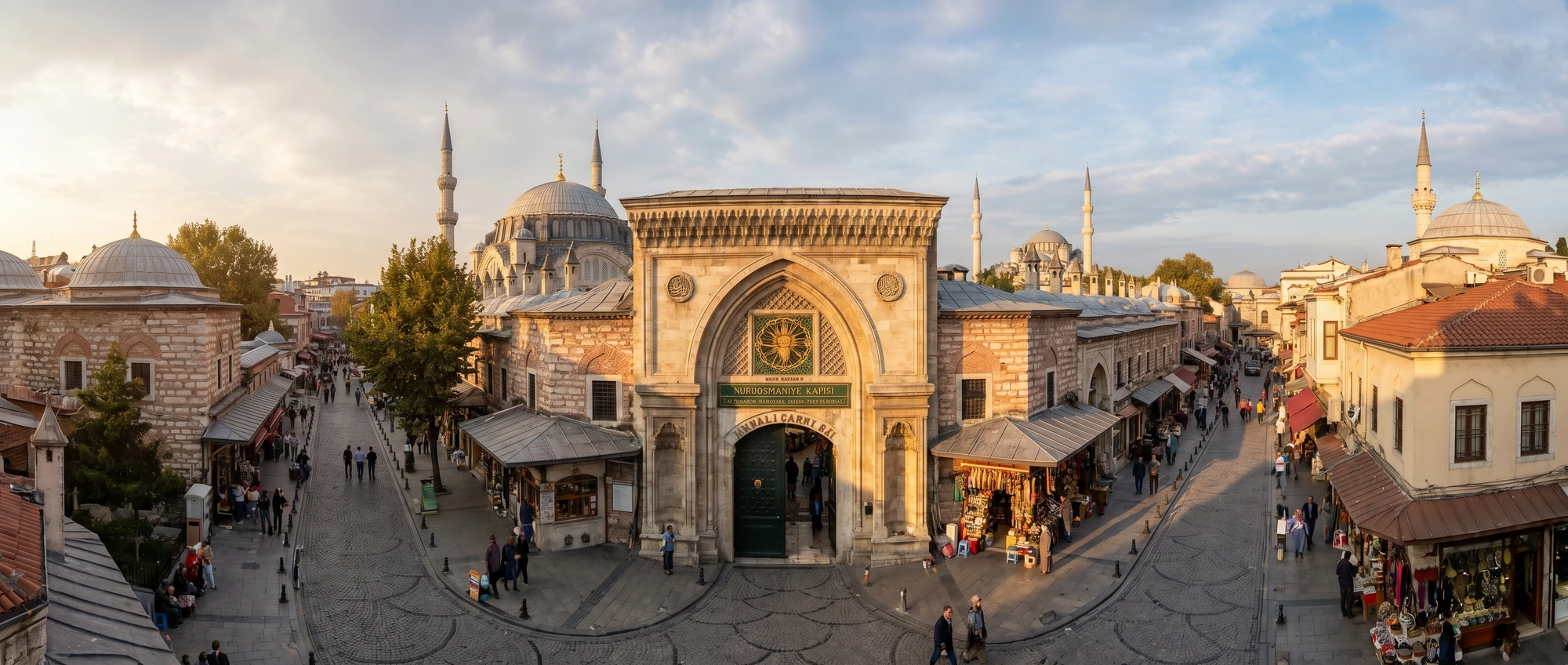
There is no ticket and no entry fee for the Grand Bazaar, so the only planning that matters is the calendar: it is closed all day Sunday and on the two Eid holidays (Ramazan Bayramı and Kurban Bayramı). That single fact strands more UK visitors than anything else — people save it for their last day, which falls on a Sunday, and arrive to shuttered gates. Go on a weekday morning, soon after the 09:00 opening, before the coach groups pour in through the Nuruosmaniye Gate and the central lanes turn shoulder-to-shoulder.
Getting there is easy: take the T1 tram to Beyazıt-Kapalıçarşı or Çemberlitaş, each a two-minute walk to a gate, or walk the 10–15 minutes uphill from Hagia Sophia and the Blue Mosque. Once inside, accept that the marked price is an opening bid. Haggling is expected on carpets, gold, leather and lamps — counter at roughly half, settle somewhere in the middle, and be ready to walk away (you’ll often be called back). Pay in cash Turkish lira where you can; traders quote euros and dollars to tourists, but lira gives you more room and you’ll need it at the smaller stalls.
What to skip, and is it worth it?
Honest verdict: the Grand Bazaar is worth an hour of your morning for the spectacle — a covered market of around 4,000 shops under painted vaults that has traded continuously since Mehmed II built it in the 1450s. As a place to actually shop, it’s weaker. Prices are tourist-inflated, the “antique” rugs are rarely old, and the spices are cheaper and fresher down the hill at the Spice Bazaar in Eminönü. Treat it as a walk-through, not a shopping list.
If you do want one good buy, ceramics, Turkish tea glasses and a proper backgammon set hold up better than the mass-produced lamps near the main gates. Pair the visit with the short downhill walk to the Spice Bazaar and the Eminönü waterfront, rather than stacking it against Topkapı Palace the same morning — the bazaar is tiring in a way that doesn’t leave much patience for a second big sight.
Planning the rest of your trip? See the Istanbul city guide.