Dalmatia
Diocletian's Palace
How to visit Diocletian's Palace in Split: which bits are free, which paid corners are worth the euros, and when to walk the Peristyle before the crowds land.
Where
Split, Croatia
Opening hours
The palace grounds are open 24/7, year-round, for free. Ticketed interiors run roughly 09:00–20:00 in summer and 09:00–17:00 in spring/autumn, with shorter winter hours (often to 15:00). The Cathedral closes to sightseers during Mass. Always confirm your date locally.
Tickets
Grounds free. Cellars/Substructures about €8 adults (~£7), under-14s/seniors/students less; a short stretch of the Cellars is free. Cathedral of St Domnius from about €7 (~£6) including crypt and baptistery; a combined Cathedral ticket with bell-tower access runs around €10–15 (~£9–13). Temple of Jupiter about €3 (~£2.60).
Time needed
2–3 hours for the grounds plus the Cellars and Cathedral; a quick free wander of the Peristyle and gates takes 30–45 minutes.
In short
Visiting Diocletian's Palace
Most of Diocletian's Palace is free — it's not a fenced ruin but the lived-in heart of Split's Old Town, open day and night, so you can wander the Peristyle, the gates and the alleys without a ticket. Pay only for the corners that earn it: the underground Substructures (the Cellars, ~€8), the Cathedral of St Domnius and its bell-tower climb. Walk it before 09:00 or after the day-trippers and cruise crowds thin in the evening, and allow 2–3 hours.
What’s free, and what you actually pay for
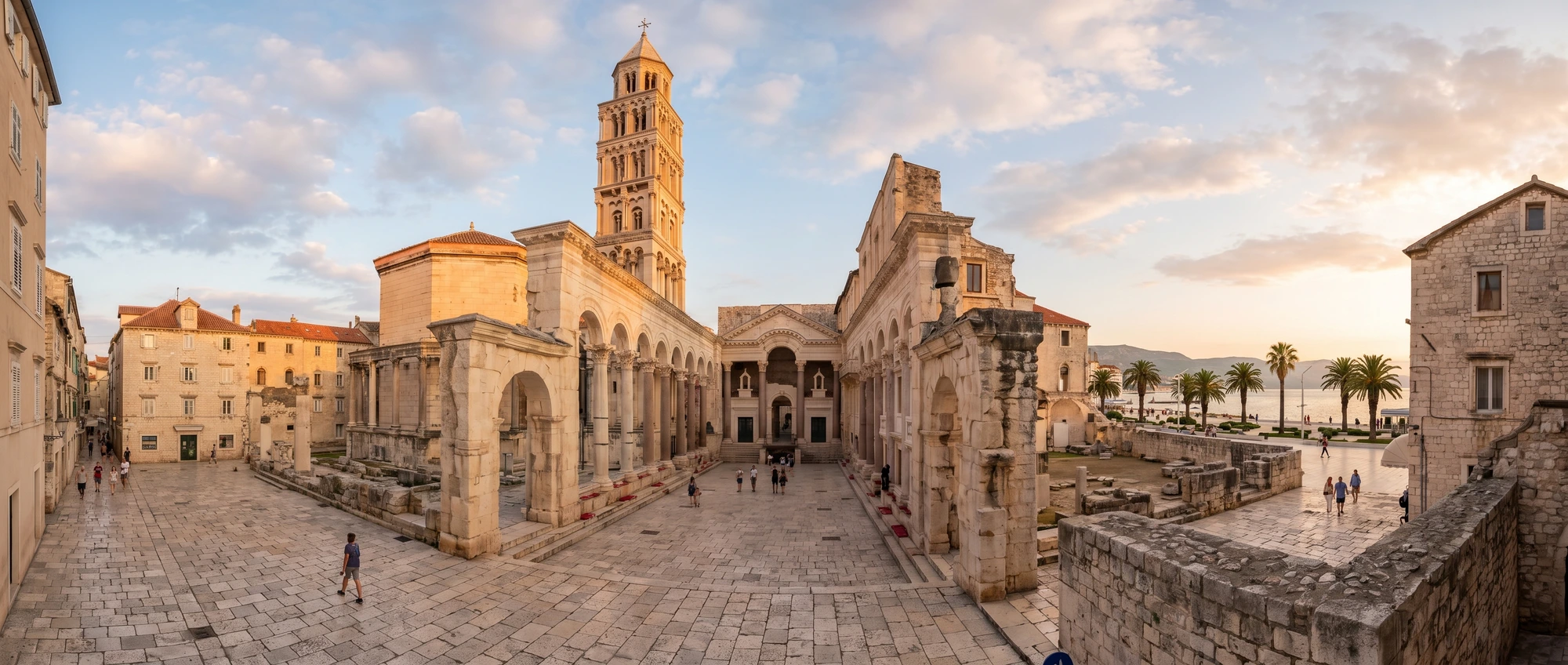
The thing to understand before you go is that Diocletian’s Palace isn’t a single attraction with a turnstile. It’s a quarter of Split — about half the Old Town — built inside and on top of a Roman emperor’s retirement palace, and people still live, work and run cafe tables inside the 1,700-year-old walls. So the grounds are free and open 24 hours a day: you can walk through the Golden, Silver, Iron and Bronze gates, stand in the colonnaded Peristyle court, and lose yourself in the marble alleys without paying anything or queuing for anything.
What costs money is a handful of interiors, and they’re worth picking between rather than buying as a job lot:
- The Substructures (the Cellars) — around €8 (roughly £7). Vaulted Roman undercrofts that copy the floor plan of the vanished imperial apartments above, so they’re the best way to grasp how big this place really was. They were also the dragon dungeon and Meereen throne room in Game of Thrones. One short stretch, running from the Bronze (Brass) Gate up to the Peristyle, is free.
- The Cathedral of St Domnius — from about €7 (about £6) for the cathedral, crypt and baptistery. It’s Diocletian’s own octagonal mausoleum, repurposed as a church by the people he persecuted, which is a decent piece of historical irony for the money.
- The bell tower — usually only sold on a combined Cathedral ticket, around €10–15 (about £9–13). It’s a climb of roughly 180-odd narrow, steep steps for a rooftop view over the red tiles to the harbour and Marjan hill. Skip it if stairs or tight stairwells aren’t your thing.
- The Temple of Jupiter — about €3 (£2.60), a small but well-preserved Roman temple tucked down a side lane.
Which paid bits are worth it?
Go early or late. Before 09:00 the Peristyle is close to empty and the morning light is the best of the day; by mid-morning the cruise-ship passengers and the day-trippers coming off the Hvar and Brač ferries pour in and the main lanes get shoulder-to-shoulder in July and August. The other good window is the evening, when the day crowds have gone, the stone is floodlit, and the cafe in the Peristyle puts cushions on the temple steps.
Allow two to three hours if you’re doing the Cellars and the Cathedral as well as the free wander; a quick lap of the gates and the Peristyle is 30–45 minutes.
The free part is the main event, and it’s genuinely one of the best things you’ll do in Croatia — walking a Roman palace that never stopped being a town. Of the paid bits, the Cellars give you the most “ancient” feeling for your money and the bell-tower view is the best vantage in Split. The Cathedral interior is small for the queue it sometimes draws. Pair the palace with a sundown drink on the Riva waterfront just outside the Bronze Gate, or a walk up Marjan hill rather than rushing straight onto a ferry the same afternoon — Split rewards a slow evening.
Planning the rest of your trip? See the Split city guide.
More to see in Split
Book the essentials
Tours & tickets
Diocletian's Palace FAQs
Do you have to pay to enter Diocletian's Palace?
Are the Cellars (Substructures) worth it?
What is the best time of day to visit?
Ready to book?
Check tickets & tours