Istria
Pula Arena
How to visit Pula's Roman amphitheatre: opening hours by season, the €10 ticket, what's actually inside the underground galleries, and whether it's worth a full visit or a walk-past.
Where
Pula, Croatia
Opening hours
Published hours checked 25 October 2026: April 08:00–20:00; May/September 08:00–21:00; June–August 08:00–22:00; October 08:00–19:00; November–March 09:00–17:00. Ticket sales end one hour before closing. Concerts/set-up can restrict access: https://www.arenapula.hr/en/visitor-info/.
Tickets
Adult €10; children/pupils/students €5; under-5s free. The operator lists 15% group reduction for more than 10 people, not 10 or more, and free QR audio guides. Tariffs checked 25 October 2026: https://www.arenapula.hr/en/visitor-info/.
Time needed
45 minutes to an hour to walk the stands, the arena floor and the underground galleries.
In short
Visiting Pula Arena
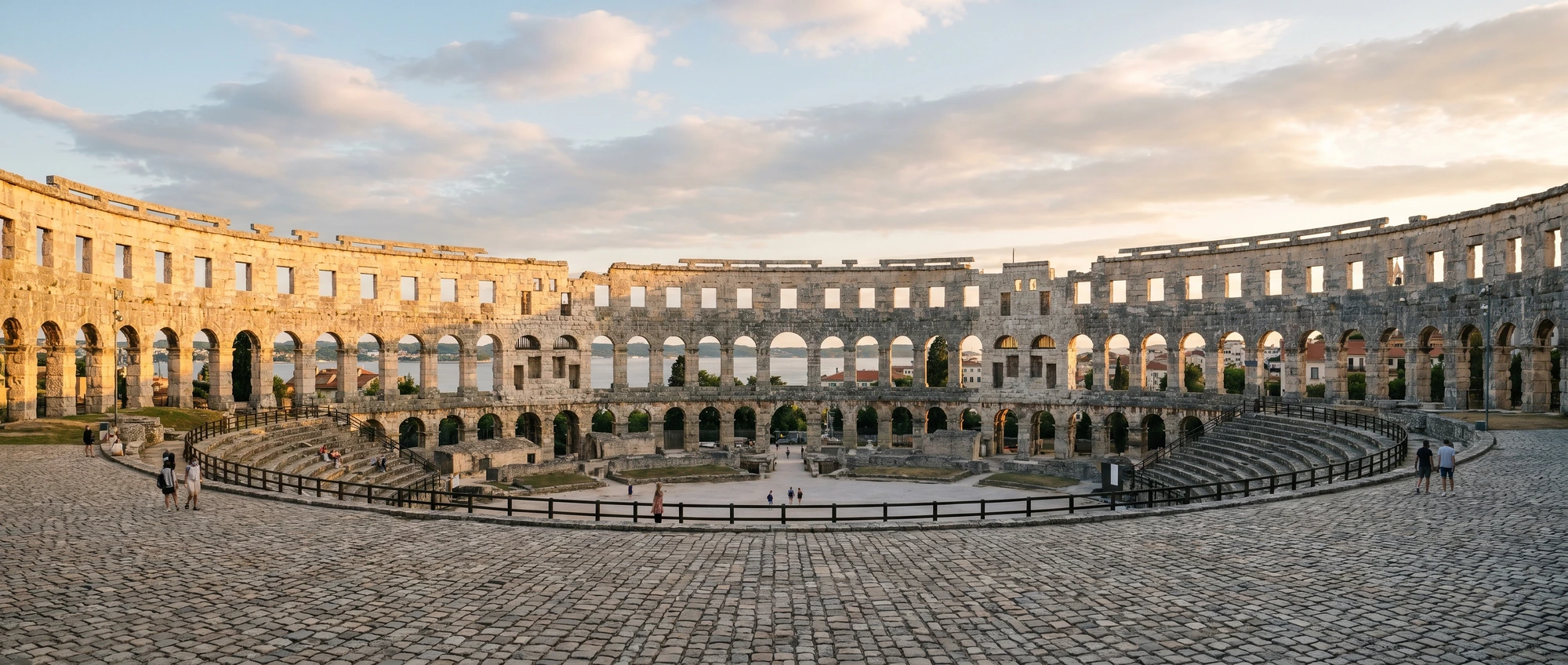
One of the six best-preserved Roman amphitheatres anywhere, and the only one that keeps its full outer wall and all four towers — built under Augustus and finished in the 1st century AD for around 23,000 spectators. The €10 adult ticket gets you onto the arena floor, up into the stands, and down into the underground galleries that once held the gladiators and now show a small exhibition on Roman Istrian wine and olive oil. Allow 45 minutes to an hour. You can see the outside for free from the street, but going in is the only way to stand on the floor and read the four towers from inside.
How to visit without overthinking it
The operator lists €10 adult admission, €5 for children, pupils and students, free entry for under-5s, and a 15% reduction for groups of more than ten. Tickets are sold at the entrance and online; the operator recommends online purchase to reduce waiting. Check the dated visit conditions and any booking charge before paying. A ticket does not guarantee immediate entry or unrestricted access during events.
What the ticket actually opens up is three things: the stands, where you can climb the tiers and read the seating bowl; the arena floor, where the gladiatorial games and public executions happened; and the underground galleries, the service passages that once held gladiators and animals and now hold a small permanent exhibition on Roman-era Istrian wine and olive-oil making — mills, presses, and the amphorae used to ship it down the coast. The audio guide is free: scan the QR codes posted around the site rather than paying for a separate device.
Is the ticket inside worth €10?
Opening hours swing hard with the season, so check the date before you commit a morning to it. It runs 09:00–17:00 from November to March, stretches to 08:00–22:00 in June, July and August, and sits somewhere between in spring and autumn (08:00–20:00 in April, to 21:00 in May and September, 08:00–19:00 in October). The ticket office closes an hour before the gates do, which catches people out at the end of the day. Go early or in the last couple of hours to dodge the midday cruise-tour crowds and the worst of the Istrian summer heat — there’s almost no shade on the floor.
Yes, go in. The outside is free to circle from the street and it’s genuinely impressive — this is one of only six Roman amphitheatres anywhere to survive this complete, and the only one that keeps its full outer ring and all four towers, built under Augustus and finished in the 1st century AD for around 23,000 spectators. But the €10 is what gets you onto the floor and down into the passages, which is where the scale stops being a photo and starts being a room you’re standing in. Budget 45 minutes to an hour. If your dates line up with the summer concert and opera season or the Pula Film Festival, an evening event under the lit walls is a different, better experience than the daytime walk-through — worth checking before you book the daytime ticket. Pair the visit with the Temple of Augustus and the Arch of the Sergii a few minutes’ walk into the old town rather than treating the Arena as a standalone stop.
Planning the rest of your trip? See the Pula city guide.
More to see in Pula

Book the essentials
Tours & tickets
Pula Arena FAQs
Do you need to book Pula Arena tickets in advance?
Is Pula Arena worth it?
What's inside the underground galleries?
Ready to book?
Check tickets & tours