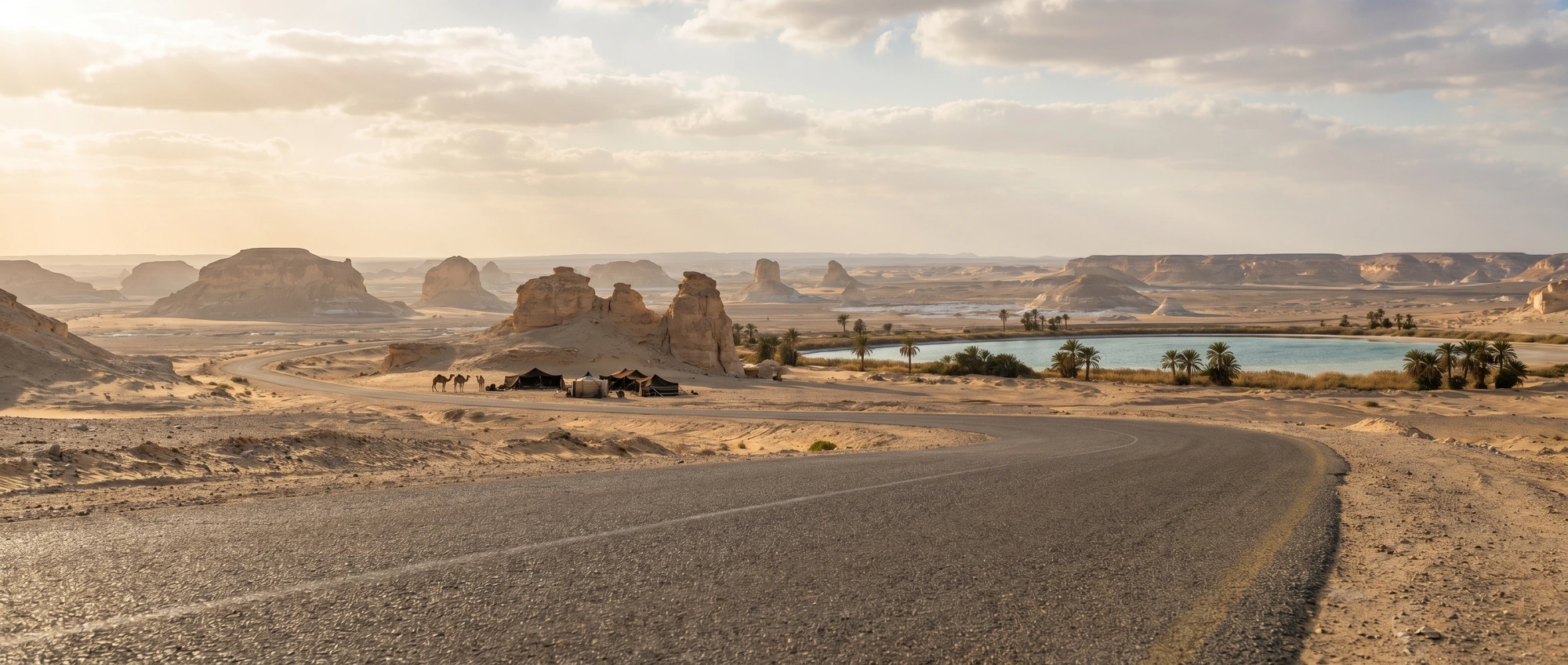
Western Desert, Egypt
Western Desert & Oases
The desert-adventure side of Egypt few package tourists see: Siwa's salt lakes, an overnight camp under the chalk towers of the White Desert, and the bits of the map the FCDO tells you to skip — sorted before you commit.
In short
Western Desert & Oases at a glance
The Western Desert is Egypt without the temple crowds: a 700,000 km² sea of sand holding a string of spring-fed oases and the surreal chalk pillars of the White Desert. Almost everyone reaches it from Cairo, and the one trip that pays off for a first-timer is the Bahariya Oasis overnight — about 4–4.5 hours by road to Bahariya, then a 4x4 into the White and Black Deserts to camp under the stars. Siwa, the famous palm-and-salt-lake oasis near the Libyan border, is a much bigger commitment: there are no flights, so it's an 8–10 hour drive or overnight bus from Cairo (or roughly 4 hours from the Mediterranean coast at Marsa Matruh). FCDO advises against all travel within 20km of the Libya border, except El Salloum (all but essential). The wider area west of the Nile Valley and Delta has an all-but-essential warning with named town, site and road exceptions; these are listed in the Egypt country guide. Siwa town and the Marsa Matruh–Siwa road are exceptions, but the Bahariya/Al Bawiti–Siwa road is warned against and closed. Check the official map for your complete route.
This is the Egypt that doesn’t appear on the Nile-cruise brochures — a vast emptiness of sand, salt lakes and wind-sculpted chalk that sits a few hours’ drive west of the crowds at Giza. The trip almost everyone should do first is the Bahariya Oasis overnight: a paved-road run out of Cairo, then a 4x4 into the White Desert to sleep among formations that look like a frozen sea. It’s the rare part of Egypt where the silence, not the sightseeing, is the whole point.
Plan the precise route before booking. FCDO advises against all travel within 20km of the Libya border, except El Salloum, where it advises against all but essential travel. The wider Western Desert warning has named town, site and road exceptions, including Siwa town and the Marsa Matruh–Siwa road; the Bahariya/Al Bawiti–Siwa road is warned against and closed. Use the Egypt guide’s full restrictions and the official regional advice and map. An organised trip does not remove the restrictions.
Bahariya, Farafra and the White and Black Deserts need advance permits and an official guide. Off-road trips require a qualified guide and Ministry of Interior permit; phone reception and medical facilities are limited. Siwa is a separate journey from the White Desert, reached via the Mediterranean coast rather than the closed cross-desert road. Do not drive outside main cities and resorts at night.
The route
Two very different trips share this region, so decide which one you're doing before you book. The White Desert overnight is a doable add-on to a Cairo stay; reaching Siwa is a proper expedition that needs its own block of days. Drive times below are realistic road estimates with checkpoints, not optimistic brochure figures, and every desert leg assumes a licensed 4x4 operator rather than a hire car.
-
Days 1–2
Cairo to Bahariya & the White Desert
Leave Cairo early for the ~365 km, 4–4.5 hour drive to Bahariya Oasis on the paved desert highway. Swap into a 4x4 there and run out to the Black Desert and the White Desert's wind-carved chalk towers, camping overnight in the protected area. This is the single best taste of the region and works as a 2-day round trip back to Cairo.
-
Day 3
Farafra & Dakhla (optional loop south)
If you've got more time, continue the inner-oasis loop south from Bahariya to Farafra (~180 km) and on to Dakhla, with hot and cold springs, mud-brick old towns and the Crystal Mountain en route. It's a long way for quiet rewards — most UK visitors turn back after the White Desert rather than committing to the full circuit.
-
Days 4–6
Siwa Oasis
Siwa is a separate journey, not a continuation — it's reached from Cairo (8–10h) or the Mediterranean coast at Marsa Matruh (~4h, ~300 km), not across the open desert from the other oases. Give it 3–4 nights for the Shali fortress ruins, the salt lakes you float in, the Temple of the Oracle and Cleopatra's spring, and sunset over the Great Sand Sea.
Where to base yourself
Pick one or two bases rather than moving every night.
Bahariya Oasis (Bawiti)
£ valueThe launch town for every White Desert trip and the practical base if you're only doing the overnight camp. Simple lodges and eco-camps rather than resorts; most people sleep one night in the desert itself and treat Bawiti as the handover point for the 4x4.
Best for: The White Desert overnight from Cairo
Siwa Oasis
££ mid-rangeMud-brick eco-lodges and a handful of higher-end retreats built in the traditional kershef (salt-and-mud) style, scattered among the palm groves and salt lakes. This is a slow, off-grid base — come to switch off, not for nightlife or beaches.
Best for: A 3–4 night oasis stay near the Libyan border
Overnight desert camp (White Desert)
£ valueThe reason most people come: a basic but unforgettable camp pitched among the chalk formations, with dinner cooked on a fire and a sky full of stars. It's organised by your 4x4 operator inside the protected area — expect a roll-mat and a blanket, not a luxury glampsite unless you pay for it.
Best for: The headline night of the trip
Getting around Western Desert & Oases
Use an official guide and arrange permits in advance for Bahariya, Farafra and the White and Black Deserts; off-road trips require a qualified guide and Ministry of Interior permit. Phone reception and medical facilities are limited. FCDO advises against all travel within 20km of the Libya border, except El Salloum (all but essential). The wider area west of the Nile Valley and Delta has an all-but-essential warning with named town, site and road exceptions; these are listed in the Egypt country guide. Siwa town and the Marsa Matruh–Siwa road are exceptions, but the Bahariya/Al Bawiti–Siwa road is warned against and closed. Check the official map for your complete route. From Cairo, organise road transfers to Bahariya; reach Siwa via Marsa Matruh rather than the closed Bahariya–Siwa road. Do not drive outside main cities and resorts at night. Check any Great Sand Sea excursion's exact route against the FCDO map and permit conditions.
Book the essentials
Where to stay
Tours & tickets
Airport transfers
Car hire
Stay connected
Western Desert & Oases FAQs
Can you visit the White Desert and Siwa on the same trip?
Is the Western Desert safe to visit?
When is the best time to visit Egypt's Western Desert?
Ready to book?
Compare car hire