North Rhine-Westphalia
Königsallee (the Kö)
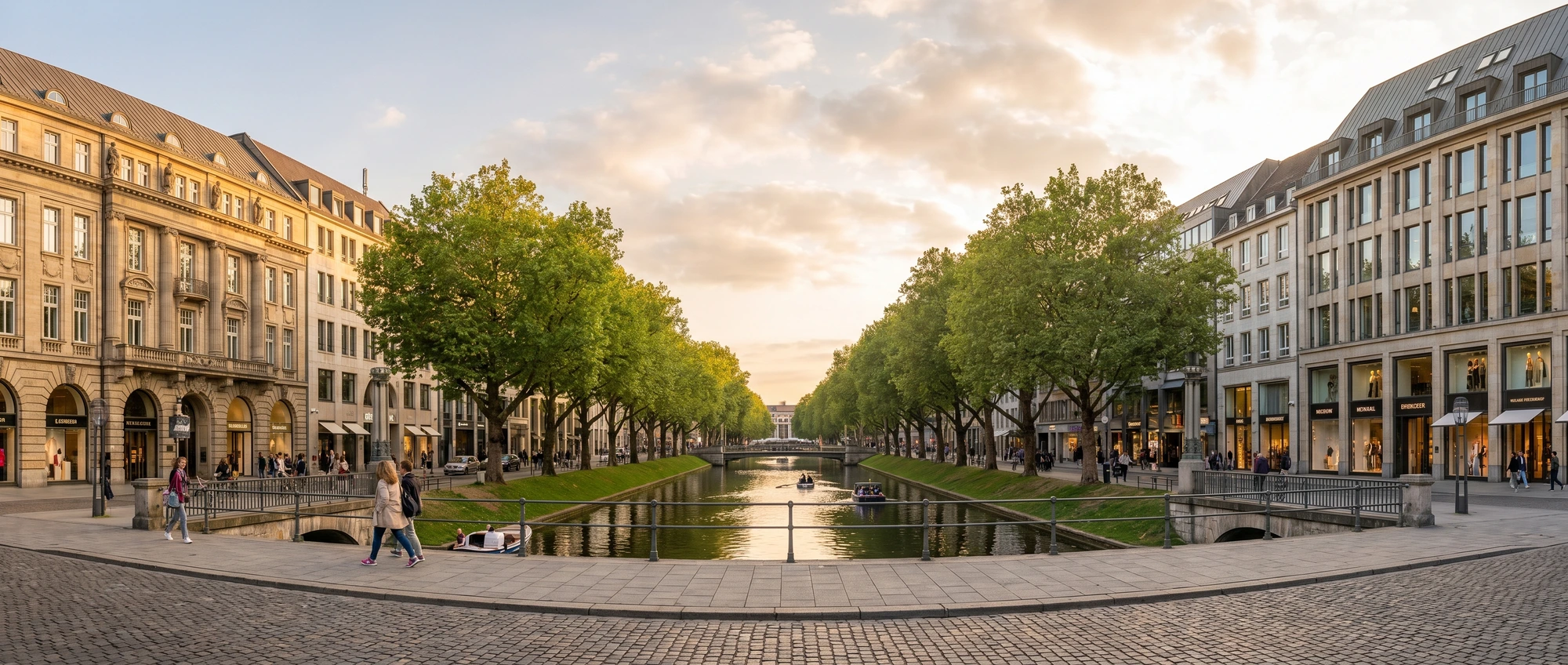
Düsseldorf's tree-lined luxury boulevard, the Kö: a canal flanked by flagship designer stores and the Kö-Bogen arcades, worth a slow walk even if you are not buying.
Where
Düsseldorf, Germany
Opening hours
Open access (always open) to walk the boulevard and canal-side. The shops, the Kö-Bogen and the cafes keep their own hours, generally daytime into early evening and closed on Sundays as is standard in Germany. Confirm current hours and prices on the official site.
Tickets
Free — no ticket needed to walk the Königsallee or sit by the canal. You spend only if you shop, or stop for a coffee or lunch at one of the cafes lining the boulevard.
Time needed
An hour for a slow walk both sides of the canal, longer if you browse the Kö-Bogen or settle in for coffee.
In short
Visiting Königsallee (the Kö)
The Königsallee — the Kö — is Düsseldorf's grand shopping boulevard: a tree-lined ornamental canal flanked on one side by flagship designer stores and the curved Kö-Bogen arcades. For many visitors it is the reason to come. It is free to walk and worth a slow stroll even if you are buying nothing — the architecture, the water and the people-watching are the point.
A canal lined with money
For a good number of visitors the Königsallee — universally shortened to the Kö — is the single best reason to spend an afternoon in Düsseldorf. The set-up is unusual and rather lovely: a broad ornamental canal runs down the middle, shaded by mature chestnut trees, with a fountain at one end and an arched bridge or two crossing the still green water. Along the eastern bank sit the flagship designer stores — the names you would expect, with the polished shoppers to match. The western side is gentler, with banks, cafes and offices.
The honest framing is that this is a shopping street first, so if luxury retail leaves you cold, do not come expecting hidden depth. What it does offer for free is one of the more elegant urban walks in the Rhineland and some first-rate people-watching. It costs nothing to stroll both banks and sit by the canal.
The Kö-Bogen and the people-watching
At the northern end, where the Kö meets the Hofgarten park, stand the Kö-Bogen buildings: a modern shopping-and-office development by the architect Daniel Libeskind, and beside it the much-photographed Kö-Bogen II, whose stepped facade is planted with thousands of hornbeam hedges — said to be one of Europe’s largest green facades. Together they have turned the top of the boulevard into a genuine architectural stop, not just a row of shops.
Allow about an hour to walk it properly: down one bank, across a bridge, back up the other, with a pause for coffee. Bear in mind the German rhythm — shops shut on Sundays, though the boulevard itself never closes. Pair the Kö with the old town’s brewery taps a few minutes’ walk away and you have the two faces of Düsseldorf in an afternoon: polished commerce here, and beer and cobbles there.
Planning the rest of your trip? See the Düsseldorf city guide.