Rhineland-Palatinate, west Germany
The Moselle Valley
A first Moselle (Mosel) wine-valley trip for UK travellers: the Trier-to-Koblenz river run, the Riesling towns of Bernkastel and Cochem, Burg Eltz, real drive times and whether you need a hire car.
In short
The Moselle Valley at a glance
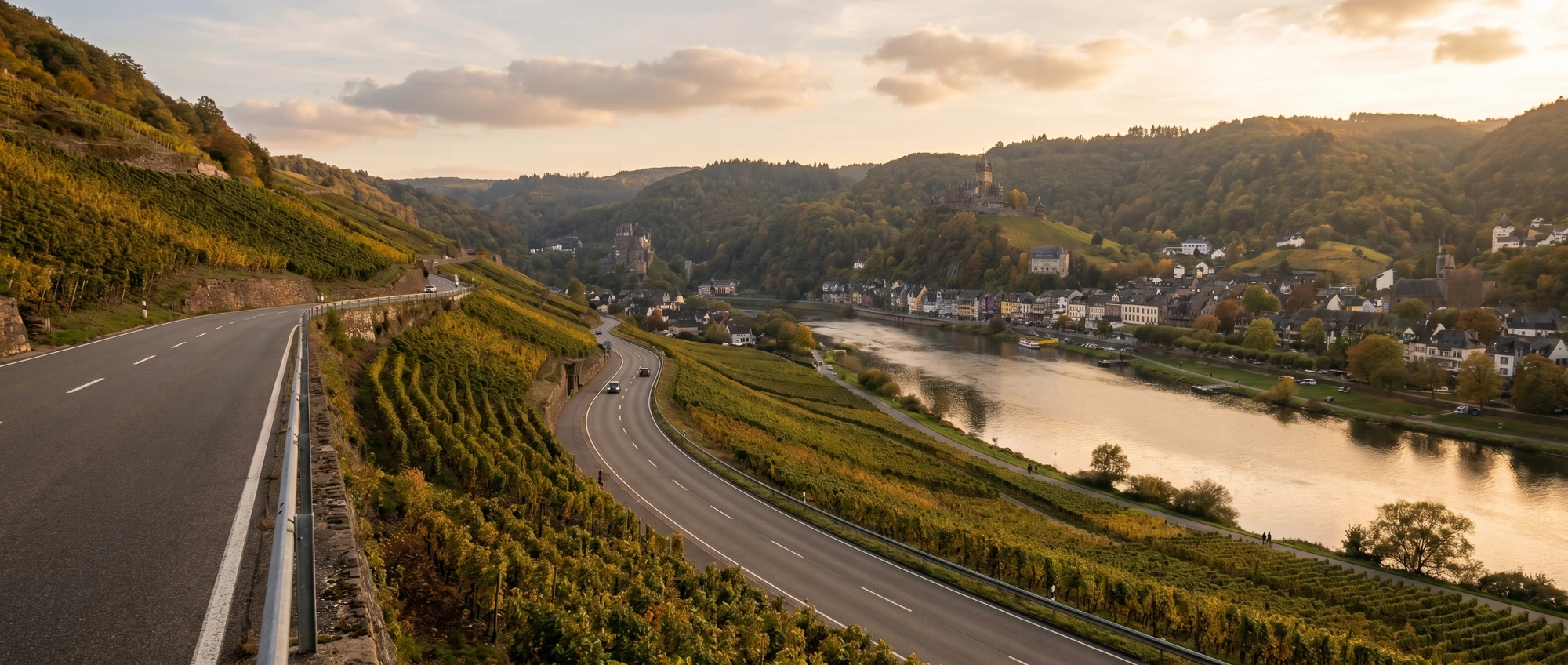
The Moselle (German Mosel) is the looping wine river that runs about 240km from the Luxembourg border at Perl down to Koblenz, where it meets the Rhine. It is gentler and quieter than the busier Rhine Gorge next door: half-timbered Riesling towns like Bernkastel-Kues, Cochem and Beilstein sit at the foot of some of Europe's steepest terraced vineyards, with Trier — Germany's oldest city, founded by the Romans — anchoring the southern end. The classic first trip is a slow run downriver from Trier to Cochem, tasting Riesling and detouring up to the fairytale Burg Eltz. You can do much of it by the Mosel rail line and the summer KD river boats, but a hire car is what reaches the cellar doors and the hilltop castle. Allow 3–4 days for the highlights, a week to add the wine festivals and the back roads.
The Moselle — Mosel to the Germans — is the gentler, quieter cousin of the Rhine that runs alongside it. Where the Rhine Gorge is all dramatic castles and barge traffic, the Mosel loops lazily through 240km of terraced vineyards from the Luxembourg border down to Koblenz, past half-timbered wine towns where the Riesling slopes climb almost vertically behind the rooftops. The first-timer’s mistake is treating it as a day-trip add-on to the Rhine and rushing through. It rewards the opposite: base in Roman Trier at the top and a wine town like Bernkastel-Kues or Cochem downstream, an hour apart by road, and let the river set the pace.
The other thing visitors underestimate is how much the car earns its keep here. The Mosel railway and the summer KD river boats are lovely and will get you between Trier, Bernkastel, Cochem and Koblenz, but the things that make the valley — the cellar doors on the back lanes, the steep Calmont vineyard walk above Bremm, and above all Burg Eltz, the 850-year-old castle tucked up a side valley near Moselkern — sit off the line. Burg Eltz alone is worth the hire car: it’s a ~15-minute walk from its car park, or a taxi-and-trudge from the nearest station. If driving on the right puts you off, base car-free in Trier or Cochem and accept you’ll see the river towns but skip the hilltop castle and the smaller cellars.
The route
A relaxed 4-day run downriver that pairs Roman Trier with the wine-and-castle towns of the central Mosel, with no long backtracking — the river does the work. Drive times are estimates on the winding B53 riverside road, which is slower than the kilometres suggest, so don't over-plan the days. The Mosel rail line (Trier–Koblenz) and the summer KD river boats mean you can do much of this car-free if you base on the railway and accept that Burg Eltz needs a taxi or a walk from Moselkern station.
-
Day 1
Trier
Start in Germany's oldest city: the Porta Nigra Roman gate, the Kaiserthermen imperial baths, the amphitheatre and the Romanesque cathedral — a compact UNESCO half-day on foot. Trier sits at the upper end of the German Mosel near the Luxembourg border, has the best hotel choice and is the cheapest base. Pick the hire car up here as you leave rather than parking it in the old town.
-
Day 2
Trier to Bernkastel-Kues
Drive downriver on the B53 (about 50 minutes, longer with vineyard stops) to Bernkastel-Kues, the postcard Riesling town with its crooked Marktplatz, the ruined Landshut castle above and the famous Doctor vineyard on the slope. Taste in a cellar or two, then stay the night so you have the half-timbered square to yourself after the day-trippers leave.
-
Day 3
The middle Mosel to Cochem
Carry on downriver (roughly 1h15 with stops) past Traben-Trarbach's art-nouveau villas and the Bremmer Calmont — Europe's steepest vineyard, pitched at up to 65 degrees above Bremm. Finish in Cochem, dominated by the photogenic Reichsburg castle on its cone of rock; ride the chairlift up to the Pinnerkreuz cross for the river view, then stay the night.
-
Day 4
Burg Eltz & on to Koblenz
Detour to Burg Eltz, the 850-year-old hilltop castle hidden in a side valley near Moselkern — a ~15-minute walk from the car park or a short shuttle, and the valley's signature sight. Then drop down to Koblenz (about 40 minutes), where the Mosel joins the Rhine at the Deutsches Eck; ride the cable car up to Ehrenbreitstein fortress before driving back to drop the car or catching the train home.
Where to base yourself
Pick one or two bases rather than moving every night.
Trier
££ mid-rangeThe upper-Mosel anchor and the most practical base: Germany's oldest city, with the Roman ruins, the widest choice of hotels and restaurants, and the main rail station for car-free arrivals. Better value than the small river towns and central for the Luxembourg border and the upper vineyards, though it's a city rather than a riverside village in feel.
Best for: First-timers, no-car arrivals, Roman history
Bernkastel-Kues
££ mid-rangeThe prettiest central-Mosel base: a half-timbered Riesling town built around a crooked market square, with cellar doors, the ruined Landshut castle above and the Doctor vineyard on the slope. The hub for the September wine festival and well placed for boat trips and the middle-Mosel towns, though it books out and quietens once the coaches leave.
Best for: Wine tasting, half-timbered scenery, river boats
Cochem or Beilstein
££ mid-rangeStay downstream for the castle scenery: Cochem under its turreted Reichsburg, with a chairlift and the most facilities, or tiny Beilstein across the water — a near-untouched medieval hamlet of one square and a ruined castle. Both sit on the Mosel rail line (Cochem) or a short hop from it, and put you closest to Burg Eltz and Koblenz.
Best for: Castle views, the Burg Eltz detour, the lower Mosel
Getting around The Moselle Valley
A hire car is the natural way to tour the Moselle — the cellar doors, the back-lane villages and Burg Eltz up its side valley are the whole point, and parking in the small towns is easy and cheap. Remember to drive on the right, that the riverside B53 is winding and slower than it looks, and that German low-emission Umweltzone rules require a windscreen sticker in some town centres. That said, you can do a lot car-free: the Mosel railway runs Trier–Bullay–Cochem–Koblenz with regional trains, the summer KD river boats link Bernkastel, Cochem and Koblenz at a gentle pace, and small car-and-passenger ferries cross to villages like Beilstein. The catch is Burg Eltz, which needs a taxi or a ~35-minute forest walk from Moselkern station. Pick the car up as you leave a town rather than paying for centre parking, and book it from Frankfurt-Hahn, Luxembourg or Cologne airport for the best rates.
Book the essentials
Where to stay
Tours & tickets
Airport transfers
Car hire
Stay connected
The Moselle Valley FAQs
How many days do you need in the Moselle Valley?
Do you need a car in the Moselle Valley?
What is the best time to visit the Moselle Valley?
Ready to book?
Compare car hire