Rhineland-Palatinate / Hesse, western Germany
The Rhine Valley
A first Rhine Gorge trip for UK travellers: the Bingen-to-Koblenz castle stretch, what the KD river boats and the Rhine Valley railway actually cost, where to base yourself in Bacharach or St. Goar, and whether you need a hire car.
In short
The Rhine Valley at a glance
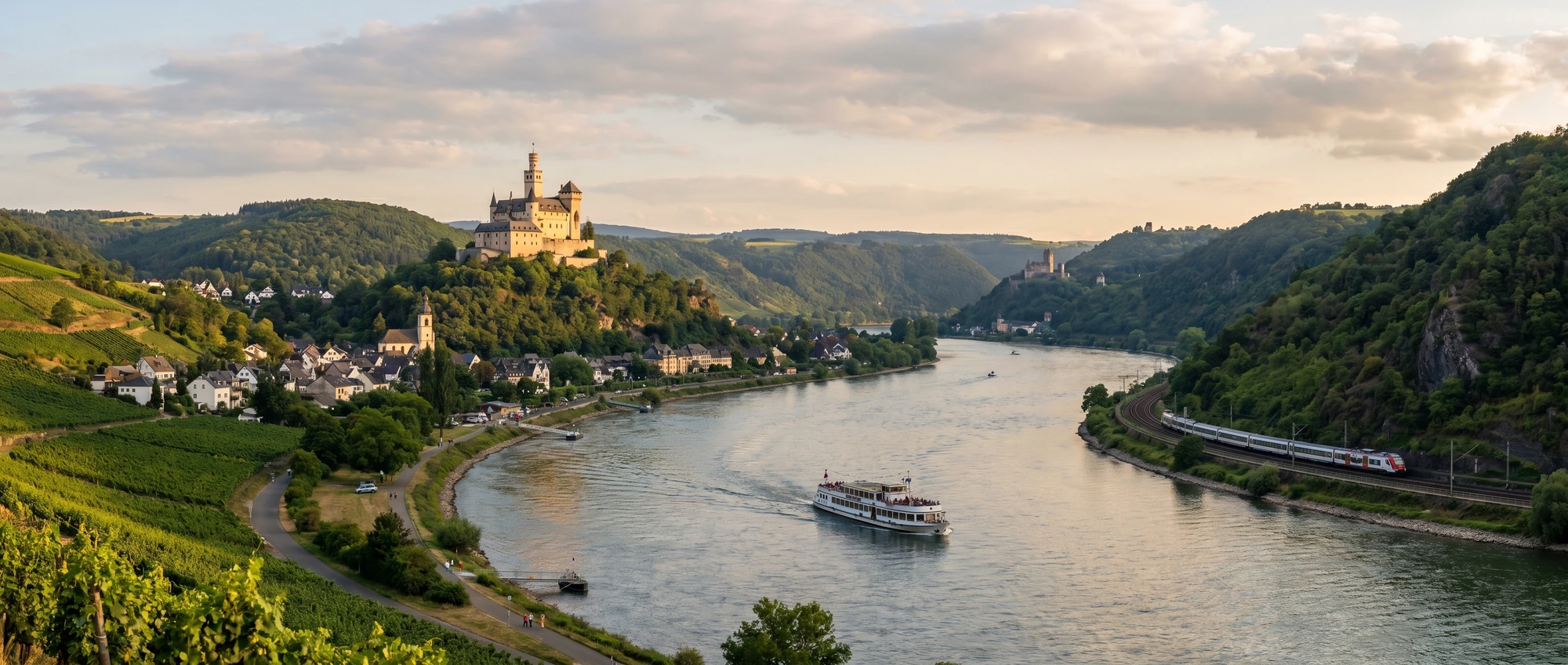
The Rhine Valley people mean when they say it is the UNESCO-listed Upper Middle Rhine Gorge — the 65km of steep vineyards, slate castles and tight river bends between Bingen/Rüdesheim and Koblenz, where the Lorelei rock narrows the water. The castles come thick and fast here: Marksburg above Braubach is the only Middle Rhine hilltop castle never destroyed, Rheinfels above St. Goar is the biggest ruin, and Pfalzgrafenstein sits midstream on its own island near Kaub. The classic way to see it is from the deck of a KD river boat between Rüdesheim and Koblenz, with the parallel Rhine Valley railway (Köln–Mainz line) running both banks so you can boat one way and train back. Allow a full day for the headline gorge, two or three nights to base in a wine village like Bacharach and slow down.
The Rhine Valley worth crossing Europe for is a short one: the 65km UNESCO-listed gorge between Bingen/Rüdesheim and Koblenz, where the river squeezes between steep Riesling terraces and a castle seems to crown every other bend. The first-timer’s mistake is trying to drive both banks of it. You can’t usefully — there’s no road bridge across the gorge between Koblenz and Mainz, so the moment you want the other side you’re queuing for a small car ferry at Bingen or St. Goar. The locals long ago worked out the better trick: ride a KD river boat slowly downstream past the castles, then take the Rhine Valley railway straight back along the bank in a fraction of the time. Boat one way, train the other, and the same stretch never repeats.
The other thing to get right is the base. Koblenz at the northern end has the most hotels, but it’s a working city, and you’d be staying off the gorge to sleep in it. The villages are the point: Bacharach inside its medieval walls, or St. Goar under the ruined bulk of Burg Rheinfels, both small enough to walk in an evening and both on the boat and rail stops, so you can do the whole region without a car. Save Rüdesheim for the wine — the Drosselgasse lane and the Niederwald cable car up over the vineyards — and the day-coach crowds that come with it. The castles you most want to step inside, like Marksburg above Braubach, sit too high for the boat to reach, so a hire car earns its keep only if those hilltop forts are what you came for.
The route
A relaxed 3-day plan that bases you in one gorge village and uses the boat downstream and the train back so you never backtrack the same way. Times are from the central gorge; KD boats run roughly Easter to late October only, so the river legs are seasonal — check the KD timetable before you build a day around a sailing, and treat the railway as the reliable all-year fallback.
-
Day 1
Rüdesheim and the Niederwald
Start at the southern gateway: wander Rüdesheim's narrow Drosselgasse wine lane, then take the Niederwald Seilbahn cable car (about €10 return) up over the Riesling terraces to the Germania monument for the first big view down the gorge. Cross to Bingen on the little car-and-passenger ferry if you want the Mäuseturm tower and the Hildegard wine country. Base the night in Rüdesheim or push on to Bacharach.
-
Day 2
The boat through the gorge to St. Goar
Pick up a KD river boat at Bacharach or Rüdesheim and ride it slowly downstream — past the island toll-castle of Pfalzgrafenstein at Kaub, the twin 'feuding-brothers' castles, and the Lorelei rock where the river narrows. Get off at St. Goar and climb to Burg Rheinfels, the biggest castle ruin on the Rhine, before taking the Rhine Valley railway back to your base. Allow most of a day for this central stretch.
-
Day 3
Koblenz and the Deutsches Eck
Train down to Koblenz at the northern end, where the Mosel meets the Rhine at the Deutsches Eck point. Ride the Seilbahn cable car (built for the 2011 garden show) across the river to Ehrenbreitstein fortress for the view back up the gorge, then loop home. If you're driving, detour to Marksburg above Braubach — the one Middle Rhine castle never destroyed, and the most complete to tour inside.
Where to base yourself
Pick one or two bases rather than moving every night.
Bacharach
££ mid-rangeThe prettiest base in the gorge: a tiny half-timbered wine village inside medieval walls, with the ruined Wernerkapelle and Stahleck castle (now a hostel) on the hill above. It sits on both the KD boat stops and the Rhine Valley railway, so you can do the whole region car-free from here. Rooms are limited and book out in summer.
Best for: First-timers, car-free trips, wine and the prettiest setting
St. Goar / St. Goarshausen
££ mid-rangeThe mid-gorge pair facing each other across the river below Burg Rheinfels, linked by a small car ferry. St. Goar (west bank) has the big castle ruin and most of the hotels; St. Goarshausen (east bank) sits right under the Lorelei. A practical, central base on both the boat and rail lines, slightly more workaday than Bacharach.
Best for: Castle-first trips, the Lorelei and a central position
Rüdesheim
££ mid-rangeThe lively southern gateway and the busiest base — the Drosselgasse wine lane fills with coach groups by day, then quietens at night. Best for the Niederwald cable car, the Riesling vineyards and the easy run to Frankfurt airport. Touristy and pricier in peak season, but well connected and full of Weinstuben.
Best for: Wine, the cable car, easy Frankfurt access
Koblenz
££ mid-rangeThe northern city anchor where the Mosel joins the Rhine. More of a working town than a gorge village, but it has the widest choice of hotels, the Ehrenbreitstein cable car and direct trains down the gorge — a sensible base if you want city amenities and are touring the Mosel as well.
Best for: City amenities, the Mosel, the northern end
Getting around The Rhine Valley
The clever way around the Rhine Gorge is to mix the boat and the train, not drive both banks. KD (Köln-Düsseldorfer) river boats run between Rüdesheim, Bacharach, St. Goar and Koblenz roughly Easter to late October, drifting past the castles at the pace the views deserve; the parallel Rhine Valley railway — the main Köln–Mainz line — runs trains along both banks all year, frequently and fast, so the standard plan is boat one way and train back. A hire car adds the hilltop castles the boat and train can't reach (Marksburg above Braubach, Burg Sooneck) and the wine roads above the vineyards — but remember to drive on the right, and note there is no road bridge across the gorge between Koblenz and Mainz, so bank-to-bank crossings are by small car ferry (Bingen–Rüdesheim, St. Goar–St. Goarshausen, Boppard–Filsen and others). Pick the car up at Frankfurt or Cologne airport rather than in a gorge village, where parking is tight, and decide which bank to base on before you arrive.
Book the essentials
Where to stay
Tours & tickets
Airport transfers
Car hire
Stay connected
Trains & rail passes
The Rhine Valley FAQs
How many days do you need in the Rhine Valley?
What is the best way to see the Rhine Gorge — boat or train?
Which town should you stay in along the Rhine Valley?
Do you need a car for the Rhine Valley?
Ready to book?
Compare car hire