Dodecanese
Palace of the Grand Master
Visiting Rhodes’ Palace of the Grand Master: the separate palace and walls tickets, Kos mosaics and the seasonal calendar.
Where
Rhodes Town, Greece
Opening hours
April–October: palace daily 08:00–20:00. November–March:08:30–15:30, closed Tuesdays. Last entry 20 minutes before close. Walls walk has a separate calendar: summer Monday–Friday 12:00–15:00, Saturday closed; winter closed. Confirm any unlisted Sunday operation. Closed 1 January, 25 March, 1 May, Orthodox Easter Sunday and 25–26 December; check exceptional notices. https://www.hh.gr/en/destinations/palace-of-the-grand-master/ (checked 25 October 2026).
Tickets
Palace admission €20 full/€10 eligible reduced; the walls walk is a separate €5/€3 product. Source checked 25 October 2026: https://www.hh.gr/en/destinations/palace-of-the-grand-master/
Time needed
About an hour for the palace itself; longer if you read the two ground-floor archaeology exhibitions properly. Budget half a day if you use the combined ticket on the museum too.
In short
Visiting Palace of the Grand Master
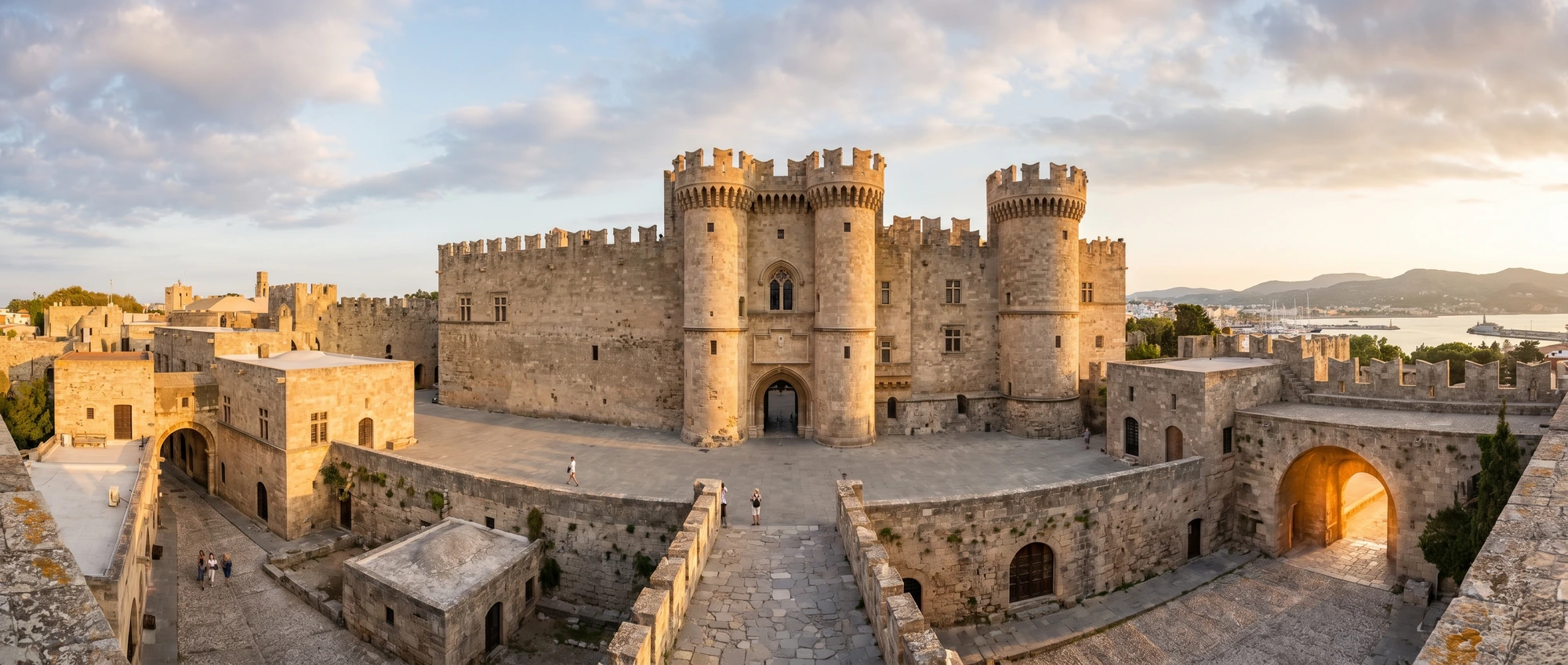
Check the palace ticket separately from the walls walk and other Rhodes museums; the palace and walls are separate products. The palace sits at the top of the Street of the Knights. Its first-floor mosaics, brought from Kos, are a reason to visit. Allow about an hour and check the seasonal opening calendar.
How to visit without overpaying
The palace and walls walk are separate products. The current official catalogue lists palace admission at €20 full/€10 eligible reduced, and the walls at €5/€3. The old €10 four-site combination is not established. Check the opening day and concession proof for each site (25 October 2026).
The palace sits at the top of the Street of the Knights (Ippoton), at the highest northwest corner of the Old Town. You cannot drive inside the medieval walls, so you arrive on foot from the harbour or one of the gates either way — follow the cobbled, slightly uphill Street of the Knights and the gatehouse with its two round towers is at the end. Go in the morning in summer: the stone is cooler, the halls are quieter, and you avoid the cruise-day crush that builds through the middle of the day.
What’s actually inside, and is it worth it?
Be clear-eyed about what you’re seeing. The medieval palace was largely destroyed by a gunpowder explosion in 1856, and what stands today is a 1930 s reconstruction built by the Italians as a residence for their governor (and a planned holiday home for Mussolini that was never used). So it is not a furnished crusader castle — it’s an imposing shell with a museum inside.
The reason to go up the stairs is the first-floor rooms paved with ancient mosaic floors, lifted wholesale from the neighbouring island of Kos and reinstalled here — genuinely beautiful, and the palace’s single best feature. The ground floor holds two strong permanent exhibitions on the ancient and medieval city that reward twenty minutes of reading. Allow about an hour for the palace alone, or half a day if you fold in the Archaeological Museum on the same combined ticket.
It earns its place as the headline indoor sight of the Old Town, especially on the combined ticket — but manage expectations on the reconstruction, and make the Kos mosaics the thing you actually come up to see.
Planning the rest of your trip? See the Rhodes Town city guide.
More to see in Rhodes Town
Book the essentials
Tours & tickets
Palace of the Grand Master FAQs
Does the palace ticket cover other Old Town sites?
Is the Palace of the Grand Master worth it?
How do you get to the palace?
Ready to book?
Check tickets & tours