North Iceland
Goðafoss
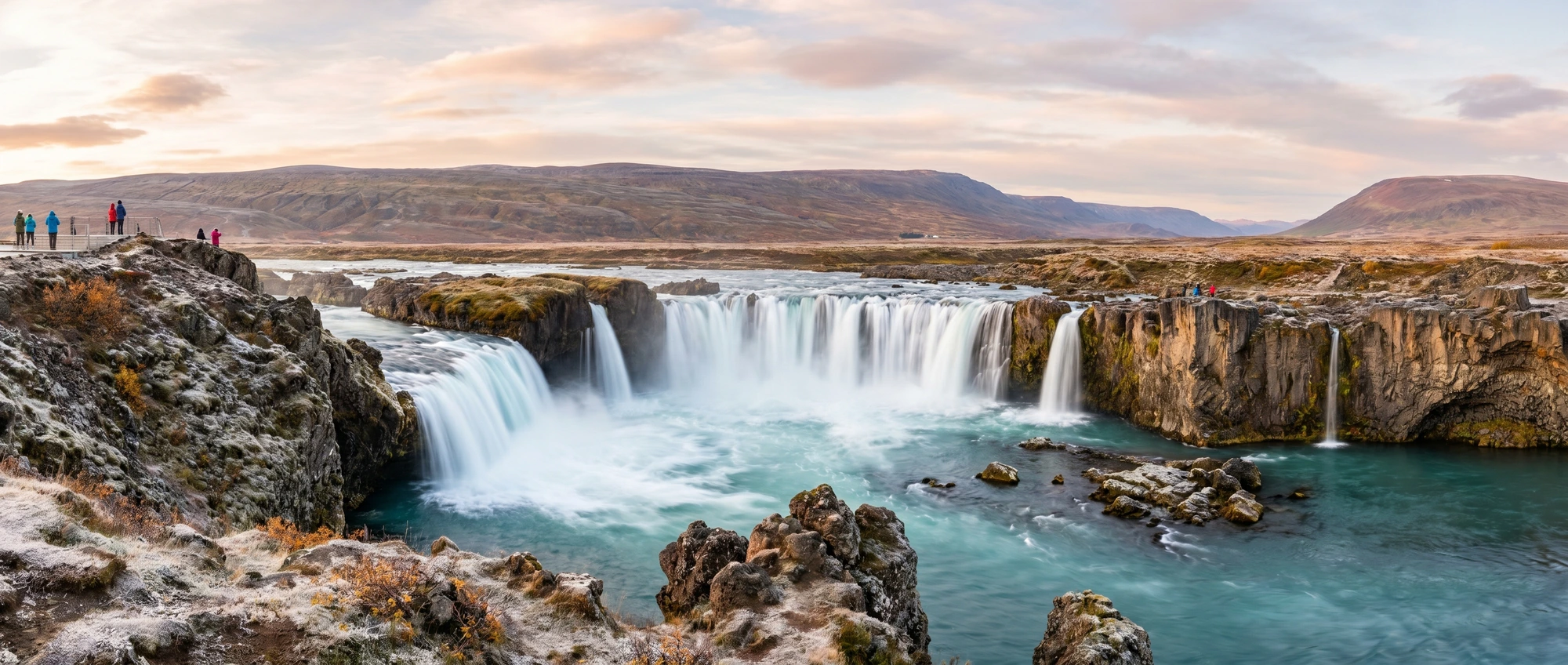
The 'waterfall of the gods': a wide horseshoe right off Route 1, 35 minutes east of Akureyri, with a two-minute walk to the lip and a free loop to the postcard far bank.
Where
Akureyri, Iceland
Opening hours
Open access (always open). The waterfall and its paths are free and accessible at any hour year-round, conditions permitting; the roadside car park, cafe and toilets keep their own seasonal hours, and winter ice can make the paths slippery.
Tickets
Free — no ticket needed to see the falls. Parking at the roadside facilities may carry a small charge, and the cafe and shop are paid, but viewing Goðafoss itself costs nothing.
Time needed
20 to 40 minutes for a quick stop on one bank; closer to an hour if you walk the bridge and visit both sides for the different angles.
In short
Visiting Goðafoss
Goðafoss, the 'waterfall of the gods', is a wide horseshoe cascade sitting right off Route 1 about 35 minutes east of Akureyri. A two-minute walk from the car park reaches the lip; loop to the far bank for the classic postcard angle. It is free, quick and the easiest big sight to fold into a Mývatn day trip. Parking and facilities are at the roadside.
The waterfall of the gods
Goðafoss is one of Iceland’s most photographed waterfalls, and unusually for a sight of its size it asks almost nothing of you to reach it. It sits right beside Route 1, the Ring Road, about 35 minutes east of Akureyri, so there is no rough track or long hike — you pull into the roadside car park, and a two-minute walk brings you to the lip of a wide, curving horseshoe where the Skjálfandafljót river spills over a basalt rim in a milky-blue arc. The name, “waterfall of the gods”, traces to the year 1000, when the lawspeaker is said to have thrown his pagan idols in as Iceland adopted Christianity.
It is free to see, open at any hour, and there are toilets, a cafe and a shop at the roadside (parking may carry a small charge). That combination — big, easy, free, on the main road — makes it the simplest major waterfall in the north to tick off.
Doing it well, and slotting it in
There are paths on both banks, joined by a footbridge. The west bank is the quick win, a short stroll from the main car park with a powerful head-on view; cross to the east bank for the wider, more classic postcard angle that catches the whole horseshoe. With an hour you can comfortably do both; if you are pushed, the west side alone is enough to justify the stop.
The smart move is to treat Goðafoss as the opening act of a Mývatn day: it sits squarely on the route, so you photograph it early, then carry on east to the pseudo-craters, Dimmuborgir and the mud pots, finishing at the Nature Baths. Go early or late to dodge the tour-bus crowds, and in winter take real care — the spray-soaked paths ice over and the edges are unfenced in places. Solid footwear and a respectful distance from the lip are all the planning it needs.
Planning the rest of your trip? See the Akureyri city guide.