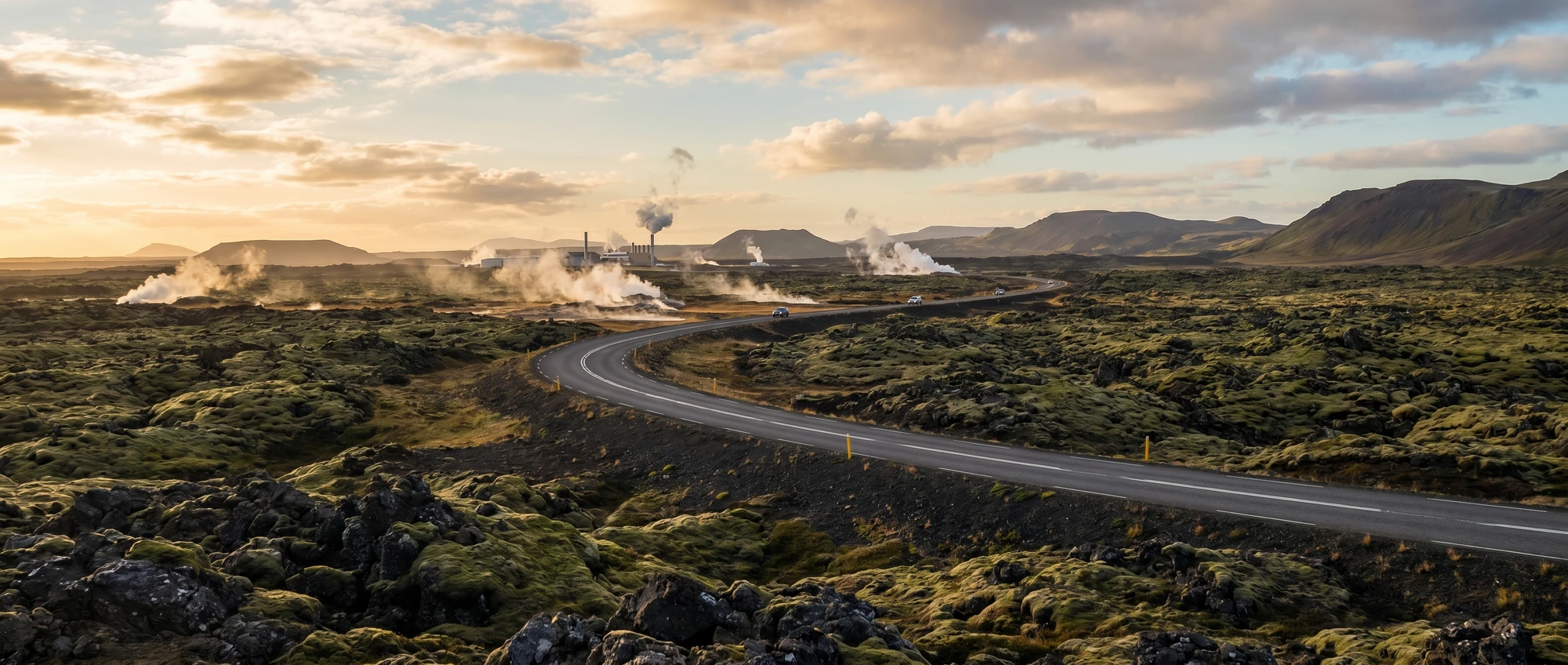
Southern Peninsula (Suðurnes), Iceland
Reykjanes Peninsula
The peninsula your flight lands on: how to fill the airport hours and the Blue Lagoon stop, what the 2023-onward eruptions actually mean for a visit, and the free lava-and-geothermal loop most people drive straight past.
In short
Reykjanes Peninsula at a glance
The Reykjanes peninsula is the flat, lava-covered finger of land you land on: Keflavík airport (KEF) sits at its western tip, about 50 minutes' drive from Reykjavík, so almost every Iceland trip starts and ends here. Most people see only the Flybus window and the Blue Lagoon near Grindavík, but the peninsula also has the free Bridge Between Continents over the Mid-Atlantic Ridge, the steaming Gunnuhver geothermal field and the Reykjanesviti lighthouse — an easy half-day loop on paved roads. It is also the centre of Iceland's 2023-onward eruption series, so the one honest rule is to check vedur.is and safetravel.is before you book the Blue Lagoon, because it sits in the evacuation zone and has shut at short notice during eruptions.
Almost nobody plans a trip to Reykjanes, yet almost everyone goes — it’s the lava-covered peninsula your plane lands on, with Keflavík airport at its western tip about 50 minutes from Reykjavík. The instinct is to bolt straight up Route 41 to the city, but the half-day either side of your flight is exactly when this corner pays off. Twenty minutes from the terminal you can walk the Bridge Between Continents over a rift between the North American and Eurasian plates, watch Iceland’s largest mud pool boil at Gunnuhver, and stand under the Reykjanesviti lighthouse above the seabird stacks — all free, all on paved roads, and all but empty compared with the Golden Circle coaches an hour east.
The honest complication is the Blue Lagoon, which sits near Grindavík on this same peninsula rather than near the city. It’s the obvious arrival or departure soak, from about £60 a slot, but Grindavík is the town at the centre of the eruption series that began in December 2023: it has been evacuated, and the Blue Lagoon has closed at short notice when an eruption flares. None of that makes Reykjanes unsafe to visit — the airport keeps running and the rest of the peninsula carries on as normal — but it does mean you check vedur.is and safetravel.is before you commit to that stop, book a refundable slot, and keep the Sky Lagoon at Kópavogur in your back pocket as the fallback on the Reykjavík side. Treat Reykjanes as a flexible bookend to the trip, not a fixed plan, and it rarely disappoints.
The route
Reykjanes works best as a stopover rather than a base — a half-day either side of your flight rather than a separate night. This loop assumes you've picked up a hire car at KEF; all of it is on paved Routes 41/425/427, and drive legs are from the previous stop. Skip the Blue Lagoon and Grindavík legs entirely if vedur.is shows an active eruption or closure.
-
Arrival half-day
Land, then the Bridge Between Continents
Straight out of KEF, drive 15 minutes south on Route 425 to the Bridge Between Continents — a footbridge over a sand-filled rift between the North American and Eurasian plates, free and ten minutes to walk. Carry on to the Gunnuhver geothermal field (Iceland's largest mud pool, also free) and the red-and-white Reykjanesviti lighthouse on the cliffs above the Reykjanesta seabird stacks. Allow 90 minutes for all three.
-
Optional add-on
Brimketill and the Grindavík coast
A 15-minute hop east on Route 425 brings you to Brimketill, a natural lava-rock pool the Atlantic surges into — a five-minute photo stop, but stay behind the railings as the swell is lethal. This leg runs past Grindavík and the Blue Lagoon turn-off, so only do it if vedur.is shows no active eruption; the road and town have closed at short notice since 2023.
-
The soak
Blue Lagoon (conditions permitting)
If it's open, the Blue Lagoon near Grindavík is 20 minutes from the airport and from ISK 9,990 (£60) — book the slot in advance and time it for your last morning so you fly home relaxed. Take the warning seriously: it sits in the Grindavík evacuation zone and has shut mid-day during eruptions. If it's closed, the Sky Lagoon at Kópavogur, on the Reykjavík side, is the safe fallback.
-
Inland detour
Krýsuvík, Seltún and Kleifarvatn
With a spare hour on the way to Reykjavík, loop inland on Route 42 to the Seltún geothermal field at Krýsuvík — boardwalks over bubbling, sulphur-yellow mud, free to walk — and the dark, deep Kleifarvatn lake beside it. It rejoins Route 41 for the final 30-minute drive into the capital.
Where to base yourself
Pick one or two bases rather than moving every night.
Keflavík / Reykjanesbær town
££ mid-rangeThe practical airport-night base, five to ten minutes from KEF, for an early flight or a late landing — chain and guesthouse rooms that are cheaper than central Reykjavík, plus the harbour-side Viking World museum if you've hours to kill. There's little nightlife and you're 50 minutes from the city, so treat it as a transit stop, not a holiday base.
Best for: Early flights, late arrivals, a cheaper airport night
Reykjavík (101 / city centre)
£££ premiumThe sensible overall base: the peninsula is a half-day loop, so sleep in the capital and drive or Flybus out for your flight. The 101 postcode puts you by the harbour, restaurants and the BSÍ terminal where the Flybus and most day tours pick up. Pricey but walkable, and well clear of the Reykjanes eruption zone.
Best for: The whole trip, nightlife, transport links
Blue Lagoon hotels (Grindavík area)
£££ premiumTwo on-site hotels let you soak after the day-trippers leave and before they arrive — the premium way to do it. The honest caveat: they're inside the Grindavík evacuation zone tied to the 2023-onward eruptions and have closed at short notice, so book refundable and check vedur.is before you travel.
Best for: A premium Blue Lagoon stay, conditions permitting
Getting around Reykjanes Peninsula
A hire car picked up at KEF is the most flexible way to see Reykjanes, and you'll want one for the rest of Iceland anyway — the loop runs on paved Routes 41, 425 and 427, so a 2WD is fine in summer; in winter (November–March) take a 4x4, check road.is, and accept that wind closes the exposed coastal stretches fast. The peninsula is small, roughly 50km end to end, so the whole free loop is under two hours' driving. If you're not driving, the Flybus from KEF is ISK 3,999 (£24) to Reykjavík's BSÍ terminal or ISK 5,199 (£31) to your hotel door, and several operators run a direct Blue Lagoon transfer so you can soak between flight and city with your bags stored. The crucial point isn't transport but conditions: the 2023-onward eruption series is centred here, so before you commit to Grindavík, the Blue Lagoon or the coastal lava sights, check vedur.is and safetravel.is — roads and the Blue Lagoon have closed at short notice, and the rest of the peninsula carries on as normal when they do.
Book the essentials
Where to stay
Tours & tickets
Airport transfers
Car hire
Stay connected
Reykjanes Peninsula FAQs
Is it safe to visit the Reykjanes peninsula with the volcano erupting?
Should I do the Blue Lagoon at the start or end of my trip?
How do I get from Keflavík airport to Reykjavík without a car?
Is the Reykjanes peninsula worth seeing beyond the airport and Blue Lagoon?
Ready to book?
Compare car hire