Liguria
Cinque Terre
A UK traveller's guide to the Cinque Terre: which of the five villages to base in, how the train-and-trekking card actually works, real costs in pounds, and the trail closures nobody warns you about.
In short
Cinque Terre at a glance
The Cinque Terre is five pastel fishing villages strung along a cliff-backed stretch of the Ligurian coast, joined by a train that tunnels between them in two or three minutes and by the famous Blue Trail above. You don't drive here — cars are banned or pointless in the villages — so the trip is built around the Cinque Terre Express train and a walking pass. Base in one village, ride the train freely with the Cinque Terre Card, and treat the whole place as one linear town. Two nights is enough to see all five; three lets you hike at a sane pace and dodge the day-trippers.
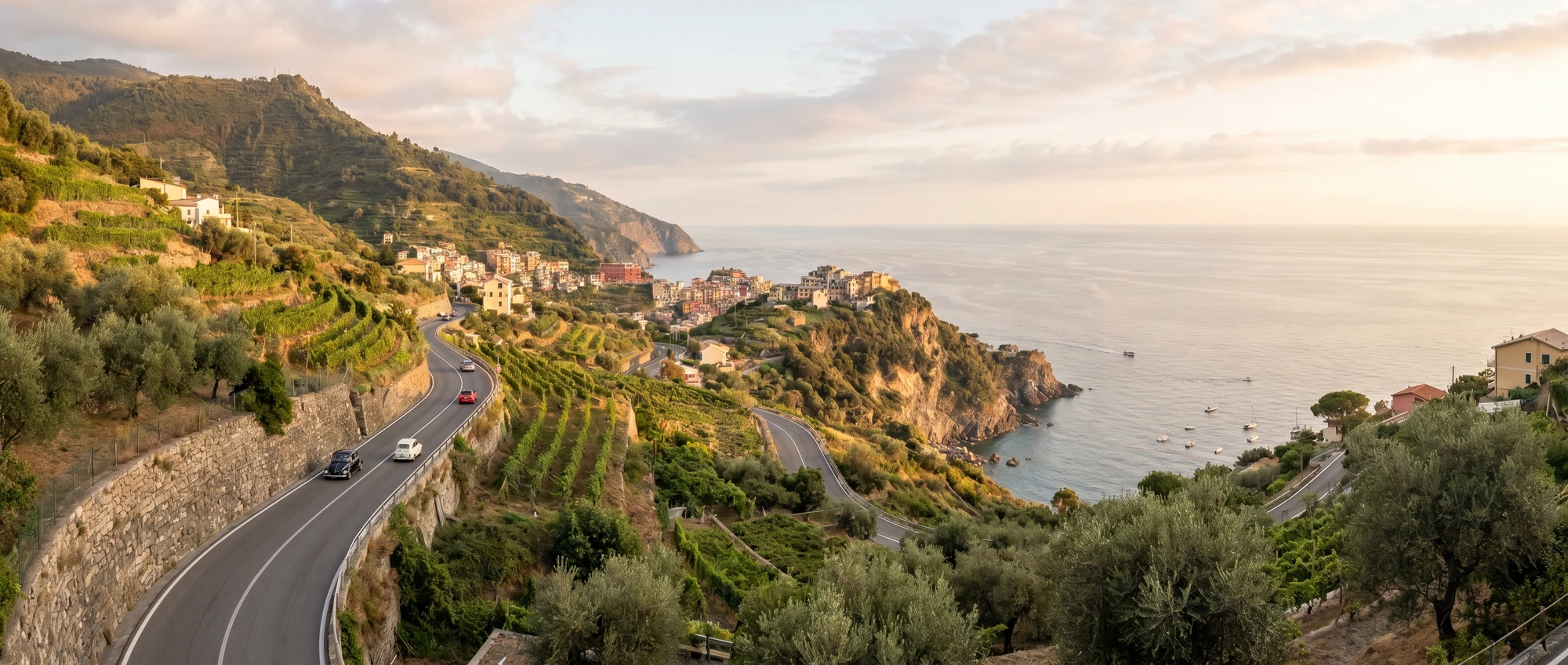
The Cinque Terre — “five lands” — is five fishing villages pinned to a cliff-backed stretch of the Ligurian coast between Genoa and Pisa, joined by a train that tunnels between them in two or three minutes and by the Blue Trail walking path strung above the sea. The whole point is that you don’t drive: cars are banned or useless in the villages, so the trip is built around the Cinque Terre Express train and a walking pass, and you treat the five as one long linear town. Base yourself in one village, ride the train freely with the Cinque Terre Card, and you can see the lot in a couple of days.
The honest part is that the famous trails are not all open. In mid-2026 the Blue Trail is broken in two places — Manarola to Corniglia is shut by a long-running landslide and Monterosso to Vernazza closed after a wall collapsed in heavy February rain — so the reliable on-foot link is the Corniglia–Vernazza–Monterosso stretch, while the train covers the gaps. The good news is the Via dell’Amore, the one-kilometre cliff path between Riomaggiore and Manarola, has reopened and is now folded into the Cinque Terre Card. Check the national park’s trail status before you bank on any particular walk; conditions here genuinely change between seasons.
Where you sleep shapes the trip. Monterosso is the easy choice — flat streets, the only real beach, and room to swing a suitcase. Vernazza is the prettiest harbour and books out first, so reserve months ahead. And if you want the quiet, Corniglia sits up on a clifftop with no harbour, which means the boats and tour groups skip it entirely; the price is 300-odd steps up from the station. Go in May, June, September or early October — the villages hold about 4,000 people but take 2.5 million visitors a year, and July and August are a cruise-ship crush you don’t need.
The route
There's no loop to drive here — the Cinque Terre is one linear coast and the Express train is your spine. This is a relaxed two-to-three-night plan that sees all five villages on foot and by train, timed so you're walking the trails in the cool morning and watching sunset over a harbour rather than queueing behind a tour group. Train hops between villages are two to four minutes; trail times assume an unhurried pace with photo stops.
-
Day 1
Arrive & settle into your base
Get in by train via La Spezia or Levanto (forget about driving — there's nowhere to park). Pick up your Cinque Terre Card at the station, drop your bags, and spend the afternoon in your home village. If you're in Riomaggiore, walk down to the harbour at golden hour; the pastel houses stacked above the water are the classic first impression of the Cinque Terre.
-
Day 2
Hike the open trails, train the closed gaps
Start early — by 9am the Blue Trail fills up. Walk the Corniglia–Vernazza–Monterosso stretch (the most reliably open section in 2026, roughly 3–4 hours of real cliff-path walking), then hop the train back. Where landslides have shut a section (Manarola–Corniglia, Monterosso–Vernazza), the train tunnels through in minutes, so a closed trail never strands you.
-
Day 3
The Via dell'Amore, Corniglia & a slow finish
Walk the reopened Via dell'Amore, the one-kilometre cliff path between Riomaggiore and Manarola — now included in the Cinque Terre Card with no separate ticket. Climb the 300-odd steps up to clifftop Corniglia (or take the shuttle bus) for the quietest village and the best vineyard views, then end with an aperitivo and a cone of fritto misto before you head out.
Where to base yourself
Pick one or two bases rather than moving every night.
Monterosso al Mare
££ mid-rangeThe most practical base: the only proper sandy beach in the Cinque Terre, the flattest streets and the widest choice of restaurants and hotels. It's split into an old town and a newer beach quarter, so it feels more like a small resort than a fishing village — which is exactly why families and anyone hauling a suitcase should start here.
Best for: First-timers with luggage, beach days, families
Vernazza
£££ premiumThe prettiest of the five — a natural harbour ringed by stacked pastel houses, with a little square that's pure postcard. It also books out first and has the fewest rooms, so reserve months ahead. It's the one village from which, in 2026, you can still walk to a neighbour on each side (Corniglia and, conditions permitting, Monterosso).
Best for: The view, photographers, romance
Corniglia
££ mid-rangeThe clifftop outlier: no harbour, so boats can't dock and tour groups thin out, leaving the quietest, most residential pace of the five. The catch is the 300-plus-step Lardarina staircase (or a shuttle bus) up from the station — fine with a daypack, a slog with a wheelie case. Best vineyard views and the calmest evenings.
Best for: Peace and quiet, walkers, light packers
Getting around Cinque Terre
The Cinque Terre Express train is the backbone — it runs every 15–30 minutes and tunnels between the five villages in two to four minutes each, so a closed walking trail never strands you. Get the Cinque Terre Treno Card (around £20/€23 a day in 2026) for unlimited Express rides plus the trail network; the cheaper Trekking Card covers paths only if you don't plan to train-hop much. Cars are a non-starter — the villages are pedestrianised or unreachable, and parking is scarce and pricey at La Spezia or Levanto on the edge. Passenger ferries link four of the villages (not clifftop Corniglia) in summer and are the prettiest way to see the coast from the water, though they're slower and weather-dependent.
Book the essentials
Where to stay
Tours & tickets
Airport transfers
Car hire
Stay connected
Cinque Terre FAQs
How many days do you need in the Cinque Terre?
Is the Cinque Terre Card worth it?
Are the Cinque Terre hiking trails open?
What is the best time to visit the Cinque Terre?
Ready to book?
Compare car hire