Chubu
Japanese Alps
The old-Japan loop through the Chubu mountains for UK travellers: Matsumoto, Takayama, Kamikochi and Shirakawa-go, how the buses and trains actually connect, real yen costs in pounds, and why the season you go in decides the whole trip.
In short
Japanese Alps at a glance
The Japanese Alps are the mountainous middle of Honshu — the Chubu region — where you swap Tokyo's neon for castle towns, thatched farmhouses and a glacial valley you reach only by bus. The standard loop strings together Matsumoto (a black castle), Kamikochi (the Alps' showpiece hiking valley), Takayama (the best-preserved old town in central Japan) and the UNESCO village of Shirakawa-go. It links the two main lines into the mountains — the Azusa from Tokyo to Matsumoto and the Hida from Nagoya to Takayama — so you can arrive one way and leave the other without backtracking. Allow five nights for the full arc, three if you drop either Matsumoto or Kamikochi.
The Japanese Alps are the old-Japan that gets squeezed out of a first Tokyo–Kyoto trip: a knot of 3,000-metre peaks across the Chubu region, with castle towns, thatched farmhouses and a car-free glacial valley wedged between them. The classic route is an arc — Matsumoto for the black castle, Kamikochi for the hiking, Takayama for the best-preserved Edo old town in central Japan, and the UNESCO village of Shirakawa-go to finish. The neat trick is that two different railways feed the mountains: the Azusa runs up from Tokyo to Matsumoto in the east, and the Hida runs up from Nagoya to Takayama in the west. Arrive on one and leave on the other and you loop the whole region without ever retracing a step.
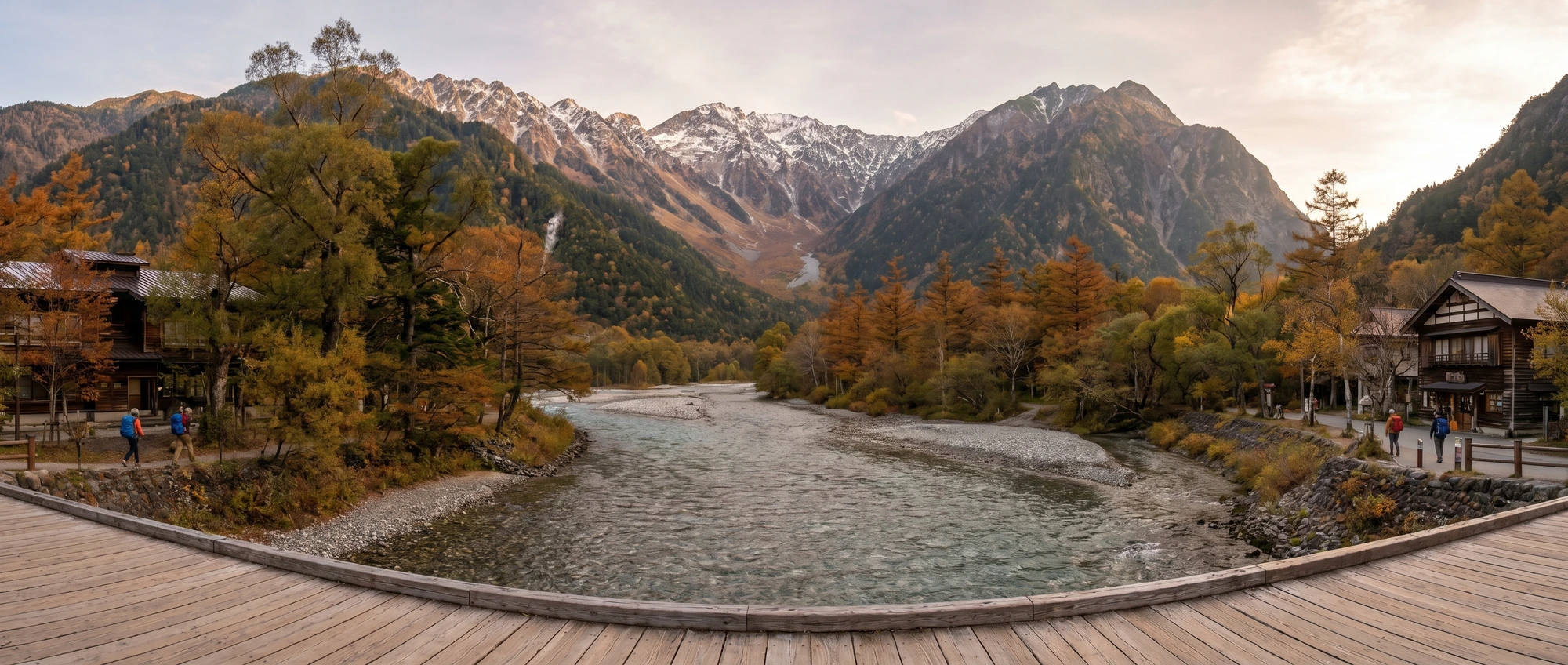
The thing that catches people out is the season. Kamikochi — the valley most travellers come for — closes to buses and lodges from roughly mid-November to mid-April under deep snow, and bans private cars all year, so you change to a park shuttle at Sawando or Hirayu whatever the date. October is the prize, when the larches turn gold around Kappa Bridge; late April to May gives you snow-melt greenery and fewer crowds. If you turn up in the winter shoulder expecting the headline valley, you’ll find it shut. Build the trip around when Kamikochi is open, then slot the towns around it.
Inside the region the trains stop and the buses take over, and that’s where the Japan Rail Pass runs out: the Azusa and Hida are covered, but the Alpico bus to Kamikochi and the Nohi bus to Shirakawa-go (about ¥2,800 and 50 minutes from Takayama) are not. Don’t hire a car — Kamikochi won’t let you drive in and Takayama’s old town is for walking. Base yourself in Takayama, do Shirakawa-go as a half-day rather than an overnight unless you’ve booked a farmhouse months ahead, and price the regional Alpine-Takayama-Matsumoto pass against your exact legs before you buy each ticket separately.
The route
A five-night arc that uses both mountain railways so you arrive from Tokyo and leave towards Nagoya (or Kanazawa) without a single backtrack. Times below are limited-express and bus estimates; the Hida and Azusa are both covered by the Japan Rail Pass, but the Nohi and Alpico mountain buses are not.
-
Days 1–2
Matsumoto
Take the Azusa limited express from Shinjuku (about 2h40). The black-and-white keep of Matsumoto Castle is the original 1590s structure, not a concrete rebuild — entry is ¥1,300 (~£7) paper or ¥1,200 by app. Spend a half-day on the castle and the Nakamachi merchant lanes, then use the second day for the city or a Daiō wasabi-farm cycle.
-
Day 3
Kamikochi
Bus from Matsumoto via the Kamikochi Line, changing to the park shuttle at Sawando (around 1h40 all in). Private cars are banned, so everyone arrives by bus. Walk the flat riverside path from Kappa Bridge to Myojin Pond and back — about 2 to 3 hours, no climbing needed. Sleep in Takayama or back in Matsumoto; the valley's few lodges book out far ahead.
-
Days 4–5
Takayama
Reach Takayama over the Abō Pass bus (or loop back via Matsumoto). This is the trip's best base: free Edo-era old town, the riverside morning markets from 7am, sake breweries you can taste at, and Takayama Jinya — the only surviving Edo government house in Japan — for ¥440. Hida Folk Village (open-air farmhouses) fills a half-day if it rains.
-
Day 6
Shirakawa-go
Hourly Nohi bus from Takayama, about 50 minutes and ¥2,800 one way (reserve a seat in peak season). Walk the gassho-zukuri thatched village, climb to the Shiroyama viewpoint, and head back by mid-afternoon — or carry on west to Kanazawa on the same bus line to end the trip on the coast.
Where to base yourself
Pick one or two bases rather than moving every night.
Takayama (old town / station side)
££ mid-rangeThe single best base for the region: walkable Edo streets, the morning markets, and the hourly bus hub for Shirakawa-go and Kamikochi. Stay near Sanmachi for atmosphere or by the station for early buses. A ryokan night here, with Hida-beef kaiseki and a private onsen, is the splurge to plan around.
Best for: Main base, old town, bus connections, a ryokan night
Matsumoto (around the castle / Nawate)
££ mid-rangeThe natural first stop off the Azusa from Tokyo and the launch point for Kamikochi. Base near the castle and Nakamachi lanes; it's a real working city, so cheaper and less touristy than Takayama, with good izakaya and an easy castle stroll.
Best for: Arrival from Tokyo, Kamikochi launchpad, value
Hirayu Onsen
££ mid-rangeA small hot-spring village on the mountain pass between Matsumoto and Takayama and the bus interchange for Kamikochi and the Shinhotaka Ropeway. Stay here if you want an onsen night in the mountains themselves rather than in a town, and to be first on the morning Kamikochi shuttle.
Best for: Onsen, early Kamikochi access, between the two main towns
Getting around Japanese Alps
Two limited expresses get you into the mountains and are both covered by the Japan Rail Pass: the Azusa (Shinjuku–Matsumoto, ~2h40) and the scenic Hida (Nagoya–Takayama, ~2h15). Inside the region, though, you're on buses the rail pass doesn't cover — Alpico for Matsumoto–Kamikochi (you must change to the car-free park shuttle at Sawando), and Nohi for Takayama–Shirakawa-go (about ¥2,800, hourly, reserve in peak season). A hire car is pointless: Kamikochi bans private vehicles outright and Takayama's old town is for walking. If you're doing the whole loop, the regional Alpine-Takayama-Matsumoto pass can undercut buying each leg separately — price it against your exact route before committing.
Book the essentials
Where to stay
Tours & tickets
Airport transfers
Stay connected
Trains & rail passes
Japanese Alps FAQs
How many days do you need for the Japanese Alps?
Can you visit Kamikochi in winter?
Do you need a car in the Japanese Alps?
How do you get from Takayama to Shirakawa-go?
Ready to book?
Book experiences