Chubu
Kenroku-en
One of Japan's three great landscape gardens, in the heart of Kanazawa — why the early-opening hour makes or breaks the visit, and what you actually see.
Where
Kanazawa, Japan
Opening hours
Broadly open daily, with longer hours in the warmer months (around 07:00–18:00) and shorter ones in winter (around 08:00–17:00); a free early-morning admission window often runs before official opening. Hours and the free window shift seasonally, so confirm current hours and prices on the official site.
Tickets
Admission is a token sum — around ¥320 (roughly £1.70) for adults at the time of writing, with over-65s and young children typically free. There is often a free early-morning entry window. Confirm current hours and prices on the official site.
Time needed
Allow about 60–90 minutes to walk the main loops at a relaxed pace; longer if you stop at a teahouse or pair it with neighbouring Kanazawa Castle.
In short
Visiting Kenroku-en
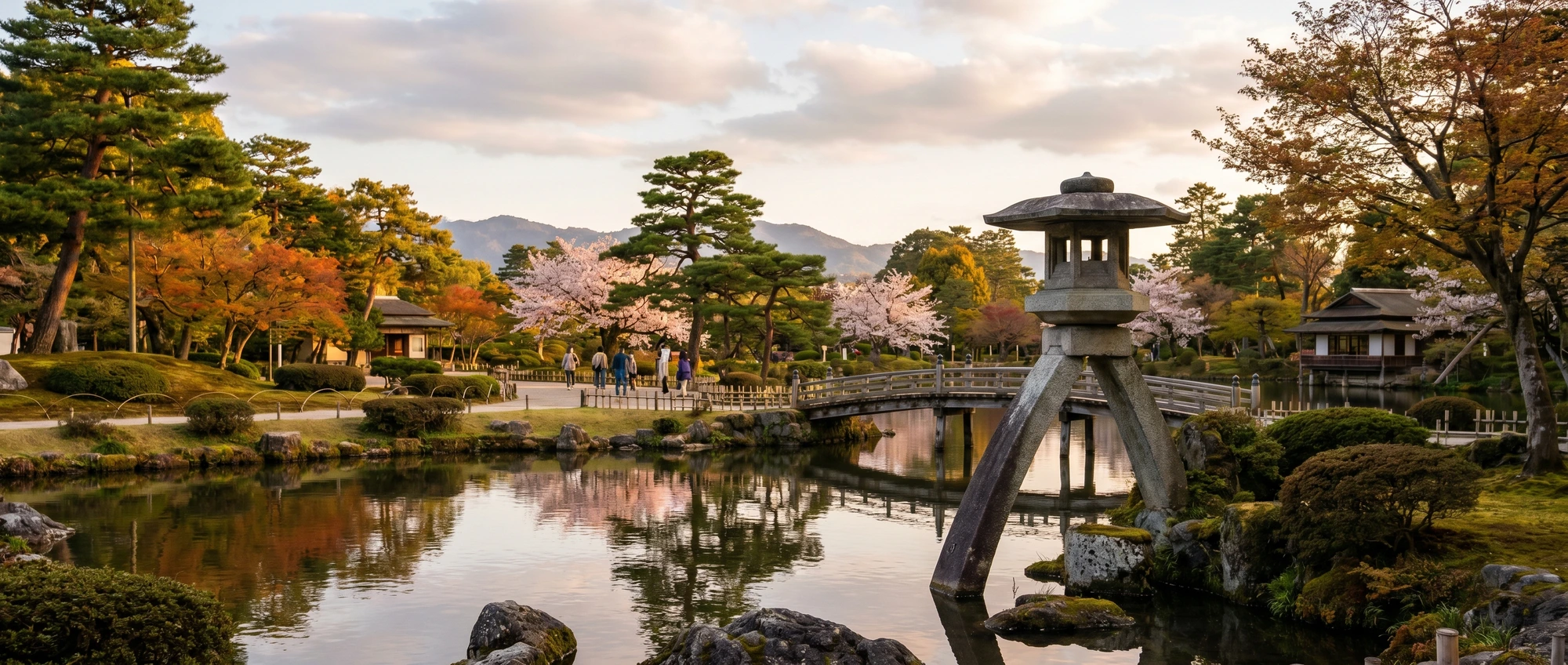
Kenroku-en is one of Japan's three great landscape gardens and the main reason most people stop in Kanazawa. Entry is a token sum, so the real currency is timing: arrive at opening for soft light and quiet paths, or face a coach-park shuffle. Expect ponds, teahouses, the famous Kotoji stone lantern and seasonal colour rather than a single headline sight.
What you are walking into
Kenroku-en is reckoned one of Japan’s three great landscape gardens, and for most travellers it is the single reason to break a journey in Kanazawa. Do not arrive expecting one headline monument: this is a composed landscape, a few hectares of ponds, winding streams, manicured pines, teahouses and framed viewpoints meant to be walked slowly and read like a series of pictures. Its signature image is the Kotoji stone lantern on two splayed legs beside Kasumigaike pond — the shot you will already have seen.
The garden also rewards the season you catch it in. Plum and cherry blossom in spring, deep greens and irises in summer, fierce maple colour in autumn, and in winter the yukitsuri — the rope cones rigged over the pines to hold snow — turn it into something unmistakably Japanese.
Go at opening, and it is barely a cost
Here is the practical heart of it. Entry is a token sum — around ¥320, roughly £1.70, with over-65s and small children usually free — so price is not the variable that matters. Timing is. Arrive at opening and you get soft early light and near-empty paths; turn up mid-morning and you join the coach parties for a shuffling loop that flattens the whole experience. There is also frequently a free early-morning admission window before official opening, which is the connoisseur’s move.
Allow 60 to 90 minutes for the main loops, more if you pause at a teahouse for matcha. It sits right beside Kanazawa Castle, so the two pair naturally into a morning. Hours and that free window shift with the season, so confirm them on the official site before you set out — but the rule of thumb never changes: be at the gate when it opens.
Planning the rest of your trip? See the Kanazawa city guide.
More to see in Kanazawa
Book the essentials
Tours & tickets
Kenroku-en FAQs
Why does the opening time matter so much at Kenroku-en?
How much does it cost to enter Kenroku-en?
What is there to see inside the garden?
Ready to book?
Check tickets & tours