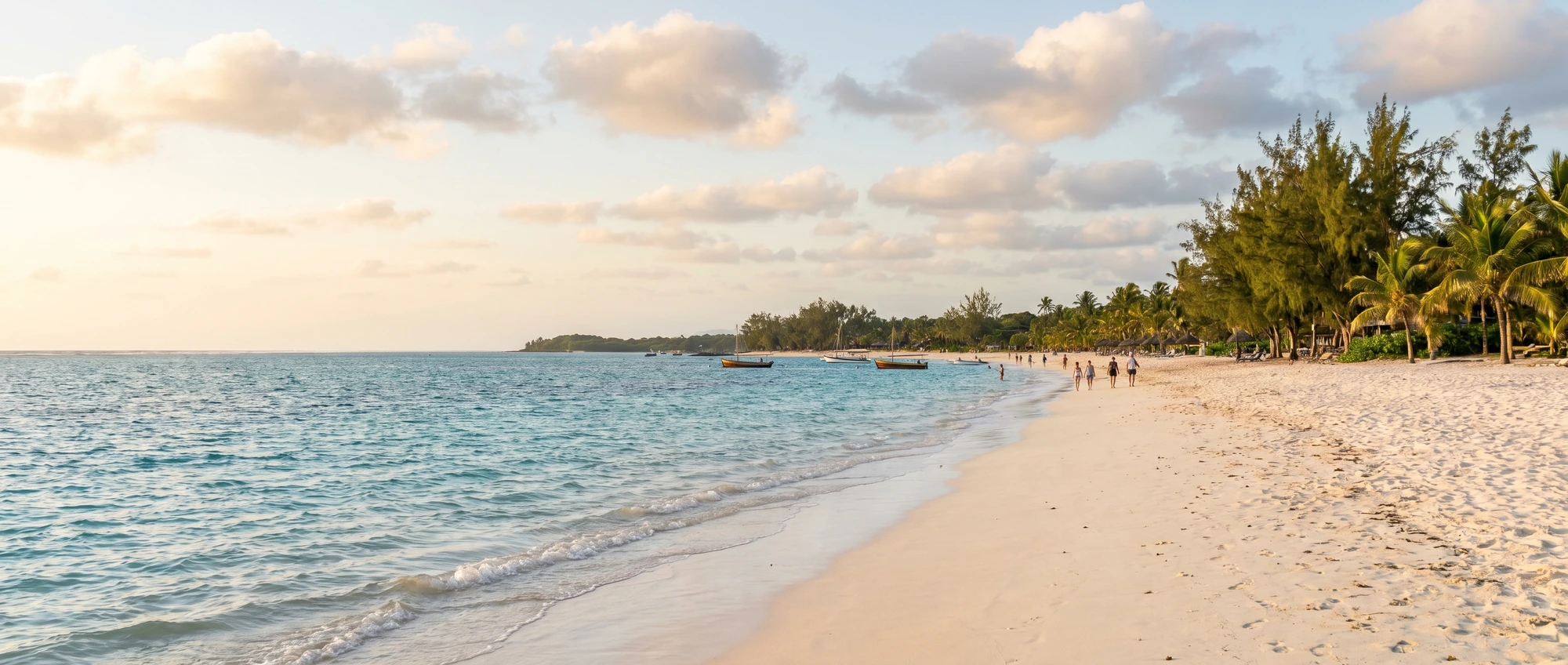
East Coast, Mauritius
Belle Mare
An honest UK guide to Belle Mare: Mauritius's quiet east-coast luxury strip — the long white-sand lagoons, the Île aux Cerfs boat trips, and why the wind in July–August is the thing nobody warns you about.
In short
Belle Mare at a glance
Belle Mare is the long, quiet sweep of white-sand lagoon down the middle of Mauritius's east coast, between Trou d'Eau Douce and Poste de Flacq. It's the island's upmarket beach strip — a run of five-star resorts and spas with the calmest, palest water on the island and far fewer crowds than busy Grand Baie up north. The catch nobody flags at booking is the wind: the east faces the southeast trade winds, so in the cool dry months of July and August it can be genuinely breezy and a few degrees cooler. Come in the warm shoulder months and you get the best beach on the island with the space to enjoy it; the headline day out is the boat trip to Île aux Cerfs, 10 minutes offshore.
Belle Mare is the part of Mauritius you book when you want the island’s best beach without the crowds: a long, unbroken sweep of white sand and pale lagoon down the middle of the east coast, lined with five-star resorts and spas rather than the bars and boat touts of Grand Baie up north. It has two quiet advantages first-timers underrate — it’s the shortest premium-beach transfer from the airport, about 45 minutes, and the Île aux Cerfs boat trip launches from Trou d’Eau Douce at the south end of the strip, ten minutes offshore.
The thing nobody flags at the point of booking is the wind. The east coast faces straight into the southeast trade winds, so the cool dry months of July and August — exactly when many UK families travel — can be genuinely breezy and a few degrees cooler than the sheltered north. That doesn’t make it a mistake; it makes timing the whole game. Come in the warm shoulder months of November or April–May and you get the calmest, palest water on the island with the space to enjoy it. Treat Belle Mare as a settle-in base, not a touring one: pick one resort, then day-trip to the south’s scenery and the capital from there.
The route
Belle Mare isn't a touring base — it's a settle-in beach week where you pick one resort and day-trip from it. This is a relaxed 5-day skeleton built around the east coast with a hire car or fixed-price taxis: beach recovery from the flight, the island-classic boat trip, the wild south, and a half-day in the capital. Drive times are real east-coast estimates on Mauritian roads.
-
Days 1–2
Land and settle on the lagoon
You land at MRU in the southeast and it's only about 45 minutes up to Belle Mare — the shortest premium-beach transfer on the island. After a ~12-hour flight and a 3–4 hour time jump, do nothing on day one but the beach and an early night. Use day two for the lagoon, snorkelling off the sand and finding the nearest supermarket in Centre de Flacq, about 10 minutes inland.
-
Day 3
Île aux Cerfs boat trip
The signature east-coast day out: a catamaran or speedboat to Île aux Cerfs, the picture-postcard islet just 10 minutes offshore from Trou d'Eau Douce (about 15 minutes' drive south of Belle Mare). Book through an operator with a Ministry of Tourism permit and check the boat carries enough life jackets (GOV.UK). A smaller speedboat costs more than the big group catamarans but skips the crowds.
-
Day 4
The wild south and Chamarel
Drive south and inland — about 1h30 to Le Morne and the Black River Gorges National Park for forest walks and viewpoints, plus Chamarel for the Seven Coloured Earths and waterfall. This is the scenic, un-resort half of the island. A full day with a hire car, or a fixed-price taxi day at ~₨3,000–5,000 (~£47–78).
-
Day 5
Port Louis and a slow finish
It's about an hour across to the capital, Port Louis, for the Central Market, the Caudan waterfront and the Aapravasi Ghat UNESCO site. Keep the back half of the day light for the beach and packing — the airport transfer and checkout eat into departure day, so don't plan a big excursion for the flight home.
Where to base yourself
Pick one or two bases rather than moving every night.
Belle Mare beach (Poste de Flacq end)
£££ premiumThe northern stretch of the strip, with the longest unbroken white-sand lagoon and the biggest cluster of five-star resorts and spas. This is the postcard Belle Mare — quiet, polished and very much an in-resort holiday, with the supermarket and ATMs a short drive inland at Centre de Flacq.
Best for: Luxury, calm, in-resort beach days
Trou d'Eau Douce (south end)
££ mid-rangeThe fishing village at the south of the strip and the launch point for Île aux Cerfs boats. More local, more affordable and walkable than the resort row, with small Creole restaurants and guesthouses — the better base if you want a village feel and the boat trips on your doorstep rather than a sealed resort.
Best for: Boat trips, value, a village base
Palmar & Belle Mare south
££ mid-rangeThe quieter middle of the coast, between the big resorts, with a mix of mid-range hotels and self-catering villas a short walk or drive from the public beach. A good compromise if you want the east-coast lagoon without the five-star price, and it keeps the south's scenery and the boat jetty within easy reach.
Best for: Self-catering, mid-range stays, families
Getting around Belle Mare
There's no train and no airport bus on this coast, so it's a hire car or fixed-price taxis. A hire car (~£25–40/day) is the one that unlocks the south and the capital; you drive on the left like the UK, and the east-coast roads are quiet bar the busy Centre de Flacq junctions. If you'd rather not drive, taxis work on negotiated fixed prices agreed before you set off — a short hop to Trou d'Eau Douce is ₨500–700 (~£8–11) and a full-day island tour ₨3,000–5,000 (~£47–78). The local buses run inland via Centre de Flacq, are nearly free at ₨15–35 (~£0.25–0.50) and reach Port Louis, but they're slow and stop in the early evening, so they're a budget tool rather than a convenience. For the airport, pre-book a private transfer (~₨1,500–2,500, ~£23–39 per car) rather than haggling in arrivals after the 12-hour flight.
Book the essentials
Where to stay
Tours & tickets
Airport transfers
Car hire
Stay connected
Belle Mare FAQs
Where is Belle Mare and how far is it from the airport?
Is Belle Mare windy, and when should I go?
How do I get to Île aux Cerfs from Belle Mare?
Ready to book?
Compare car hire