Marrakech-Safi
Sahara Desert (Merzouga & Erg Chebbi)
The honest guide to Morocco's big dunes: why Erg Chebbi at Merzouga beats Zagora, what a 3-day tour from Marrakech actually involves, real costs in pounds and the months worth booking.
In short
Sahara Desert (Merzouga & Erg Chebbi) at a glance
Erg Chebbi at Merzouga is the Morocco postcard everyone wants: a sea of orange dunes rising to 150m, reached by camel for a night in a desert camp. The catch is the distance. Merzouga is 560km and a full 9–10 hours' drive from Marrakech over the Tizi n'Tichka pass, so the honest minimum is a 3-day loop — two long driving days bookending the dunes. Do not let anyone sell you a 2-day Merzouga run from Marrakech: that's two days mostly in a minibus for a few hours of sand. If you only have two days, do Zagora instead (closer, but rocky and not the big dunes) or fly the loop differently. From Fez the desert is closer, so a Fez-start tour can be the smarter pairing. Go in spring or autumn — summer routinely tops 45°C and no decent operator camps in July or August.
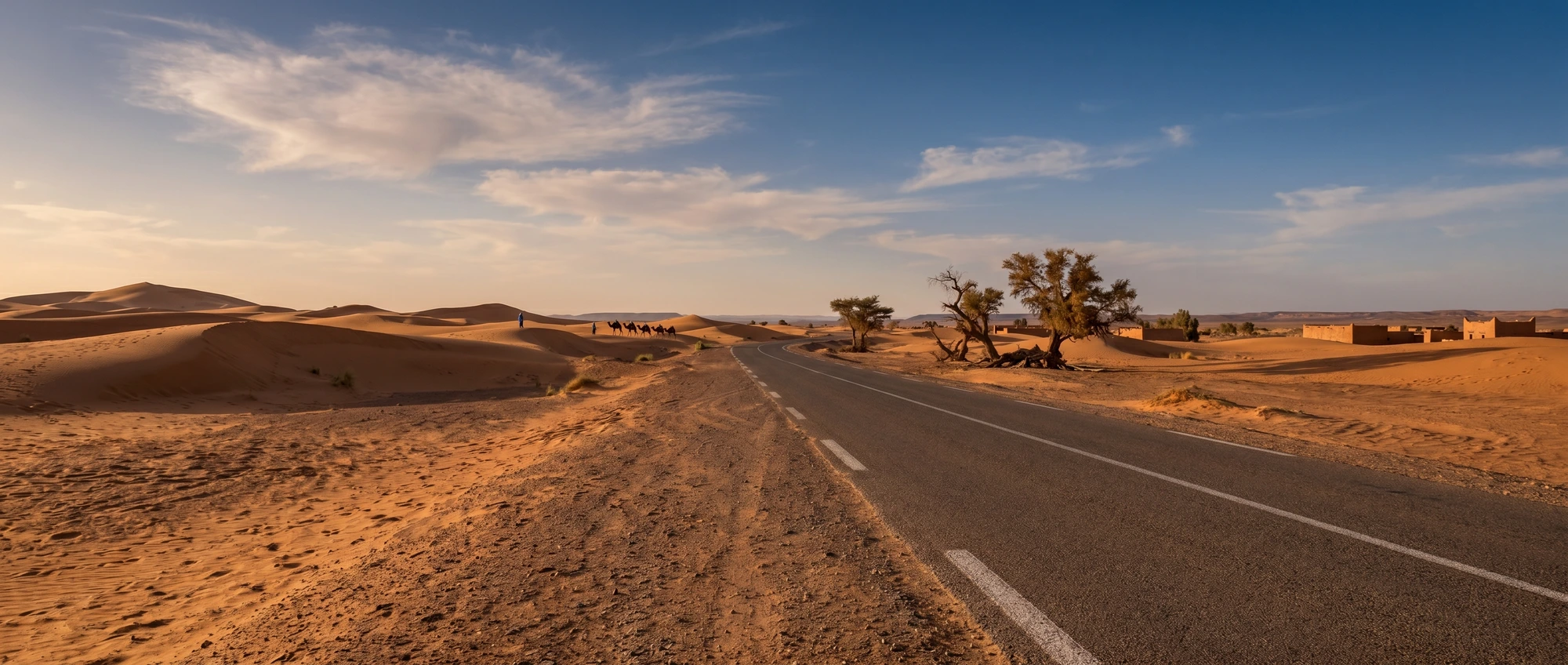
The dune sea you’ve seen on every Morocco poster is Erg Chebbi, a 20-odd-kilometre run of orange sand rising to 150m at the village of Merzouga, hard against the Algerian border. Getting there is the whole story: it’s 560km and a full 9–10 hours from Marrakech, climbing the Tizi n’Tichka pass — North Africa’s highest paved road at 2,260m — before the landscape unspools through Aït Benhaddou’s mud-brick kasbah, the Todra Gorge and the Valley of Roses. That distance is why the only sensible version is a 3-day loop: two long driving days either side of one night in the dunes. The 2-day Merzouga tours sold off Marrakech’s streets are a trap — they’re almost entirely minibus for a couple of hours of sand.
If two days really is your limit, the closer Zagora desert (6–7 hours out) is the fallback, but be clear-eyed: Zagora is rocky scrub with modest dunes, not the cinematic Sahara. Merzouga is the one worth the drive. A neater trick, if your wider route allows, is to start from Fez instead — the dunes are about 90km nearer — and do a one-way Fez-to-Marrakech desert tour so you cross the Atlas once rather than doubling back through both imperial cities.
On cost, a shared small-group 3-day tour lands around £80–130 per person including the camp, camel ride and most meals; a private tour for two runs roughly £425–765 for your own driver and pace, and luxury 4x4-and-ensuite-camp options start near £425 each. Go in spring or autumn — March–May or September–November — when days sit at a workable 25–35°C and the nights merely cool rather than baking or freezing. Summer tops 45°C and no decent operator camps in July or August. Whatever the month, pack warm layers: desert nights drop sharply, and check your travel insurance actually covers the camel trek.
The route
The standard, sensible version is the 3-day loop out of Marrakech — the only length that gives you a proper night in the dunes without spending the whole trip in transit. Day 1 and Day 3 are big driving days; Day 2 is the payoff. Times below are drive times with the usual photo and mint-tea stops. From Fez the same loop runs in the opposite direction and shaves a couple of hours off the desert legs.
-
Day 1
Marrakech → Aït Benhaddou → Dades
A 7am start and 6–7 hours of driving: over the Tizi n'Tichka pass (2,260m, North Africa's highest paved road) to the UNESCO mud-brick ksar of Aït Benhaddou — the film-set kasbah from Gladiator and Game of Thrones — then on through Ouarzazate and the Valley of Roses to an overnight in the Dades Valley or Kelaa M'Gouna. Expect frequent photo stops; the scenery does the heavy lifting on this leg.
-
Day 2
Dades → Todra Gorge → Erg Chebbi camp
A shorter driving day (4–5 hours) through the Todra Gorge, where 300m cliffs squeeze a palm-shaded river, then east via Tinghir and Erfoud to Merzouga. You swap the minibus for a camel in the late afternoon and ride into the Erg Chebbi dunes for sunset, dinner under the stars and Berber drumming, sleeping in a desert camp. This is the day everyone comes for.
-
Day 3
Sunrise dunes → long drive back to Marrakech
Climb a dune for the Sahara sunrise, ride the camels back for breakfast, then face the longest leg: 8–9 hours back to Marrakech, usually via the Draa Valley. You'll arrive tired and dusty around 8pm. Book a hammam for the next morning — your legs and lungs will thank you.
Where to base yourself
Pick one or two bases rather than moving every night.
Merzouga desert camp (Erg Chebbi)
££ mid-rangeThe whole point of the trip: a tented camp pitched among the dunes, reached by camel or 4x4. Standard camps are basic — shared facilities, mattress on the floor, a fire and a tagine. Luxury camps add private ensuite tents, proper beds, heating or AC and a generator, and are worth the upgrade for the cold nights and the loos. Either way you're there for the silence and the stars, not the thread count.
Best for: The night you came for — book through your tour
Dades Valley / Kelaa M'Gouna (en route)
£ valueWhere almost every 3-day tour stops on night one — a string of small guesthouses and hotels in the rose-growing valley below the Dades Gorge. Functional rather than special, but it breaks the drive sensibly and the gorge road above it is a highlight in its own right. You won't choose this yourself; the operator picks it.
Best for: Breaking the day-one drive
Merzouga or Hassi Labied village (independent base)
££ mid-rangeIf you'd rather skip the tour and base yourself near the dunes for a few nights, the villages of Merzouga and Hassi Labied have kasbah-style hotels and guesthouses right at the sand's edge, many with their own camel treks and camps. Better for slow desert days, stargazing and avoiding the convoy crowds — but you'll need a hired driver or a long self-drive to reach them.
Best for: A multi-night, slower desert stay
Getting around Sahara Desert (Merzouga & Erg Chebbi)
There is no train and no comfortable self-drive route to the Sahara — the High Atlas passes are long and winding, so the desert loop is an organised tour or a hired driver-guide, full stop. From Marrakech the realistic choices are a shared small-group 3-day tour (cheapest, fixed itinerary, a minibus of strangers), a private 3-day tour or hired 4x4 with driver (more money, your own pace, better camps), or starting from Fez, which is ~90km closer to the dunes and pairs well with a one-way Fez-to-Marrakech routing so you don't double back. Avoid the 2-day Merzouga tours sold from Marrakech: at 9–10 hours each way they're almost entirely driving for a token few hours in the sand. If two days is all you have, do the 2-day Zagora trip instead and accept it's the rocky desert, not Erg Chebbi.
Book the essentials
Where to stay
Tours & tickets
Airport transfers
Car hire
Stay connected
Sahara Desert (Merzouga & Erg Chebbi) FAQs
How many days do you need for the Sahara from Marrakech?
Is Merzouga or Zagora better for the Sahara?
How much does a 3-day Sahara desert tour cost?
When is the best time to go to the Merzouga desert?
Is it better to start the desert tour from Marrakech or Fez?
Ready to book?
Compare car hire