Podlaskie Voivodeship, eastern Poland
Białowieża Forest
How to actually plan a Białowieża trip from the UK: getting to the village without a car, booking the guided Strict Reserve walk, and where to reliably see wild European bison rather than just hoping.
In short
Białowieża Forest at a glance
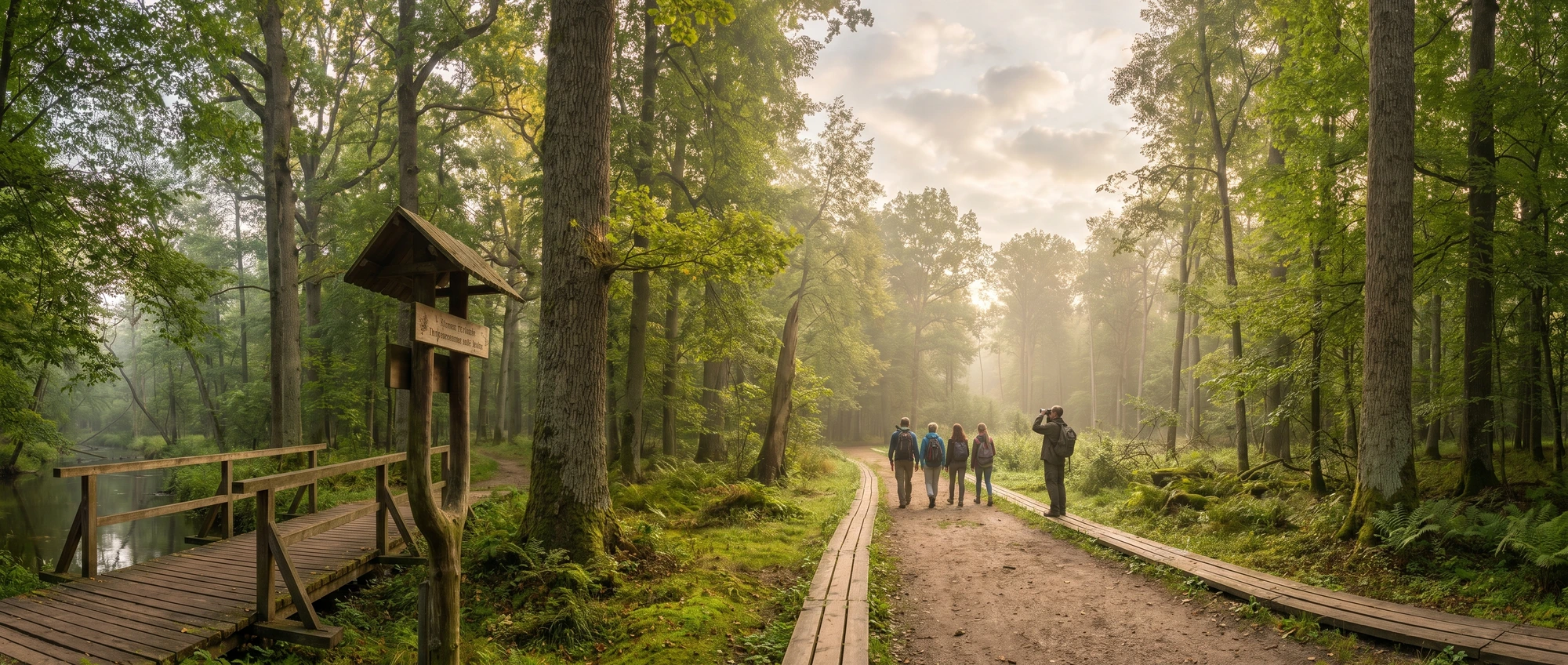
Białowieża is the last big fragment of the lowland forest that once covered the European plain — a UNESCO site of 600-year-old oaks and dead, standing timber straddling the Polish–Belarusian frontier, and the home of the wild European bison, the continent's heaviest land animal. The forest is in two halves people confuse. The Strictly Protected Area (Obszar Ochrony Ścisłej) is the primeval core: you can only walk in with a licensed Białowieża National Park guide, booked ahead, on a roughly 4km, three-hour route through cathedral-like old growth. The rest of the forest — managed woodland laced with marked walking and cycling trails — you can roam freely. To actually see bison, most people go to the European Bison Show Reserve (Rezerwat Pokazowy Żubrów), an enclosure 3km west of the village where bison, wolves, lynx and tarpan-type horses are reliable in any season. Wild herds are a dawn-and-dusk, autumn-and-winter gamble best done with a wildlife guide. Białowieża village is the only sensible base; it's a long way east — about 60km southeast of Białystok and a 3.5-hour drive or train-plus-bus from Warsaw — so plan two nights, not a day trip.
Białowieża is what the European lowlands looked like before the plough — the last big stand of primeval forest on the continent, a UNESCO core of 600-year-old oaks and collapsing, moss-furred timber that runs across the Polish–Belarusian border. It’s also the home of the wild European bison, brought back from extinction here after the First World War. The thing first-timers get wrong is assuming they’ll just drive in and find them: the bison are wild, and the old-growth heart of the forest, the Strictly Protected Area, is sealed off to anyone without a licensed National Park guide. You book that walk ahead — roughly 4km and three hours through cathedral-quiet oak and lime — and it doesn’t run on Mondays, so the trip has to be planned around it rather than turned up to on spec.
The other mistake is treating it as a Warsaw day trip. Białowieża sits right out in the eastern borderland of Podlasie, about 60km southeast of Białystok and a good 3.5 hours by car from Warsaw — or a train to Hajnówka and a connecting bus the last 17km if you’re car-free. That distance is the whole reason to stay two nights in Białowieża village, the only sensible base, with the Palace Park, the Nature and Forest Museum and the marked trails on the doorstep. For a guaranteed sighting, the European Bison Show Reserve 3km west of the village keeps bison, wolves and lynx you can count on seeing; the free-roaming herds are a dawn-and-dusk, autumn-and-winter affair, and worth a guided wildlife safari if seeing them truly wild is the point of the trip.
The route
A two-night break that pairs the guided primeval-core walk with a near-guaranteed bison sighting and a slow day on the marked trails, with the village as your only base. Białowieża is genuinely remote — the last leg from Warsaw is around 3.5 hours by car or a train-and-bus combination via Hajnówka — so treat the journey itself as half of day one rather than trying to do this as a Warsaw day trip.
-
Day 1
Travel in and the Palace Park
Drive or train-and-bus in to Białowieża village (about 3.5 hours from Warsaw, or 1h40 by bus from Białystok). Settle in and walk the open Palace Park around the old Tsarist hunting-estate grounds, calling at the Nature and Forest Museum on the Park's central glade for the bison and old-growth context before the guided walk the next morning.
-
Day 2
The guided Strict Reserve walk and the Bison Reserve
Take the morning guided walk into the Strictly Protected Area — booked ahead, roughly 4km and three hours through 600-year-old oaks and lime trees with a National Park guide (it does not run on Mondays). In the afternoon head 3km west to the European Bison Show Reserve to be sure of seeing bison, wolves and lynx, then try a guided dawn or dusk wildlife drive if you want a shot at the truly wild herds.
-
Day 3
Trails, the Narrow-Gauge railway, then out
Spend the morning on the freely accessible side of the forest — hire a bike for the marked trails, or ride the seasonal Hajnówka narrow-gauge forest railway that runs tourist services into the woods in summer. Drive or bus back towards Białystok and Warsaw in the afternoon for an onward connection or a night in the city before flying home.
Where to base yourself
Pick one or two bases rather than moving every night.
Białowieża village
££ mid-rangeThe only practical base, and a good one: a single low-rise village strung along the road by the National Park entrance, the Palace Park and the museum, with the marked trails and the Bison Show Reserve within a few kilometres. Hotel Żubrówka is the main spa hotel; otherwise it's family guesthouses and agritourism rooms (pokoje gościnne) that book out fast in the autumn rut and over summer weekends.
Best for: First-timers, the guided walks, walking and cycling on the doorstep
Hajnówka
£ valueThe small town 17km west where the trains terminate and the seasonal narrow-gauge forest railway starts. It has cheaper rooms and the Orthodox church heritage of the Podlasie borderland, but it sits outside the forest itself, so you'll be commuting in. Worth it only if Białowieża is full or you're relying on the rail connection.
Best for: Budget rooms, rail arrivals, the narrow-gauge railway
Białystok
££ mid-rangeThe regional capital, about 60km northwest, with proper hotels, restaurants and the Branicki Palace. Too far for repeated forest visits — it's a 1h40 bus each way — but a useful first or last night if you're arriving late or treating Białowieża as one stop on a wider Podlasie loop.
Best for: City comforts, transport hub, an arrival or departure night
Getting around Białowieża Forest
A hire car is much the easiest way to reach and explore Białowieża: it's about 3.5 hours from Warsaw or a touch over an hour from Białystok on quiet roads, and a car lets you reach the Bison Show Reserve, the trailheads and a dawn wildlife spot on your own schedule. Remember to drive on the right. Without a car it's still doable but slower — take a train from Warsaw or Białystok to Hajnówka, then the connecting PKS bus the last 17km into Białowieża, or a direct bus from Białystok that takes about 1h40; check return times carefully, as evening services thin out. Within the village everything bar the Strict Reserve is walkable or cyclable, and bike hire is the local way to cover the flat, marked forest trails. The primeval core itself is closed to private cars and bikes — you only enter it on foot with a licensed National Park guide, on horseback, or by the traditional horse-drawn cart, all booked through the Park.
Book the essentials
Where to stay
Tours & tickets
Airport transfers
Car hire
Stay connected
Trains & rail passes
Białowieża Forest FAQs
How do you get to Białowieża from Warsaw without a car?
Can you actually see wild bison in Białowieża?
Do you need a guide for Białowieża Forest?
When is the best time to visit Białowieża?
Ready to book?
Compare car hire