Southern Sri Lanka
South Coast
The Galle-to-Tangalle beach belt where most UK beach weeks land: the £2 coastal train, which town to base in, blue-whale season off Mirissa and why you should never self-drive here.
In short
South Coast at a glance
The South Coast is where most first-time UK trips to Sri Lanka end up flopping on a beach, and it strings together neatly along one road and one slow train line. The belt runs Galle → Unawatuna → Weligama → Mirissa → Tangalle, roughly 80km of palm-backed bays, with the historic Dutch fort of Galle as its anchor and the whale-watching port of Mirissa as its headline. It only works December to April — in the May–September south-west monsoon the sea here turns rough and the east coast takes over — and you do it without a hire car, using the coastal train and a driver. Allow 4–5 nights to enjoy it properly, or treat it as the relaxing tail end of the classic island loop.
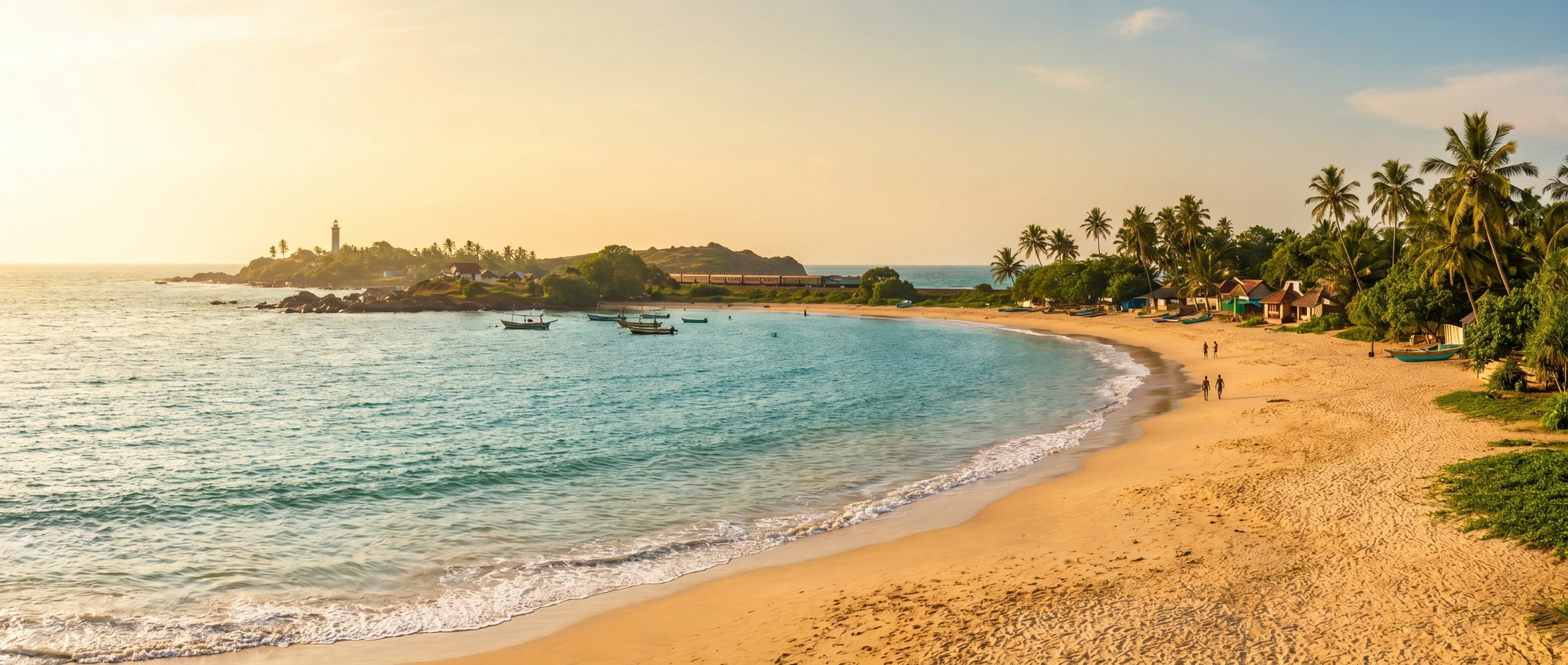
The South Coast is the bit of Sri Lanka most people are actually picturing when they book the trip: a thin ribbon of palm-backed bays running east from the old Dutch port of Galle through Unawatuna, Weligama and Mirissa to the quiet sands around Tangalle. It’s the relaxing tail end of the classic island loop — you come down off the hill-country train, swap tea plantations for surf and whales, and spend your last few nights doing very little. Because it’s all strung along one road and one slow coastal railway, it’s far easier to travel than the inland legs, and you rarely need to move base more than once.
The mistake first-timers make is timing it wrong, and the second is treating the towns as one undifferentiated “beach”. This coast only works December to April; in the May–September south-west monsoon the sea here turns rough and grey and you’d be far happier on the east coast instead. And the towns are genuinely different — Galle is for the fort and the food rather than swimming, Unawatuna and Mirissa are the easy swimming beaches, Weligama is where you learn to surf, and Tangalle is for couples who want empty sand and nothing else. Pick the town to match what you actually want, ride the train along the shore rather than fighting the highway, and never put yourself behind the wheel.
The route
A relaxed four-to-five-night run along the belt, west to east, that you can bolt onto the end of the hill-country loop or do as a standalone beach week. Distances are short — the whole coast is about 80km — but the road is slow and busy, so lean on the train where you can and a driver where you can't. Times below are real coastal-road and rail estimates in the December–April dry season.
-
Days 1-2
Galle
Base inside or just outside the 17th-century Dutch fort, a UNESCO-listed walled town of Dutch-colonial streets, ramparts and cafés — walkable in a morning and best at sunset on the walls. From Colombo it's ~2.5h on the scenic coastal train (about £2 in second class) or a similar drive. Use it as your cultural anchor before the beaches.
-
Day 3
Unawatuna & Weligama
Unawatuna's sheltered curve is the South Coast's easiest swimming beach, ~15 minutes by tuk-tuk from Galle (~£3-4). Push on to Weligama, ~30-40 minutes further, the broad shallow bay where almost everyone in Sri Lanka takes their first surf lesson — boards and a beginner lesson run about £8-12. Both are close enough to day-trip from a Galle or Mirissa base.
-
Days 4-5
Mirissa
Mirissa, ~10 minutes east of Weligama, is the headline beach and the whale-watching port: December to April is blue and sperm whale season, and a half-day boat trip is roughly £35-45 — take the early ~6.30am departure for the calmest sea. The crescent beach itself is good for swimming and sundowners; the coconut-tree hill is the over-photographed viewpoint. Two nights lets you slow right down.
-
Optional extension
Tangalle
If you want quiet over buzz, continue ~1h east to Tangalle, the least-developed end of the belt — long empty bays, boutique stays and a slower pace, though some beaches have strong currents so check before you swim. From here the airport is a long ~3.5-4h transfer, so build in a buffer or an airport-area final night near Colombo.
Where to base yourself
Pick one or two bases rather than moving every night.
Galle (fort and edge)
££ mid-rangeThe cultural base: boutique stays inside the walled Dutch fort or quieter, better-value guesthouses just outside it. You get colonial streets, the best restaurants on the coast and the train station, but the fort itself has little beach — pair it with a beach town if you want to swim daily.
Best for: Culture, food, walkability
Mirissa / Weligama
££ mid-rangeThe action middle of the belt: Mirissa for the headline beach, whale boats and sundowner bars, Weligama next door for beginner surf and a broad family-friendly bay. Busier and more backpacker-leaning than Galle, and the best single base if you mainly want beach plus whales.
Best for: Beaches, surf, whale-watching
Tangalle (east end)
£££ premiumThe quiet, low-rise far end for couples and anyone after empty sand and boutique hotels over nightlife. Furthest from Galle's culture and the airport, and some bays have rip currents, so it suits a slower, do-nothing few nights rather than a touring base.
Best for: Quiet, couples, boutique stays
Getting around South Coast
The South Coast is one long thin strip, so getting around is simple but the road is slow and shared with buses and tuk-tuks — don't hire a car and drive it yourself, exactly as GOV.UK advises islandwide. The standout is the coastal train hugging the shore from Colombo through Hikkaduwa and Galle: it's cheap (Colombo–Galle is about £2 in second class), scenic and avoids the highway traffic, though it only runs as far as Matara, just past Mirissa. Between the close-together towns — Galle, Unawatuna, Weligama, Mirissa are all within ~30-40 minutes of each other — short tuk-tuk hops are easiest; use the PickMe app for metered fares (roughly £0.20-0.25 per km) rather than haggling. For the longer airport transfer at either end, or to reach Tangalle, hire a car with a driver for around £40-55 a day, the standard and far less stressful move.
Book the essentials
Where to stay
Tours & tickets
Airport transfers
Car hire
Stay connected
South Coast FAQs
When is the best time to visit Sri Lanka's South Coast?
Which South Coast town should I base in?
Is whale-watching from Mirissa worth it?
Ready to book?
Compare car hire