Bernese Oberland
Jungfrau Region
The Bernese Oberland decoded for UK travellers: where to base between Lauterbrunnen, Grindelwald and Wengen, whether the ~£220 Jungfraujoch trip is worth it, and how the cog railways really work.
In short
Jungfrau Region at a glance
The Jungfrau region is the postcard heart of the Swiss Alps: the Lauterbrunnen waterfall valley, the village shelf of Wengen and Mürren, Grindelwald under the Eiger north face, and the rack railways climbing to Jungfraujoch, the 'Top of Europe' at 3,454m. You reach it from Zurich or Geneva by train via Interlaken, then everything moves by cogwheel railway and cable car — there is no need (or much use) for a hire car up here. Three or four nights is enough to do one big mountain day, the Lauterbrunnen valley and a cable-car peak without rushing.
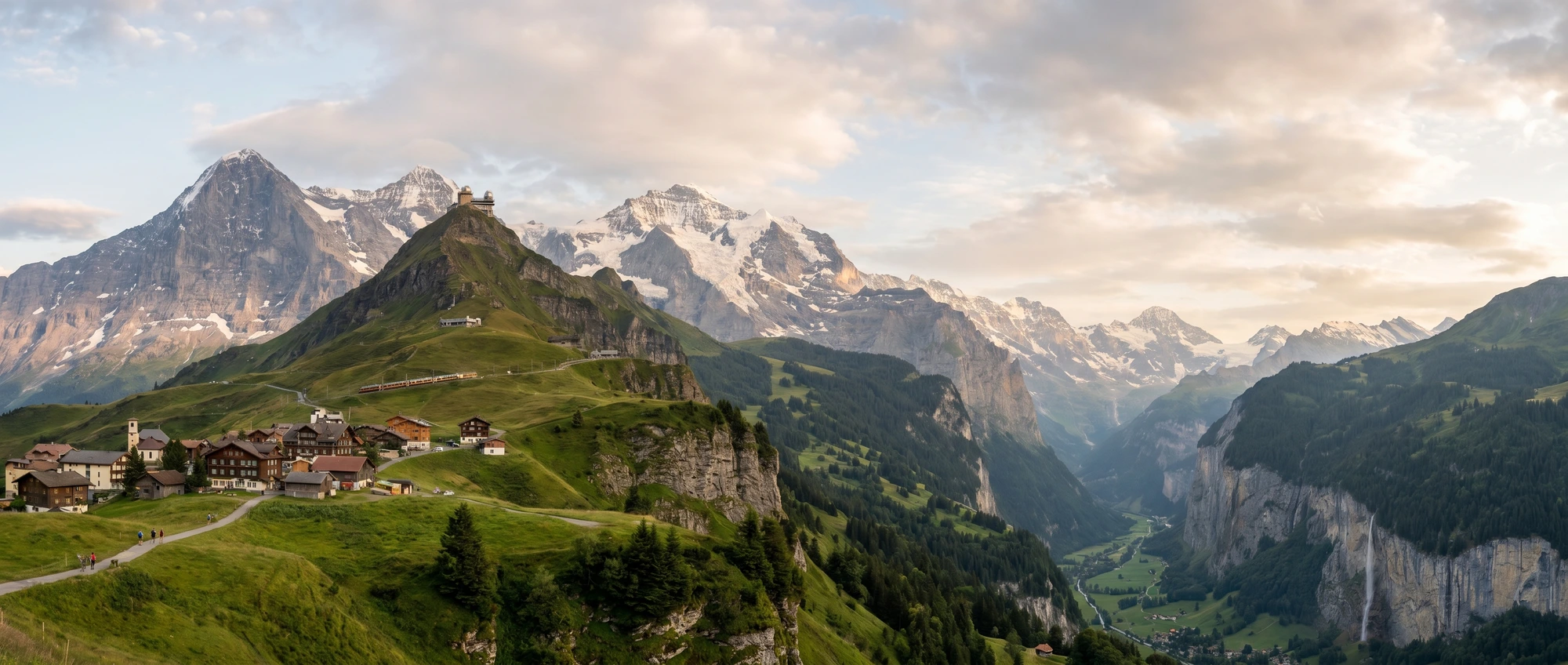
The Jungfrau region is the corner of Switzerland on every postcard: the Lauterbrunnen valley falling away beneath the Eiger, the rack railways grinding up to villages that no car can reach, and the snow tunnel at the top of it all. The trip most people picture is a base-and-radiate one — settle into one valley village and ride out to a different mountain each morning — and the single best decision you make is which shelf to sleep on. The valley floor at Lauterbrunnen is convenient but sits in shadow under the cliffs; the views everyone comes for are up at Wengen and Mürren, where you wake at the level of the peaks rather than under them.
The mistake first-timers make is pinning the whole trip on Jungfraujoch and then doing it in cloud. The ‘Top of Europe’ is real and the railway through the Eiger is extraordinary, but at around £220 a head it is the most expensive thing you can do here, and the summit is socked in more often than the brochures admit. Save it for a clear morning, check the live webcam before you commit, and on a grey day take the Schilthorn above Mürren or the First gondola above Grindelwald instead — they cost a fraction as much and you can usually actually see something. And leave the hire car at home: the cog railways and cable cars are not the way to the scenery, they are the scenery.
The route
A relaxed three-to-four-night base-and-radiate trip rather than a tour: pick one valley village, settle in, and ride out to a different mountain each day. Train times are the published Jungfrau Railways and BLS schedules; the cog railways run roughly every 30 minutes in season.
-
Day 1
Arrive via Interlaken into the valley
Train from Zurich (~2h to Interlaken Ost via the scenic Brünig line) or Geneva (~2h45 via Bern). Change at Interlaken Ost for the Lauterbrunnen train (~20 min) and settle into your valley base. Walk to the Staubbach Falls behind the village — a 300m plume off the cliff — to ease into the scenery.
-
Day 2
Lauterbrunnen valley and Mürren
Ride the valley floor to Stechelberg and take the cable car up to car-free Mürren (the cheaper, quieter shelf opposite Wengen), then the Schilthorn gondola to the Piz Gloria revolving restaurant (~CHF 108 / ~£95 return from Lauterbrunnen). The walk from Mürren to Grütschalp along the cliff edge is the region's best easy hike.
-
Day 3
Grindelwald and the Eiger
Train round to Grindelwald (~40 min from Lauterbrunnen via Zweilütschinen) under the Eiger north wall. Take the Firstbahn gondola up to First for the cliff walk and the Bachalpsee lake hike, or the Eiger Express gondola towards the glacier — both far cheaper than the summit and usually clearer.
-
Day 4
Jungfraujoch — the splurge, weather permitting
The 'Top of Europe' at 3,454m, reached by the Jungfraubahn rack railway through a tunnel inside the Eiger. Budget around CHF 250 (~£220) return from Interlaken without a pass and a full day. Only go on a clear morning — check the live Jungfraujoch webcam before you commit, because in cloud you pay top dollar for a white-out.
Where to base yourself
Pick one or two bases rather than moving every night.
Lauterbrunnen
££ mid-rangeThe valley-floor hub and the most practical first base: trains and cable cars to Wengen, Mürren, Grindelwald and Jungfraujoch all start here, and you keep a hire car or arrive by train at the door. The trade-off is that it's busy and the village itself sits in shadow under the cliffs, so the famous views are up, not from your window.
Best for: First-timers wanting one base for every excursion
Wengen or Mürren
£££ premiumThe car-free shelves above the valley — Wengen on the Jungfrau side, Mürren opposite under the Schilthorn. You reach them only by rack railway (Wengen) or cable car (Mürren), carrying luggage the last leg, and you wake up at the level of the views rather than under them. Quieter and more atmospheric than the valley; Mürren is the cheaper and calmer of the two.
Best for: Couples and walkers wanting car-free mountain quiet
Grindelwald
££ mid-rangeThe bigger resort village directly under the Eiger, with the widest choice of hotels, shops and après options and direct gondolas to First and the Eiger glacier. Less of a sleepy postcard than the car-free shelves and busier with coach groups, but the easiest base if you want amenities and a lively evening as well as the mountains.
Best for: Travellers wanting resort amenities and Eiger access
Getting around Jungfrau Region
Don't hire a car for the Jungfrau region — the whole area runs on the Jungfraubahnen network of rack railways, gondolas and cable cars, and the two best villages (Wengen and Mürren) can't be driven into at all. Arrive by train to Interlaken Ost and change onto the valley lines; if you do drive up from Geneva or Zurich, you'll pay the motorway vignette and then park at Lauterbrunnen or Stechelberg and finish by rail anyway. The money question is the pass: a Jungfrau Travel Pass (3–8 days, from around CHF 215 / ~£190 for 3 days) covers the valley trains and most lifts except the final Jungfraujoch leg, which is discounted rather than free; a Swiss Travel Pass works similarly across the wider trip. If you're staying put and doing two or three big mountain days, buy point-to-point and add the regional pass only if the maths beats it — and note the Jungfraujoch summit always carries a top-up even with a pass.
Book the essentials
Where to stay
Tours & tickets
Airport transfers
Car hire
Stay connected
Trains & rail passes
Jungfrau Region FAQs
How many days do you need in the Jungfrau region?
Is Jungfraujoch worth it?
Should I base in Lauterbrunnen, Grindelwald, Wengen or Mürren?
Ready to book?
Compare car hire