Southern Tunisia
Djerba
Tunisia's southern beach island, done honestly for UK travellers: a flat, late-warm package island where the resorts cluster on the north-east coast and the sights are the medina, the synagogue and the inland villages.
In short
Djerba at a glance
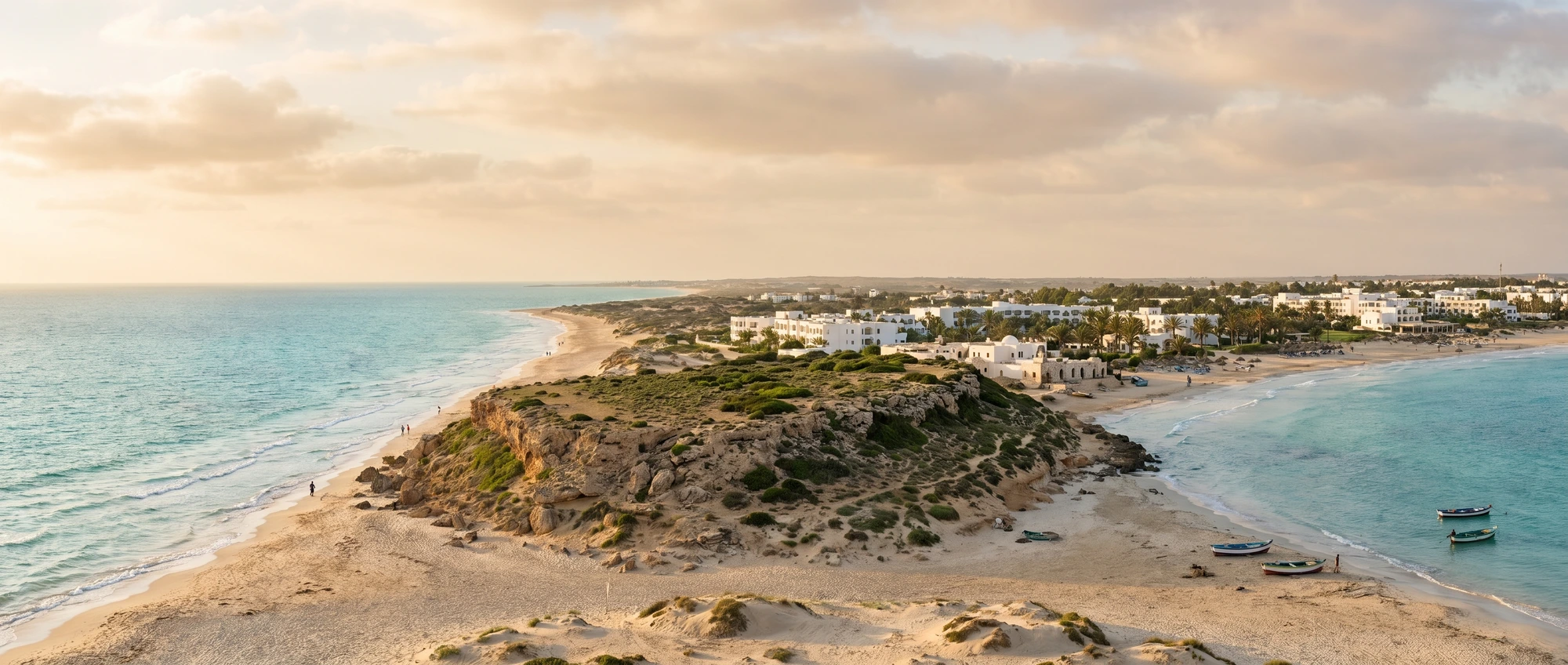
Djerba is Tunisia's southern beach island and one of the longest-established UK package destinations in the country — flat, low-rise, palm-fringed, and reached on its own airport (Djerba–Zarzis, DJE) rather than the mainland resort airports of Enfidha or Monastir. The resort strip runs along the north-east coast from Sidi Mahrez down to Aghir, so almost everyone bases there for the long sandy beaches and all-inclusive hotels. The sights are a short hop inland: the whitewashed market town of Houmt Souk, the El Ghriba synagogue at Erriadh, and the street-art village of Djerbahood. Most people come for a flat, warm, low-effort seven nights, and Djerba's draw over the mainland is that it holds its warmth latest in the season.
Djerba is the trip you take when you want Tunisia’s beach week stripped of any logistics: a flat, palm-shaded island with its own airport, where the resorts line one stretch of north-east coast and you barely need to think about how to get anywhere. It has been a UK package staple for decades, and the reason it still wins over Hammamet and Sousse is purely the calendar — it holds its warmth latest in the year, which makes it the one Tunisian island you can sensibly book for October or even early November.
The mistake first-timers make is treating Djerba as a place you tour. You don’t move around it — you pick one beach base and let the three real sights come to you on half-day trips: the whitewashed souks of Houmt Souk, the street-art lanes of Djerbahood, and the El Ghriba synagogue, one of the oldest in the world. The other thing worth knowing before you book is that the beaches vary: some stretches collect seasonal seagrass, so a hotel with a maintained beach section earns its slightly higher price, and the quieter southern resorts trade a little beach quality for calm and value.
The route
Most UK visitors do a single all-inclusive week on the beach and never leave the resort — which is fine, but Djerba's flat, compact layout means three half-day trips cover everything worth seeing without changing hotels. This is a 7-night skeleton from a north-east coast base (Sidi Mahrez/Aghir), built around the beach with the island's three real sights folded in. Distances are short: nowhere on Djerba is more than about 40 minutes' drive from the resort strip.
-
Day 1
Arrive and settle on the resort coast
Fly direct into Djerba–Zarzis (DJE). Pre-arrange a transfer rather than haggling a taxi after the flight — the airport sits on the west side of the island and most resorts on the north-east strip are 20–40 minutes away (Sidi Mahrez is closer, Aghir a touch further). Change a modest amount of cash at the airport or a bank kiosk on arrival — the Tunisian dinar is a closed currency, so it isn't sold in the UK and you'll land without any.
-
Days 2–3
Beach days on the north-east strip
Two slow days using the resort and the long sandy beaches between Sidi Mahrez and Aghir — the calm, shallow water here is genuinely good for families. The mid-table all-inclusives are well-priced, but the beach can have seasonal seagrass, so a hotel with a maintained beach section is worth paying for.
-
Day 4
Houmt Souk and Djerbahood
Head to Houmt Souk, the island's whitewashed market town, for the covered souks, the old caravanserai-style funduqs and a fish lunch at the port. Pair it with Djerbahood at Erriadh — a village whose lanes were covered in large-scale street-art murals by international artists, now a free, walkable open-air gallery about 10 minutes from Houmt Souk. Half a day covers both; agree taxi fares before you get in.
-
Day 5
El Ghriba synagogue and inland villages
The El Ghriba synagogue at Erriadh is one of the oldest in the world and Africa's most important Jewish pilgrimage site — modest dress and a head covering are expected, and security is visible. Combine it with a loop through the inland menzel farmsteads and the lagoon edge near Guellala's pottery workshops. A guided half-day tour removes the logistics if you'd rather not arrange taxis.
-
Days 6–7
Slow down, or take a desert taster
Either wind down on the beach for your last two days, or take the long day trip off the island to the mainland Sahara fringe — Tataouine, Chenini's cliff villages and the Star Wars Ksar Hadada sets are a popular full-day 4x4 excursion. Note that these desert trips don't run in the July–August heat, when inland temperatures top 40°C.
Where to base yourself
Pick one or two bases rather than moving every night.
Sidi Mahrez (north-east strip)
££ mid-rangeThe main resort beach, a long stretch of pale sand backed by the bulk of the island's all-inclusive hotels and closest to Houmt Souk. The default first-trip base where everything is easy and the airport transfer is shortest. Busier and more built-up than further south, but the beach is the best of the strip.
Best for: First-timers and families wanting the main beach
Aghir & Sidi Garous (south-east coast)
££ mid-rangeQuieter, lower-rise resorts towards the eastern tip, a little further from the airport and town but calmer and often better value. The water is shallow and warm, good for children, though some stretches collect more seagrass than the main Sidi Mahrez beach. Best if you want the pool-and-beach bubble without the busier strip.
Best for: A quieter, lower-rise beach base
Houmt Souk (the town)
££ mid-rangeThe island's capital and only real town — whitewashed lanes, the covered souks and converted funduq guesthouses around the old port. A handful of boutique stays make it an option for travellers who want character and to walk to dinner rather than a beach-club week. Not on a swimming beach, so better for a culture-first trip than a sun holiday.
Best for: Character, boutique stays and walkable dinners
Getting around Djerba
Djerba is flat and compact — about 25km across — which makes it one of the easier Tunisian destinations to potter around. Most resort visitors don't hire a car: the three sights (Houmt Souk, El Ghriba/Djerbahood and the inland villages) are all short taxi hops, and the yellow petits taxis are cheap if you insist on the meter or agree the fare before you get in, which is the most common tourist overcharge. There's no useful public transport between the resorts and the sights, so it's taxis, hotel shuttles or organised half-day tours. The island is joined to the mainland by the Roman-era El Kantara causeway in the south and a free car ferry from Ajim in the west, which only matters if you take a mainland desert day trip. Hiring a small car is worth it if you want to explore the inland menzels and the south of the island at your own pace — bring your UK licence and book ahead — but for a standard beach week it's more car than you need.
Book the essentials
Where to stay
Tours & tickets
Airport transfers
Car hire
Stay connected
Djerba FAQs
Where should you stay on Djerba?
Do you need a car on Djerba?
What is the best time to visit Djerba?
Ready to book?
Compare car hire