Emirate of Dubai
Dubai Desert
The honest guide to a Dubai desert safari for UK travellers: morning vs evening vs overnight, what AED 100 versus AED 500 actually buys you, why a conservation tour beats cheap dune-bashing, and the only months it's bearable.
In short
Dubai Desert at a glance
A desert safari is the one excursion almost every UK visitor to Dubai books, and the right one is genuinely worth doing — but the market is a mess of near-identical listings at wildly different prices, so the choice is what kind of trip you want, not which dunes you see. The decision splits three ways. A morning safari (~4 hours, from around £21pp) is the cheapest and the cooler ride if dune-bashing is what you're after. An evening safari (~6 hours, roughly £43–£100pp) is the classic: sunset over the dunes, a camp with a BBQ buffet, camel rides and a falcon or fire show. An overnight safari (from around £145pp) adds a Bedouin-style tent and stargazing. The dunes themselves are 45–60 minutes south of the city around Lahbab (the 'red dunes') for the mass-market trips, or in a protected reserve — the Dubai Desert Conservation Reserve (DDCR) or Al Marmoom — for the quieter, wildlife-led tours. Two opinions worth taking: pay up for a conservation-reserve tour rather than the cheapest dune-bashing if you'd rather see Arabian oryx than be thrown around a 4×4, and never book from a street tout — go through your hotel or a licensed operator. And the season is non-negotiable: October to April only, because the same dunes that are pleasant at 25°C in January are dangerous at 45°C in July.
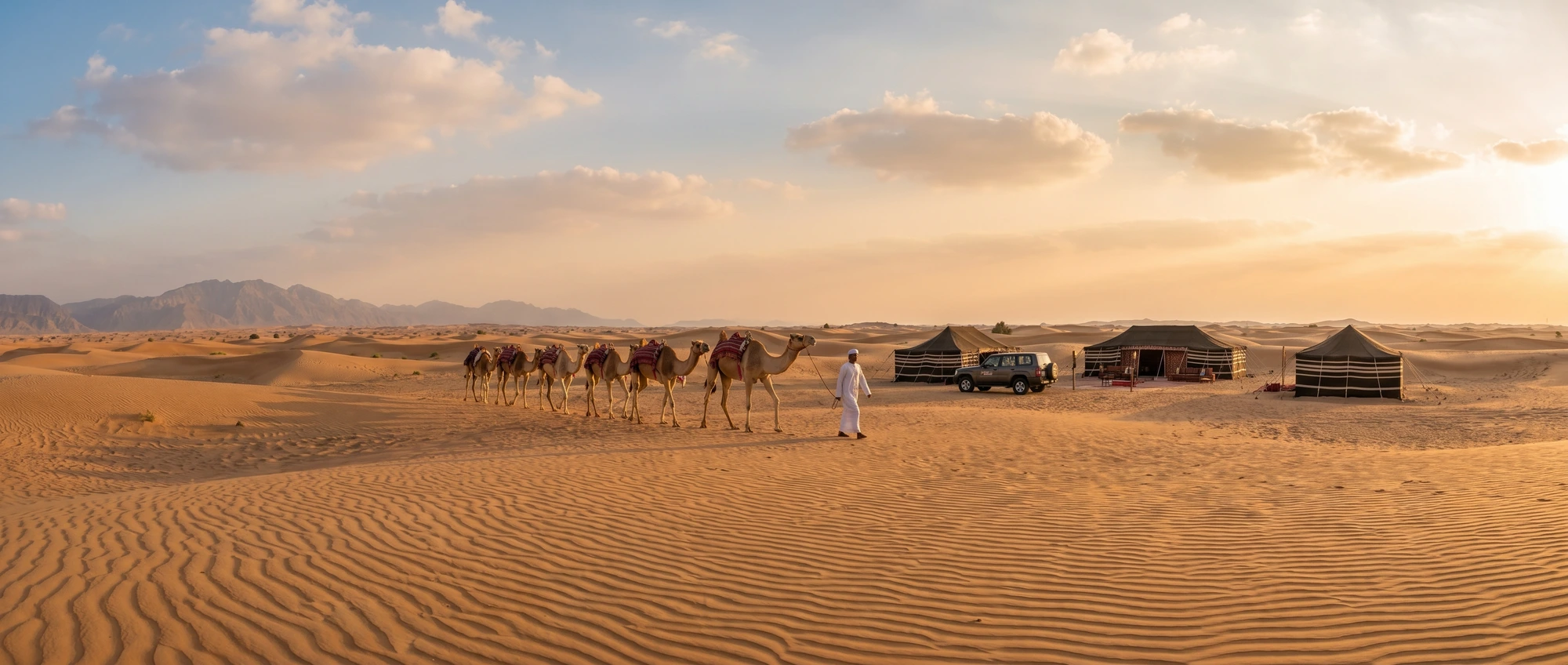
The desert safari is the one Dubai excursion nearly every UK visitor ends up booking, and it deserves the hype — an hour south of the malls and motorways, the city stops and the dunes take over. The problem is the booking: search “Dubai desert safari” and you’ll get a hundred near-identical listings at prices from £20 to £200, which makes it look like a quality gamble when it’s really a format choice. There are three: a short, cheap morning trip if dune-bashing is what you came for; the classic evening safari with a sunset, a camp and a BBQ buffet; and an overnight version that swaps the late-night transfer back for a tent and a sky full of stars.
The dunes most people ride are the “red dunes” around Lahbab, about 50–60 km and 45–60 minutes south of the city, where operators run their camps on private land. The quieter alternative is a tour inside a protected reserve — the Dubai Desert Conservation Reserve or the larger Al Marmoom — where the trip is built around Arabian oryx, gazelle and falconry rather than throwing a 4×4 down a slip-face. That conservation option is the one I’d nudge anyone towards who found the idea of dune-bashing more queasy than thrilling; operators like Platinum Heritage skip the bashing entirely.
Two rules cut across all of it. First, the season: October to April only. The same dunes that are a pleasant 25°C in January sit above 45°C in July, when an afternoon in the open desert goes from uncomfortable to dangerous. Second, who you book with: go through your hotel or a licensed operator, never a street tout or a kerbside flyer — a too-cheap deal can mean an uninsured driver on terrain where rollovers genuinely happen. Statutory and safety facts here inherit Departly’s United Arab Emirates country review; note that at the time of writing the FCDO advises against all but essential travel to the whole UAE, so reconfirm the live position on GOV.UK before you book anything.
The route
There's no 'route' through the desert the way there is through a region — you pick one safari and an operator collects you from your hotel. So think of this as choosing between three formats rather than a multi-day plan. Prices are per person, converted at £1 ≈ AED 4.9, and assume a shared 4×4 with hotel pick-up; private tours and conservation-reserve trips cost more.
-
Option 1
Morning safari (~4 hours)
Pick-up around 8–9am, back by lunchtime. The cheapest format — from roughly AED 104 (~£21pp) — and the coolest, so it's the one to choose if dune-bashing is the whole point or you're travelling with kids who'll wilt in the afternoon heat. You get the 4×4 dune ride, sandboarding and a short camel ride, but no dinner and no evening show. Good value, lower on atmosphere.
-
Option 2
Evening safari with camp dinner (~6 hours)
The classic and the one most people mean by 'desert safari'. Afternoon pick-up around 2.30–3.30pm for sunset over the dunes, then a permanent camp with a BBQ buffet, camel rides, henna, shisha and a falcon, fire or Tanoura show. Prices run from about AED 210 (~£43pp) for a basic shared trip to AED 499 (~£100pp) with red-dune bashing, a quad-bike add-on and a better camp. The sunset photos are the reason to do this one.
-
Option 3
Overnight safari in a desert camp (from ~£145pp)
Everything the evening trip includes, plus a Bedouin-style tent, dinner under the stars, a telescope-led stargazing session and a sunrise camel trek with breakfast. From around AED 716 (~£145pp). Worth it if you want the silence and the night sky rather than just a few hours in a busy camp — but bring a warm layer, because winter desert nights can fall to 5°C.
-
Premium upgrade
A conservation-reserve nature safari
Instead of mass dune-bashing at Lahbab, operators like Platinum Heritage run vintage Land Rover tours inside the Dubai Desert Conservation Reserve, where you track Arabian oryx and gazelle and watch a proper falconry display. It costs more and there's no white-knuckle dune-bashing, but it's the trip to book if you found the idea of being thrown around a 4×4 more off-putting than appealing.
Where to base yourself
Pick one or two bases rather than moving every night.
Stay in Dubai, do the safari as a day trip
££ mid-rangeFor almost everyone this is the answer: base in Downtown, the Marina or the old city, and let the safari operator collect you and drop you back. Pick-ups reach every tourist area, so you don't need to stay anywhere near the desert to do a trip.
Best for: First-timers, anyone combining the desert with the city
A desert resort (Al Maha / Bab Al Shams)
£££ premiumIf the desert is the point of the holiday, stay in it. Al Maha sits inside the DDCR with private pool villas and resident oryx; Bab Al Shams is a more affordable Arabian-style resort on the edge of the dunes. Both are special-occasion money and a 45-minute drive from the city, so pair a night or two here with city nights rather than basing the whole trip out here.
Best for: Honeymoons, special occasions, desert-first stays
An overnight safari camp
£ valueNot a hotel as such — the tented camp that comes with an overnight safari. It's the cheapest way to actually sleep in the desert, with a Bedouin-style tent, shared or simple facilities and the stargazing built in. Manage expectations on comfort: this is camping with a buffet, not a resort.
Best for: Stargazing, a single desert night on a budget
Getting around Dubai Desert
You don't drive yourself — and on the mass-market trips you legally can't, because dune-bashing happens on private operator land and conservation tours inside the DDCR are limited to licensed vehicles only. Every safari includes hotel pick-up and drop-off in a shared 4×4 Land Cruiser (private vehicles cost more), and the transfer from central Dubai to the Lahbab red dunes is 45–60 minutes each way down the E11 and E102. The Al Marmoom reserve is the exception: it's an unfenced public reserve where you can drive your own hire car to spots like the Al Qudra Lakes, though you'd still join a guided operator for actual dune driving. The single most important 'getting around' rule is who you book with: use your hotel concierge or a licensed operator, never a street tout or a kerbside flyer, because an unlicensed safari can mean an uninsured driver on terrain where rollovers do happen.
Book the essentials
Where to stay
Tours & tickets
Airport transfers
Stay connected
Trains & rail passes
Dubai Desert FAQs
Should I do a morning or evening desert safari in Dubai?
How much does a Dubai desert safari cost?
Is dune-bashing safe, and will it make me sick?
What's the difference between a normal safari and a conservation-reserve tour?
When is the best time for a Dubai desert safari?
How do I avoid getting ripped off booking a desert safari?
Ready to book?
Book experiences