Southern Transdanubia (Baranya County)
Mosque of Pasha Qasim (Gazi Kasim Pasha Mosque)
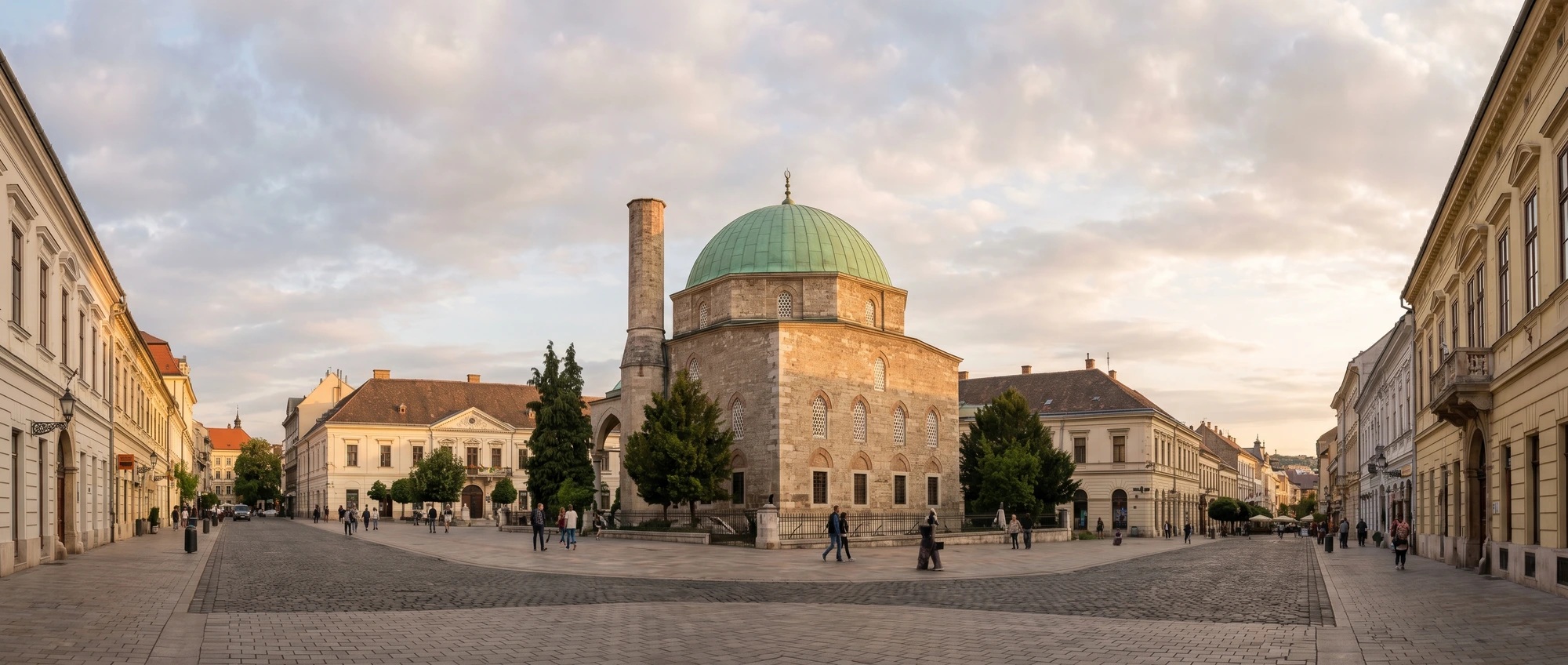
Hungary's largest surviving Ottoman building, square on Pécs's main plaza: the dome topped by both a crescent and a cross, and the mihrab and church layered together in one room.
Where
Pécs, Hungary
Opening hours
Generally open to visitors most days with shorter hours on Sundays and around services, as it still functions as a Catholic church; hours are reduced in winter. Confirm current hours and prices on the official site.
Tickets
A small entry donation of around 1,500 Ft (a few pounds) is typically requested for visitors. Confirm current hours and prices on the official site.
Time needed
About 20–30 minutes inside to take in the dome, the surviving mihrab and the church fittings; longer if you climb to any viewing level when open.
In short
Visiting Mosque of Pasha Qasim (Gazi Kasim Pasha Mosque)
The Mosque of Pasha Qasim is the largest surviving Ottoman structure in Hungary, sitting square on Pécs's main square, Széchenyi tér. Its green dome is topped, unusually, by both an Islamic crescent and a Christian cross. Inside, you can read the building's double life: the original mihrab and Ottoman arches survive alongside the Catholic church it became, layered together in a single domed room.
A building with two lives
It dominates Széchenyi tér, the main square of Pécs: a broad green dome on a square stone base, and the largest surviving Ottoman structure in Hungary. Look up and you’ll spot the detail that defines it — the dome is topped by both an Islamic crescent and a Christian cross. That isn’t a quirk of decoration; it is the building’s whole history in one image. Raised as a mosque during the Ottoman occupation, on the footprint of an earlier church, it was reconsecrated as a Catholic church after the Ottomans withdrew. It has been both, and the roofline tells you so.
Standing in the square and photographing it costs nothing, and that exterior is the headline shot most people come for.
Inside, where it makes sense
The small entry fee — around 1,500 Ft, a few pounds — is worth paying, because the building only really explains itself once you’re under the dome. Inside, the two faiths share a single room. The Ottoman bones are unmistakable: the mihrab, the prayer niche oriented towards Mecca, survives in the wall, along with the pointed arches and the calm, centred proportions of a mosque. Layered over them are the altar, statues and fittings of the working Catholic church it remains today. Reading those two layers at once is the point of going in.
It is a short visit — 20 to 30 minutes is plenty — so it slots neatly into a stroll around Pécs’s compact, walkable old town. It still functions as a church, so hours are shorter on Sundays and around services, and reduced in winter; confirm the current times on the official site before you go. Pair it with the nearby Cella Septichora and the cathedral and you have the core of a half-day in one of Hungary’s most underrated cities.
Planning the rest of your trip? See the Pécs city guide.